






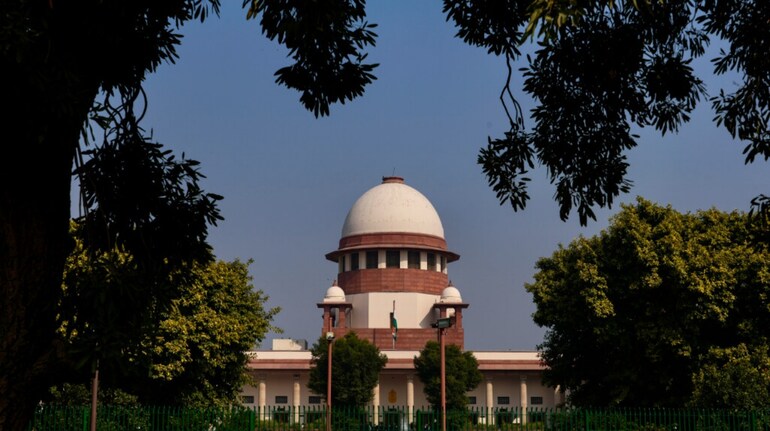

From April 7 to April 22, the Supreme Court will witness one of its rarest constitutional exercises -- a nine-judge Constitution bench hearing 67 petitions seeking a review of the September 2018 ruling that permitted women of all ages to enter the Sabarimala temple in Kerala.
This development is not routine. Benches of this size are constituted only when questions before the Court have consequences that may reshape constitutional doctrine across the country.
The dispute over Sabarimala has grown beyond a temple-entry controversy. It now raises foundational questions about faith, equality, constitutional morality, and the limits of judicial intervention in religious matters.
Why large benches are rare
Article 145(3) of the Constitution requires that cases involving a substantial question relating to constitutional interpretation must be heard by at least five judges. But benches larger than that -- seven or nine judges -- are assembled only when issues are exceptionally significant or when earlier larger bench rulings need reconsideration.
There is a hierarchy within the Supreme Court’s bench structure: two-judge and three-judge benches handle most matters; five-judge benches decide major constitutional questions; seven- and nine-judge benches are uncommon and reserved for issues with deep institutional impact. Importantly, a smaller bench cannot overrule a decision delivered by a larger bench.
With a sanctioned strength of 34 judges, forming a nine-member bench means nearly one-third of the Court is occupied with a single reference. This affects the listing of other matters and requires careful administrative planning by the Chief Justice of India. Larger benches also make consensus-building more complex and increase the likelihood of split opinions.
The largest benches in history
The biggest bench ever assembled by the Court was a 13-judge bench in Kesavananda Bharati v. State of Kerala (1973). That ruling established the Basic Structure Doctrine, holding that while Parliament may amend the Constitution, it cannot alter its “basic structure”. It remains the most influential constitutional judgment in India.
An 11-judge bench in Rustom Cavasjee Cooper v. Union of India (1970), known as the Bank Nationalisation case, broadened the interpretation of Fundamental Rights and marked a shift toward a rights-centric constitutional approach.
Nine-judge benches have delivered some of the most consequential rulings in Indian constitutional law:
Indra Sawhney v. Union of India (1992) upheld reservations for Other Backward Classes and introduced the 50% ceiling along with the “creamy layer” principle.
S.R. Bommai v. Union of India (1994) curbed misuse of Article 356 and strengthened federalism, while declaring secularism part of the Constitution’s basic structure.
I.R. Coelho v. State of Tamil Nadu (2007) ruled that laws placed in the Ninth Schedule are open to judicial review, reinforcing the Basic Structure Doctrine.
Justice K.S. Puttaswamy v. Union of India (2017) recognised privacy as a Fundamental Right and overturned earlier contrary rulings.
Seven-judge benches too have played defining roles. Maneka Gandhi v. Union of India (1978) transformed Article 21 by insisting that “procedure established by law” must be fair and reasonable, linking Articles 14, 19, and 21. Special Reference No. 1 of 1964 (Keshav Singh case) (1965) clarified the balance between legislative privilege and judicial oversight.
Five-judge Constitution benches are more common but still reserved for major constitutional disputes. Minerva Mills v. Union of India reinforced the Basic Structure Doctrine and balanced Fundamental Rights with Directive Principles. ADM Jabalpur v. Shivkant Shukla permitted suspension of habeas corpus during the Emergency -- a ruling later widely criticised and effectively overruled in Puttaswamy.
Supreme Court Advocates-on-Record Association v. Union of India struck down the NJAC and reaffirmed the collegium system. Navtej Singh Johar v. Union of India decriminalised homosexuality and expanded dignity and equality jurisprudence.
Why Sabarimala requires nine judges
The Sabarimala review is significant not merely because of temple entry. The original 2018 verdict, delivered by a 5-judge bench in a 4:1 majority, allowed women of all age groups into the temple, declaring that “devotion cannot be subjected to gender discrimination”.
Then CJI Dipak Misra, along with Justices RF Nariman, AM Khanwilkar and DY Chandrachud, formed the majority. Justice Indu Malhotra dissented.
The judgment also held that devotees of Lord Ayyappa do not constitute a separate religious denomination and struck down Rule 3(b) of the Kerala Hindu Places of Public Worship (Authorization of Entry) Rules, 1965, which barred women aged 10–50.
Review petitions followed. In November 2019, a five-judge bench led by then CJI Ranjan Gogoi, by a 3:2 majority, observed that certain questions raised in the Sabarimala review overlapped with pending cases concerning Muslim women’s entry into mosques, the entry of Parsi women married outside the community into fire temples, and the validity of Female Genital Mutilation among the Dawoodi Bohra community.
The majority decided to keep the review petitions pending until a larger bench answered broader constitutional questions. The minority, comprising Justices DY Chandrachud and RF Nariman, dissented, stating that the issues relating to Parsi and Muslim women were not before the Sabarimala bench and should not be tagged.
In January 2020, a nine-judge bench was constituted. In February, it held that the reference was maintainable and that questions of law could be referred to a larger bench in review proceedings.
The Court framed seven issues, including the scope of religious freedom under Article 25, the relationship between Articles 25 and 26, whether denominational rights are subject to other Fundamental Rights, the meaning of “morality” in Articles 25 and 26 and whether it includes constitutional morality, the limits of judicial review in religious matters, the interpretation of “Sections of Hindus” in Article 25(2)(b), and whether a person outside a denomination can challenge its practices through a public interest litigation.
Religion, equality and constitutional morality
The Sabarimala dispute sits at the crossroads of competing constitutional values. It raises the question of what qualifies as an “essential religious practice” -- a doctrine courts have applied since the 1950s to determine whether a practice deserves constitutional protection.
The nine-judge bench is expected to examine whether this test requires reformulation, whether courts should determine what is essential to a religion, and how far judicial scrutiny can extend into matters of faith.
The matter also involves balancing Articles 25 and 26 -- which guarantee freedom of religion and denominational rights -- with Articles 14 and 15, which guarantee equality and prohibit discrimination.
In February 2023, a Constitution Bench referred the validity of excommunication practices among the Dawoodi Bohras to the same nine-judge bench reviewing the Sabarimala ruling, further widening the scope of issues.
Hearing schedule and positions
The hearings are scheduled between April 7 and April 22. Parties supporting review will argue from April 7 to April 9. Those opposing review will present submissions from April 14 to April 16. Rejoinder arguments are slated for April 21, with proceedings expected to conclude on April 22.
Solicitor General Tushar Mehta informed the bench, “We (Central Government) are supporting the review of the judgment.” Senior Advocate Jaideep Gupta, appearing for the State of Kerala, stated, “So far, the State of Kerala had supported the petitioners and opposed the review.”
The present listing order was passed by a three-judge bench comprising CJI Surya Kant, Justice Joymalya Bagchi and Justice Vipul M Pancholi. The composition of the nine-judge bench will be notified separately.
At its core, the case is about defining the constitutional boundaries between faith and fundamental rights. The answer delivered by the nine-judge bench may shape how India reconciles religious autonomy with equality and constitutional morality for decades to come.

Discover the latest Business News, Sensex, and Nifty updates. Obtain Personal Finance insights, tax queries, and expert opinions on Moneycontrol or download the Moneycontrol App to stay updated!
Find the best of Al News in one place, specially curated for you every weekend.
Stay on top of the latest tech trends and biggest startup news.





