Almost a year after the Lokpal – India’s first anti-corruption ombudsman – was formed, the government has issued a format and various rules for filing complaints of alleged corruption against public servants, including the prime minister of the country.
Lokpal was set up in 2013 as an apex body to deal with cases of corruption at the national level in a time-bound manner. This was after the President had given assent to the Lokpal and Lokayuktas Act, 2013.
The Ministry of Personnel, Public Grievances and Pensions issued a notification regarding the Lokpal (Complaint) Rules, 2020 on March 2. One of the crucial clauses in the Rules states that any complaint filed against an incumbent or former prime minister will be decided, at the admission stage, by a full bench headed by the Chairperson.
The rule also states that if such a complaint is dismissed by the bench at the admission stage, records of the inquiry will not be made public.
What are the other rules and how to file a complaint against a public servant for corruption, let’s find out:
How to file a complaint?A complaint should contain details of the allegations of corruption levelled against a public servant, which includes the prime minister. It can be made in person, by post, or electronically; however, a hard copy will have to be submitted to the Lokpal within a period of 15 days from filing the electronic complaint.
The complaint can ordinarily be made in English. The Lokpal can also entertain a complaint made in any of the 22 languages mentioned in the Eighth Schedule of the Indian Constitution, including Hindi, Gujarati, Assamese and Marathi.
In addition to the duly signed statement, that details the allegation, the complaint should also have a copy of the identity proof of the complainant. If the complaint is being made on behalf of a board, company, corporation, trust or any other association of persons, a registration or incorporation certificate of the organisation needs to be attached with the statement.
A non-citizen of India can also file a complaint, only a copy of the passport will be accepted as the proof of identity.
All complainants have to mandatorily give an affidavit on non-judicial stamp paper, which, among other things, mentions that they are fully aware that “making any false and frivolous or vexatious complaint is punishable with imprisonment for a term which may extend to one year and with fine which may extend to one lakh rupees".
What happens next?After receiving a complaint, the Lokpal may order a preliminary inquiry or an investigation by an agency, like the CBI (Central Bureau of Investigation). The complaint will be disposed of within 30 days.
The anti-corruption ombudsman may have to protect the identity of the complainant or the public servant, against whom the complaint is filed, till the conclusion of the inquiry or investigation.
"Provided that the protection, shall not be applicable, in cases where the complainant himself has revealed his identity to any other office or authority while making a complaint to the Lokpal," the rules said.
The Lokpal, while processing the complaint, may even protect the integrity of the process of inquiry or investigation.
Who all come under the ambit of the Lokpal?A complaint can be filed with the Lokpal against the prime minister, a Union minister, members of Lok Sabha and Rajya Sabha, and bureaucrats.
However, certain conditions apply on how a complaint against the prime minister is pursued.
According to a report in The Indian Express, the Act does not allow an inquiry against the prime minister if the complaint relates to international relations, external and internal security, public order, atomic energy and space.
In addition, complaints against the prime minister will be admitted only if the full bench, headed by the Chairperson, considers initiation of an inquiry and at least two-thirds of the members approve it.
The inquiry against the prime minister is to be held ‘in camera’, and if the Lokpal decides to dismiss the complaint, the records of the inquiry cannot be made public.
Members of the Lokpal are also included in the Lokpal Act, as they too are public servants.
The rules, however, bar any complaint filed against a public servant under the Army Act, Navy Act, Air Force Act or the Coast Guard Act.
How is the current Lokpal placed?According to the Act, there is a provision for a Chairperson and a maximum of eight members in the Lokpal panel. Of these, four need to be judicial members.
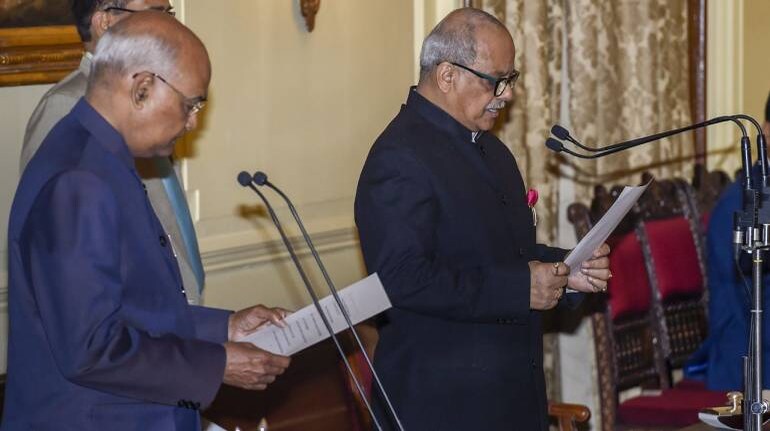
On March 23, 2019, President Ram Nath Kovind had administered the oath to Justice Pinaki Chandra Ghose as the Chairperson of the Lokpal.
Former chief justices of different high courts – Justices Pradip Kumar Mohanty, Abhilasha Kumari and Ajay Kumar Tripathi are the three judicial members of the Lokpal.
Former first woman chief of Sashastra Seema Bal, Archana Ramasundaram; ex-Maharashtra chief secretary Dinesh Kumar Jain; former IRS officer Mahender Singh and Gujarat cadre ex-IAS officer Indrajeet Prasad Gautam are the Lokpal's non-judicial members.
They were administered the oath of office by Justice Pinaki Ghose on March 27 last year.
How many complaints have been addressed so far?A total of 1,065 complaints were received till September 30, 2019. Of these, the Lokpal has disposed of 1,000 complaints, as per the latest available data.
In the absence of a format earlier, the Lokpal had decided to scrutinise all the complaints received by it, in whichever way they were sent.
Discover the latest Business News, Sensex, and Nifty updates. Obtain Personal Finance insights, tax queries, and expert opinions on Moneycontrol or download the Moneycontrol App to stay updated!
Find the best of Al News in one place, specially curated for you every weekend.
Stay on top of the latest tech trends and biggest startup news.