






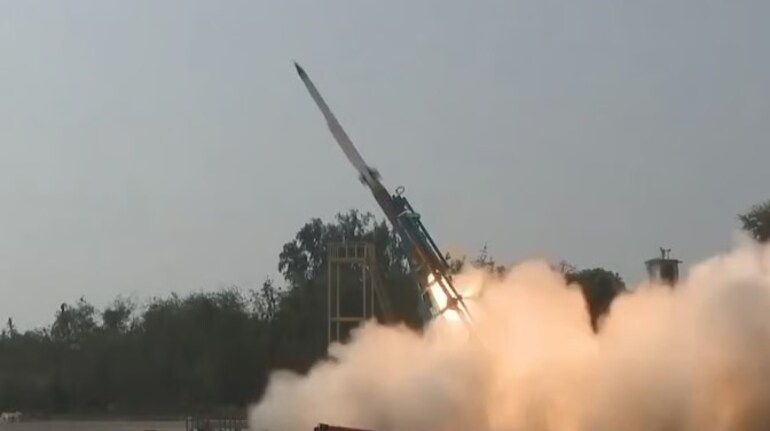

India took a major step forward in missile propulsion technology on Tuesday, after the Defence Research and Development Organisation (DRDO) successfully demonstrated its Solid Fuel Ducted Ramjet system from the Odisha coast.
The demonstration was carried out at the Integrated Test Range, Chandipur, off the coast of Odisha, at around 10.45 am on February 3, 2026. The successful demonstration places India into an elite league of nations possessing this technology that enables developing long-range air-to-air missiles to give tactical edge over the adversaries.
What is Ramjet technology?
A ramjet is a type of air-breathing jet engine that uses the missile’s forward speed to compress incoming air, rather than relying on complex rotating parts like conventional jet engines.
In a Solid Fuel Ducted Ramjet, solid fuel is burned in a controlled manner as atmospheric air flows through the engine, producing sustained thrust at high speeds.
Unlike traditional rocket motors, which burn fuel quickly and then coast, ramjet-powered missiles can maintain high speeds for much longer durations, especially in the final phase of flight.
Why the technology is vital for India?
The successful SFDR test has major strategic implications. Ramjet-powered air-to-air missiles can strike targets at much longer ranges while retaining high energy during the final moments before impact.
SFDR is an advanced missile propulsion technology on which the DRDO has been working for over a decade. This will be at the core of the futuristic Astra Mk-III beyond visual range missile with a range of 190 km to 240 km, depending on the target’s altitude.
The SFDR-based propulsion would enable the missile to intercept aerial threats at very long range at supersonic speeds, officials said. Three DRDO laboratories - Defence Research and Development Laboratory, Hyderabad; High Energy Materials Research Laboratory, Pune; and Research Centre Imarat, Hyderabad – are working on this project.
This gives fighter aircraft a decisive edge in beyond-visual-range combat, allowing pilots to engage enemy jets earlier and from safer distances. Globally, only a few countries have mastered this technology due to its engineering complexity, especially in managing stable combustion at supersonic speeds.
Discover the latest Business News, Sensex, and Nifty updates. Obtain Personal Finance insights, tax queries, and expert opinions on Moneycontrol or download the Moneycontrol App to stay updated!
Find the best of Al News in one place, specially curated for you every weekend.
Stay on top of the latest tech trends and biggest startup news.





