






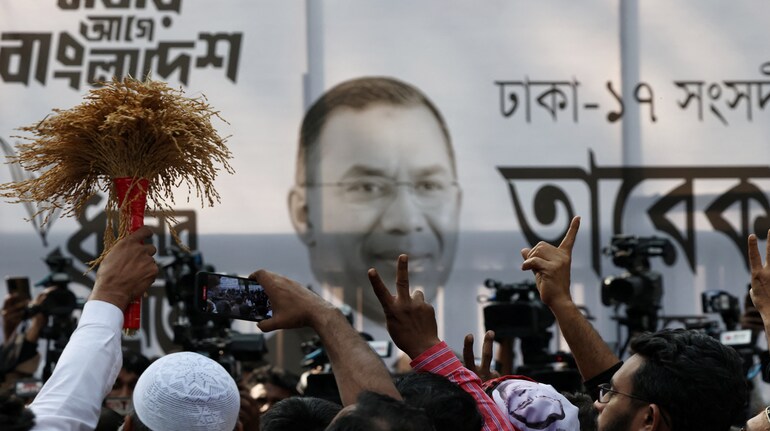

Bangladesh’s incoming government signalled it will separate its demand for Sheikh Hasina’s extradition from the larger India relationship, even as it presses New Delhi to hand over the deposed prime minister.
Speaking exclusively to The Hindu at the party headquarters in Dhaka’s Gulshan neighbourhood, Bangladesh Nationalist Party (BNP) General Secretary Mirza Fakhrul Islam Alamgir said ties with India should not be “captive” to one issue.
“We believe that Hasina has really committed serious human rights violations. There is a popular demand to punish her and we believe that India should hand her over to us. But not handing over Sheikh Hasina to Bangladesh will not be a deterrent to build broader relation including trade and commercial ties. We want to build even better ties,” Mr. Alamgir told The Hindu.
The BNP is set to form the next government on Tuesday (February 17, 2026).
Bangladesh’s interim government has repeatedly urged India to hand over Ms. Hasina and other senior Awami League leaders who left the country after the August 2024 uprising. India has not responded publicly to those requests over the past seventeen months.
Mr. Alamgir said legal proceedings against Ms. Hasina and former ministers and bureaucrats accused of crimes during the uprising would move forward. “That process will continue,” he told The Hindu.
Mr. Alamgir acknowledged that bilateral ties carry unresolved tensions. He pointed to the upcoming renewal of the Ganga Waters Treaty covering Farakka, concerns over border killings, and other sensitive matters.
“Before next year, the issue of Farakka’s water will come up under the renewal of Ganga Waters Treaty, then there is the issue of border killings and we must talk on these issues,” he said.
He dismissed confrontational rhetoric. “We can’t fight a war with India. We need to talk. Those who talk about fighting India are speaking like insane,” Mr. Alamgir told The Hindu.
Drawing a parallel, he noted that even the United States and China manage cooperation despite deep disagreements. “We should not stick to just one issue in India-Bangladesh relation,” he said.
Along with BNP Chairman Tarique Rahman, Mr. Alamgir has backed political reconciliation at home. He visited leaders of Jamaat-e-Islami and the National Citizen Party (NCP) on Sunday (February 15, 2026), ahead of government formation.
He criticised the interim administration led by Prof. Yunus, saying it failed to foster reconciliation after the 2024 uprising. “The leaders of the uprising chose Prof. Yunus,” he said, adding that the interim chief “could not go outside of the brief that the leaders of the uprising gave him.”
Mr. Alamgir framed the BNP’s 31-point agenda as an opportunity to deepen economic cooperation with India in trade, commerce, digital infrastructure and technical education.
“India has resources in technical education and we have a large number of unemployed youngsters. We need to help them with capacity building so that they can get jobs in the Gulf,” he told The Hindu.
He also said a BNP government would reassess large infrastructure projects undertaken by the Awami League government, citing a heavy loan burden. “Out of these projects we will retain the ones that serve Bangladesh’s interest,” he said.
Discover the latest Business News, Sensex, and Nifty updates. Obtain Personal Finance insights, tax queries, and expert opinions on Moneycontrol or download the Moneycontrol App to stay updated!
Find the best of Al News in one place, specially curated for you every weekend.
Stay on top of the latest tech trends and biggest startup news.





