






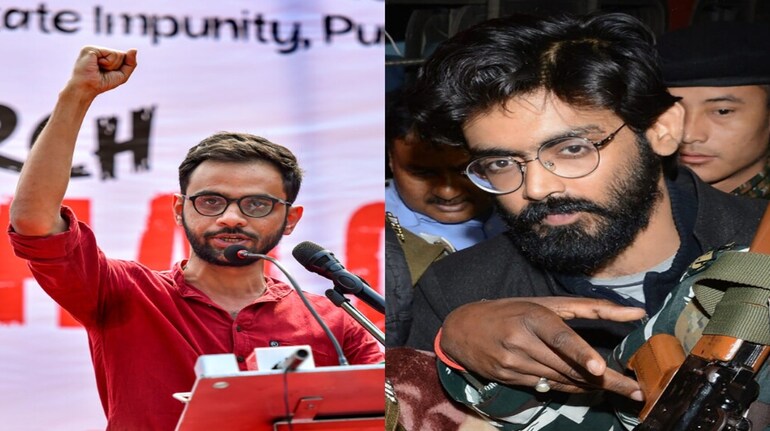
The Supreme Court, on Monday, refused to grant bail to activists Umar Khalid and Sharjeel Imam in the alleged larger conspiracy case linked to the 2020 north-east Delhi riots. It held that the prosecution material discloses prima facie allegations against them under the Unlawful Activities (Prevention) Act (UAPA).
A bench of Justices Aravind Kumar and NV Anjaria ruled that Khalid and Imam “stand on a qualitatively different footing” from other accused in the case, observing that their alleged roles were central to the conspiracy and sufficient, at this stage, to attract the statutory bar on bail under Section 43D(5) of the UAPA.
The apex court, in its judgment, reaffirmed that Article 21 of the Constitution occupies a “central space in the constitutional scheme” and that pre-trial incarceration cannot automatically be treated as punishment. “Pre-trial incarceration cannot be assumed to have the character of punishment. The deprivation of liberty will not be arbitrary,” it remarked.
The court, however, clarified that the UAPA, as a special statute, reflects a legislative judgment on the conditions under which bail might be granted at the pre-trial stage, particularly in cases involving national security and terrorism-related offences.
Further, addressing arguments that the accused had been in custody for over five years, the bench held that a delay in trial serves as a “trigger for heightened judicial scrutiny,” but cannot by itself justify bail. The top court cautioned that the right to a speedy trial cannot be used as a “trump card” in serious cases governed by special statutes like the UAPA.
Interpreting Section 43D(5) of the UAPA, the Supreme Court said the provision departs from general bail principles but does not eliminate judicial oversight. “Section 43D(5) departs from the general provisions for grant of bail. It does not exclude judicial scrutiny or mandate denial of bail as a matter of default,” the bench held.
The court explained that at the bail stage, judges must conduct a “structured enquiry” limited to two questions:
>> whether the prosecution material, taken at face value, discloses prima facie offences; and
>> whether the role attributed to the accused has a reasonable nexus to the commission of the alleged offence.
“The bail is not a forum for evaluating defences. Judicial restraint is not an abdication of duty,” the court said.
Notably, a key aspect of the ruling was the court’s interpretation of what constitutes a “terrorist act” under the UAPA.
The bench held that terrorism is not confined to physical violence or loss of life. Acts that disrupt essential services or pose a threat to the economy can also fall within the statutory definition.
“Apart from death or destruction, the provision encompasses acts that disrupt services and pose a threat to the economy,” the court observed, noting Parliament’s intent to address threats to society even in the absence of immediate physical harm.
Rejecting a collective approach, the Supreme Court stressed that each accused must be assessed independently. “It becomes necessary to examine each appeal independently,” the bench said, adding that the record shows all accused do not stand on equal footing in terms of culpability.
“The hierarchy of participation requires the court to assess each application individually. To disregard the distinction between the central roles played by some accused and the facilitatory role played by others would itself result in arbitrariness,” the court warned.
Applying these principles, the Supreme Court held that the prosecution material does not collapse the conspiracy case at this stage.
“This exercise does not dismantle the prosecution case of conspiracy,” the bench stated, observing that Khalid and Imam occupy a “qualitatively different footing” compared to other accused.
“This court is satisfied that the prosecution material discloses a prima facie allegation against the appellants Umar Khalid and Sharjeel Imam. The statutory threshold stands attracted qua these appellants,” the court ruled.
Accordingly, it held that “this stage of proceedings does not justify their enlargement on bail.”
At the same time, the SC granted bail to five other accused, Gulfisha Fatima, Meeran Haider, Shifa Ur Rehman, Mohd Saleem Khan and Shadab Ahmad, clarifying that the relief does not dilute the allegations against them.
“The grant of bail to these accused persons is not a dilution of the allegations,” the court said, reiterating that bail decisions must turn on individual roles.
While denying bail to Khalid and Imam, the apex court left open a limited window for future consideration. It also said that upon completion of the examination of protected witnesses or after one year from the date of the order, they may be at liberty to move a fresh bail application.
Directing that the trial should not be unnecessarily prolonged, the bench asked the trial court to ensure continuity in proceedings and expedite the examination of protected witnesses. “Article 21 requires the State to justify prolonged pre-trial custody,” the court said, even while recognising the distinct bail regime under the UAPA.

Discover the latest Business News, Sensex, and Nifty updates. Obtain Personal Finance insights, tax queries, and expert opinions on Moneycontrol or download the Moneycontrol App to stay updated!
Find the best of Al News in one place, specially curated for you every weekend.
Stay on top of the latest tech trends and biggest startup news.




