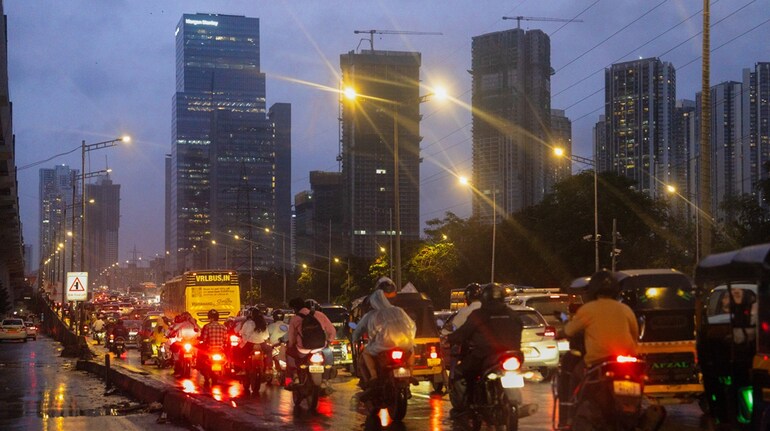

Buoyed by the success of the BJP-Shiv Sena combine in the Brihanmumbai Municipal Corporation (BMC) in the recently concluded municipal polls, a senior corporator from the BJP has proposed the civic body to introduce a tax that may pinch the pockets of Mumbaikars but will significantly help reduce traffic congestion and improve mobility in the long run.
In a bid to reduce traffic congestion in Mumbai and consequently pollution levels across the city, Colaba corporator Makarand Narwekar has proposed to introduce a congestion tax in the central business districts and use the revenue generated to improve the air quality of India’s financial capital.
Narwekar has written to Brihanmumbai Municipal Corporation (BMC) commissioner Bhushan Gagrani, urging the civic body to design a congestion pricing scheme. The tax will be levied on single-occupant private vehicles entering high-traffic zones such as south Mumbai, including Fort, Nariman Point and Colaba, especially during peak hours.
As per Narwekar’s proposal, private cars with only the driver could face a levy of Rs 50-Rs 100 per entry between 8am and 11 am and from 5pm to 8pm---times when there’s usually peak traffic.
Last year, the Mumbai Metropolitan Regional Development Authority (MMRDA) had discussed a proposal to levy a congestion fee on vehicles that spend 50 minutes or less in Bandra-Kurla Complex to ease traffic congestion. However, the proposal has not moved ahead.
Narwekar suggested that high-traffic zones be demarcated using existing CCTV networks and Automatic Number Plate Recognition cameras at entry points. "There should be a facility for automatic deduction via FASTag at checkpoints," said the BJP corporator.
"A congestion tax policy would discourage unnecessary private vehicle trips, shift commuters toward public transport, reduce congestion and lower emissions, a growing concern as Mumbai's air quality has hovered in the moderate to unhealthy range in recent weeks and months," said Narwekar.
His proposal calls for a pilot in south Mumbai, arguing that focused implementation would allow planners to assess feasibility, operational challenges and public reaction before wider roll-out.
He also pointed to projections that a congestion tax could raise Rs 200-300 crore annually, funds that could be chanelled into initiatives to improve air quality and sustainable transport.
Mumbai's traffic: A cause of concern
Mumbai's traffic and pollution figures have been a cause of concern among urban planners and health experts. Vehicle density in the city continues to rise year after year, significantly deteriorating the air quality.
According to NDTV, Narwekar, in his letter to the BMC, referenced recent recommendations in the Economic Survey, which recommended targeted congestion pricing in dense business districts in India’s heavily trafficked cities for urban mobility management, reflecting wider recognition in policy circles of the need to shift away from car-centric urban planning.
Some discussions around congestion pricing have surfaced in other cities too. Mobility experts in Bengaluru recently discussed using FASTag-based tolling on high-traffic corridors such as the Outer Ring Road, though the state government later clarified no congestion tax was officially planned.
The BMC and Maharashtra state authorities have not yet formally responded to the corporator's proposal, and any implementation would likely require detailed policy design, public consultations and legal vetting before being included in the civic body's next budget.
Congestion pricing not new
Congestion pricing is not a novel concept. Cities such as London, Stockholm, Singapore, and New York have long used pricing schemes to curb car traffic in crowded cores, with studies showing measurable reductions in congestion and, in some cases, improved air quality and transit use. Here’s a look at how congestion pricing helped meet the goals of reducing traffic and improving pollution in some cities:
LONDON
London’s congestion charge zone covers much of its historic and commercial heart. Introduced in 2003, drivers pay a daily charge to enter designated central zones during business hours, thereby discouraging unnecessary car trips, reducing pollution, and funding public transport upgrades, making the city centre safer for pedestrians, cyclists, and buses while keeping traffic predictable during peak hours.
SINGAPORE
According to News18, Singapore runs one of the world’s most sophisticated congestion pricing systems using electronic road pricing gantries across the island. Charges vary by time and location based on real-time traffic conditions. The system keeps roads flowing smoothly, reduces emissions, and supports Singapore’s vision of a highly efficient, smart, and transit-first urban transport network.
NEW YORK
Last year, New York became the first major US city to implement congestion pricing in Manhattan’s busiest core, reported News18. The system targets chronic gridlock around Midtown and Lower Manhattan, cutting traffic while raising billions for subway and bus upgrades. It marks a major shift in how American cities manage mobility and pollution.
STOCKHOLM
Stockholm's congestion tax applies when vehicles enter or exit the city centre, especially during rush hours. First tested as a trial, it became permanent after public approval in 2007 and has been credited with lowering rush-hour traffic and boosting public transit ridership. The charge has significantly cut traffic volumes, improved air quality, and encouraged commuters to shift toward trains, buses, and cycling in this water-bound capital.
Expert opinion
According to Times of India, transport experts believe that congestion pricing is a good idea for Mumbai, if it is implemented in a holistic manner.
Amit Bhatt, India Managing Director of The International Council on Clean Transportation, said one way of managing the number of vehicles on the roads is by restricting the registration of vehicles, and the other way is by imposing congestion tax.
"If the number of vehicles increase beyond threshold, the city will be gridlocked. Unlike the West, we have heterogeneous vehicles on the road. The policy should be implemented in a slightly holistic manner and the money generated should be used for sustainable transport," he said.
A V Shenoy of Mumbai Mobility Forum also endorsed the idea of congestion pricing, reported TOI. "About 400-500 vehicles are registered every day and whatever flyovers you build, they will not be able to accommodate these many vehicles. However, what is required is good public transport for those who don't get cars. Congestion pricing and good public transport should go hand in hand."
Opposition reaction
Soon after Narvekar floated the proposal, the Maharashtra Opposition came down heavily on him for trying to loot Mumbaikars by way of introducing the congestion tax.
President of Mumbai Congress Varsha Gaikwad said in a post on X, “Instead of resolving persistent traffic issues, this government wants to impose congestion tax on citizens!”
Shiv Sena (UBT) MLA Aaditya Thackeray said, “In Mumbai, the BJP mayor’s term hasn’t even started yet, and already Rahul Narvekar’s (Maharashtra Speaker) brother, Makarand Narvekar…has written a letter to the BMC demanding that a Congestion Tax be imposed on vehicles in Mumbai. Without doing anything good for Mumbai, the BJP’s only attitude is to keep looting Mumbai and Mumbaikars.”
The BJP-led Mahayuti alliance won in the recently concluded BMC polls, securing control of the BMC and ending the nearly three decades of dominant control by the Shiv Sena (undivided) over the civic body.
Discover the latest Business News, Sensex, and Nifty updates. Obtain Personal Finance insights, tax queries, and expert opinions on Moneycontrol or download the Moneycontrol App to stay updated!
Find the best of Al News in one place, specially curated for you every weekend.
Stay on top of the latest tech trends and biggest startup news.