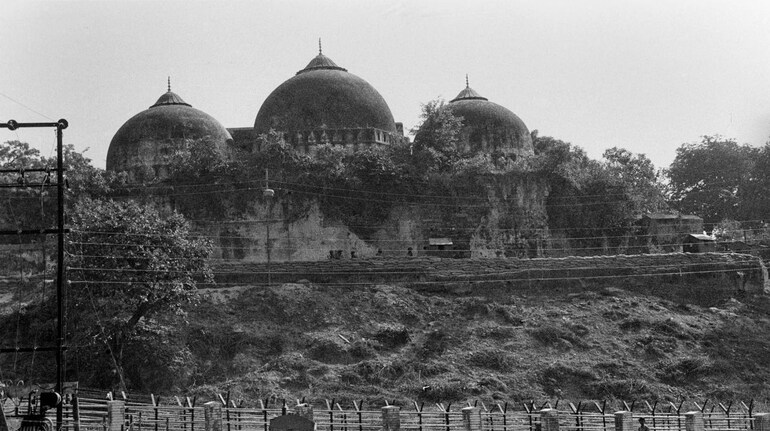
Most historical references attribute the construction of the Babri Masjid to Mir Baqi, a commander under the Mughal emperor Babur, in 1528 CE. This attribution relies primarily on Persian inscriptions recorded by 19th-century archaeologists such as A. Führer, who documented stones referring to Baqi as the builder.
The Baburnama, Babur’s memoir (translated by A.S. Beveridge), mentions his campaigns in the Awadh region but does not refer to a temple demolition at Ayodhya.
Archaeology at the site
The Archaeological Survey of India (ASI), in its 2003 excavation ordered by the Allahabad High Court, reported finding the remains of a large pre-existing non-Islamic structure beneath the demolished mosque. The report described pillars, architectural fragments and a plinth consistent with a Hindu religious structure. However, it did not specifically conclude that the earlier structure was demolished to construct the mosque. The High Court, in its 2010 judgment, cited these findings extensively.
Early signs of a dispute: 18th-19th century
In legal terms, the earliest recorded documented references to Ayodhya’s sacred geography appear in late 18th and early 19th-century British surveys.
In 1813-14, Francis Buchanan, conducting the East India Company’s survey of Gorakhpur (later published), recorded local Hindu belief that the central dome of the mosque marked the exact birthplace of Lord Ram. Similarly, Montgomery Martin in the 1830s, and P. Carnegy in his 1870 Historical Sketch of Faizabad, noted that both Hindus and Muslims venerated the site—Hindus associating it with Ram Janmabhoomi, Muslims using the mosque for prayer.
Colonial records also document periodic clashes. After riots in 1855, the British administration constructed a grille wall to physically separate Hindu and Muslim spaces:
• Outer courtyard for Hindu worship
• Inner courtyard (mosque structure) for Muslim worship
This spatial arrangement endured until 1949.
The dispute intensifies in the 20th century
On the night of 22-23 December 1949, idols of Ram Lalla appeared inside the mosque, an incident documented in the criminal case State vs. Priyadatt Ram (Faizabad magistrate records) and referenced in the Government of India’s White Paper on Ayodhya (1993). Local authorities treated it as trespass, sealed the inner courtyard, and allowed only Hindu puja, setting a precedent that shaped subsequent legal battles.
Between the 1950s and 1980s, multiple civil suits were filed: some seeking the right to worship, others claiming full title. Muslims petitioned for removal of the idols and restoration of the mosque. The Allahabad High Court’s 2010 recounting of the suits provides the most comprehensive chronology.
In 1986, a Faizabad district court ordered the unlocking of the gates to allow Hindu worship inside, an order by District Judge K.M. Pandey that rapidly escalated the political significance of the dispute.
1992 demolition and aftermath
The mosque was demolished on 6 December 1992 during a large kar sevak mobilisation. The event, widely reported in contemporary newspapers and examined by the Liberhan Commission (2009), marked a turning point in the dispute. The Central government subsequently acquired the land and asked the courts to settle ownership.
Judicial resolution
The Allahabad High Court (2010) used a combination of historical accounts, ASI findings and patterns of worship to divide the disputed land into three parts, allocating the central dome area to the deity Ram Lalla.
In 2019, the Supreme Court, in M. Siddiq (D) Thr Lrs. v. Mahant Suresh Das, held that the entire site be handed to a trust for the construction of a Ram temple, while directing that five acres of land elsewhere in Ayodhya be allotted for a mosque. The judgment accepted the ASI’s indication of a non-Islamic underlying structure.
Discover the latest Business News, Sensex, and Nifty updates. Obtain Personal Finance insights, tax queries, and expert opinions on Moneycontrol or download the Moneycontrol App to stay updated!
Find the best of Al News in one place, specially curated for you every weekend.
Stay on top of the latest tech trends and biggest startup news.