






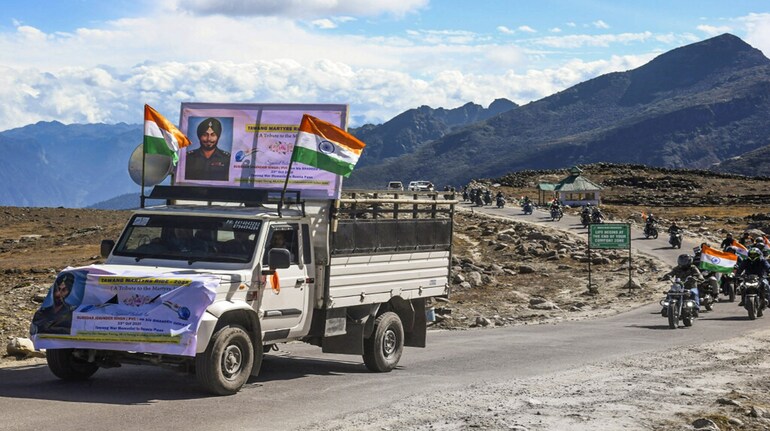
In the long shadow of the 1962 India-China war, few actions capture the imbalance, isolation and sheer human strain of that conflict as starkly as the stand made by Subedar Joginder Singh at Bum La in the North-East Frontier Agency. It was not a battle of manoeuvre or firepower. It was a platoon action, fought in freezing fog at over 14,000 feet, where the outcome hinged not on reinforcements or air support, but on whether a handful of men would hold their ground when everything else had already failed.
What happened at Bum La is remembered not because it altered the course of the war—it did not—but because it shows how, in 1962, the Indian Army’s smallest units were often left to absorb the full weight of strategic and political collapse.
NEFA before the storm
By the autumn of 1962, India’s position in NEFA was precarious. Forward posts had been pushed up along high mountain passes without adequate roads, winter clothing, artillery support or reserves. Many positions were logistically fragile, supplied by mule tracks and air drops that were themselves at the mercy of weather.
Bum La, a mountain pass linking Tawang to the Tibetan plateau, was one such position. It lay far forward, exposed, and difficult to reinforce. The troops holding it knew that if fighting came, it would come fast and hard, and that help would not arrive in time.
The broader assumptions guiding deployment were already unravelling. Political leadership underestimated Chinese intent and capability. Military planning was constrained by unrealistic directives that emphasised holding ground without providing the means to do so. When Chinese forces launched their offensive in October 1962, Indian forward units were scattered, thinly held and isolated.
The man and the platoon
Subedar Joginder Singh belonged to 1 Sikh, a regiment known for its strong platoon culture and emphasis on cohesion under stress. By 1962, he was a seasoned junior leader—not an officer, but the backbone of any infantry unit. In mountain warfare especially, the subedar was often the most experienced man on the ground, responsible for translating orders into survival.
At Bum La, Joginder Singh commanded a small platoon tasked with holding the pass. The numbers were stark. Accounts suggest he had barely two dozen men with him, armed mainly with bolt-action rifles and a single light machine gun. Ammunition was limited. The terrain offered little depth for defence. Withdrawal routes were unclear.
Against them stood a Chinese force that outnumbered the platoon many times over, supported by automatic weapons and mortar fire.
The attack at Bum La
When Chinese troops attacked Bum La, they did so with overwhelming force. Fog reduced visibility to a few metres. Fire came from multiple directions. Communication with higher headquarters was patchy, if it existed at all.
In such conditions, platoon-level leadership becomes brutally simple. There is no room for elaborate manoeuvre. The leader must decide whether to hold, withdraw, or surrender—often in seconds, and with incomplete information.
Joginder Singh chose to fight.
Despite being wounded early in the engagement, he refused evacuation. He moved from position to position, encouraging his men, redistributing ammunition and personally manning weapons when others fell. At one point, when the light machine gun crew was killed, he himself took over the gun, continuing to fire at advancing Chinese troops.
This was not heroism performed for witnesses or records. It was necessity. If the gun fell silent, the position would collapse immediately.
Fighting without illusions
What distinguishes Bum La from many other last-stand narratives is the absence of any illusion of victory. Joginder Singh and his men knew they were outnumbered, outgunned and unlikely to survive. There were no reserves waiting behind them. No counterattack was forming. The broader front was already giving way.
Yet the platoon held on.
In freezing temperatures, under constant fire, they continued to resist until ammunition ran low and casualties mounted. Joginder Singh, wounded multiple times, kept firing until he was finally overwhelmed and killed. By the time the position fell, the platoon had inflicted significant casualties on the attackers and delayed their advance.
It was, in military terms, a holding action measured in hours rather than days. But in the context of 1962, those hours mattered.
Why the stand mattered
Tactically, Bum La did not change the outcome of the war in NEFA. Chinese forces continued their advance, and Indian positions further south were soon abandoned or overrun. Strategically, the Indian Army was in retreat.
Yet actions like Joginder Singh’s stand mattered in quieter, less visible ways.
First, they disrupted the enemy’s timetable. Even brief resistance forced Chinese units to deploy, reorganise and expend resources rather than simply walking through undefended passes.
Second, they preserved a sense of military honour at a moment when national morale was collapsing. For soldiers retreating or being ordered to abandon positions elsewhere, stories of platoons that fought to the last man became anchors of meaning amid confusion and anger.
Most importantly, they exposed the truth about 1962: that the failure was not of individual soldiers or junior leaders, but of the system that placed them in impossible situations.
The Param Vir Chakra
Subedar Joginder Singh was posthumously awarded the Param Vir Chakra, India’s highest gallantry award. The citation recognised his refusal to abandon his post, his leadership despite grievous wounds, and his determination to fight on until the end.
The award was significant not only because he was a junior leader, but because it acknowledged gallantry in defeat. In Indian military history, 1962 occupies a painful space, often discussed in terms of mistakes and missed opportunities. Honouring Joginder Singh was an assertion that courage existed even when victory did not.
He remains one of the very few non-commissioned officers to receive the Param Vir Chakra, a reminder of how central small-unit leadership was to the war’s human story.
Small units, impossible burdens
The stand at Bum La highlights a recurring theme of the 1962 conflict. Platoons and companies were asked to do the work of brigades. They were deployed forward without depth, without reserves, and without realistic plans for withdrawal or reinforcement.
In modern war, failure is often attributed upward—to doctrine, intelligence, or political decision-making. But the cost of that failure is borne downward, by the smallest units. At Bum La, that cost was paid in blood by a platoon that held until it could hold no longer.
Joginder Singh’s leadership did not erase the war’s failures. But it showed what professionalism looked like when stripped of all external support.
Remembering Bum La today
In the decades since 1962, the Indian Army has invested heavily in infrastructure, logistics and mountain warfare capability along the China frontier. Roads, tunnels, surveillance systems and forward airfields now exist where mule tracks once did.
Yet Bum La remains a sobering reference point. It reminds planners and soldiers alike that technology and preparation are meaningless if political and strategic assumptions are flawed. It also reminds young leaders that, when systems fail, leadership at the lowest level still matters.
For the SIKH Regiment, Joginder Singh’s name is invoked not as legend but as instruction: stand by your men, hold your ground as long as it serves a purpose, and do not surrender your responsibility even when defeat seems inevitable.
A legacy beyond the battlefield
Subedar Joginder Singh did not choose the war he fought or the conditions under which he fought it. He did not have the luxury of questioning orders shaped far above his level. What he did have was a platoon, a weapon, and a decision to make when the attack came.
That is why his story endures.
Not because Bum La was a victory, but because it shows how dignity can exist even in strategic failure. In the history of 1962, where narratives often swing between blame and denial, Joginder Singh’s stand offers something steadier: a clear account of duty carried out to its limit.
At Bum La, a small platoon was asked to bear an impossible burden. Subedar Joginder Singh bore it with them, to the end.
Discover the latest Business News, Sensex, and Nifty updates. Obtain Personal Finance insights, tax queries, and expert opinions on Moneycontrol or download the Moneycontrol App to stay updated!
Find the best of Al News in one place, specially curated for you every weekend.
Stay on top of the latest tech trends and biggest startup news.




