






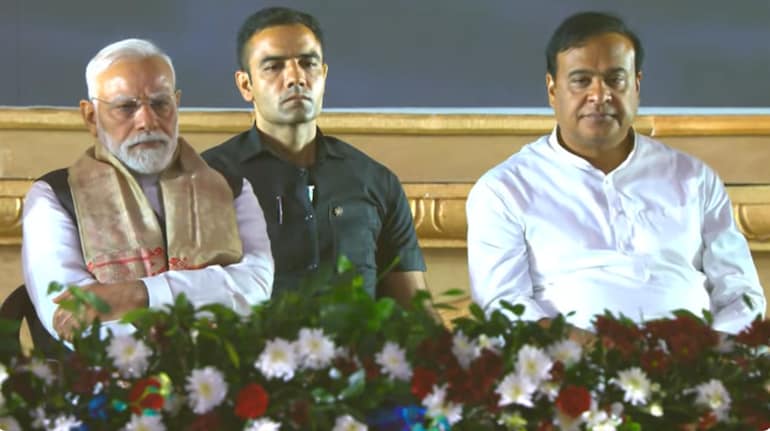
The political overtone of Prime Minister Narendra Modi's two-day visit to Assam -- where he launched projects worth Rs 15,600 crore, did not go unnoticed as he attacked the previous Congress government on multiple issues, primarily for neglecting Assamese nationalist sentiments for most part of the state's post-independence history.
In their re-election bid (for a third consecutive term in 2026), the saffron party, led by Himanta Biswa Sarma, has made several promises naturally fall into the Assamese nationalist imagination of indigeneity and belongingness. In Assam, identity has always been a core platform for electoral politics across the board.
During public addresses in Guwahati on Saturday and in Namrup on Sunday, Modi attacked the Congress on three fronts — development, welfare and anti-influx measures — signalling that these will remain the BJP’s key poll planks in the state elections due next year.
Visible cultural appeal
The Bharatiya Janata Party (BJP) has carefully used potent markers of Assamese identity to seamlessly mix into its own brand of politics. A promise that BJP has maintained consistently in its manifesto is to “strengthen the nāmghars and protect the rights of satras”.
Satras, which are essentially monastic establishments, came out of the neo-Vaishnava Bhakti Movement in Assam during the 17th and 18th centuries. Nāmghars, which are modelled somewhat like a Hindu temple, house the manuscript of Bhāgavatpurāna, which is meant to replace the images of deities in the neo-Vaishnavite order. Both are symbolic of an orthodox order of contemporary Assamese society, which retains very less of the heterodox Bhakti movement.
Another promise that the BJP to “strengthen the nāmghars and protect the rights of satras”. Satras, which are essentially monastic establishments, came out of the neo-Vaishnava Bhakti Movement in Assam during the 17th and 18th centuries. Nāmghars, which are modelled somewhat like a Hindu temple, house the manuscript of Bhāgavatpurāna, which is meant to replace the images of deities in the neo-Vaishnavite order. Both are symbolic of an orthodox order of contemporary Assamese society, which retains very less of the heterodox Bhakti movement.
Resistance to appeasement politics
Calling for resistance to what he described as appeasement politics, PM Modi said the BJP stood “like steel” to protect Assam’s identity and honour. Modi’s repeated emphasis on infiltration aligns with the crackdown launched by the BJP-led Assam government since July, with chief minister Himanta Biswa Sarma asserting that eviction from government and forest land would continue.
Most of those affected by the ongoing eviction drives are Miyas — Bengali-speaking Muslims, many of whom trace their origins to erstwhile East Pakistan, now Bangladesh. Influx has remained a major issue in Assam since the late 1970s.
In Guwahati on Saturday, the PM said the Assam government under Himanta Biswa Sarma was working hard to free the state’s resources from “illegal and anti-national encroachment”, accusing the Congress and the INDI alliance of defending infiltrators, including through legal interventions. On Sunday, he specified the infiltrators as Bangladeshis.
Discover the latest Business News, Sensex, and Nifty updates. Obtain Personal Finance insights, tax queries, and expert opinions on Moneycontrol or download the Moneycontrol App to stay updated!
Find the best of Al News in one place, specially curated for you every weekend.
Stay on top of the latest tech trends and biggest startup news.




