







The clash over Public-Private Partnerships in government medical colleges has developed into a central political storm in Andhra Pradesh, pitting the ruling TDP-led coalition against the opposition YSR Congress Party.
While the opposition has branded the move as a march toward privatisation, the government insists PPPs are the only way to finish long-stalled medical projects and bring affordable healthcare within reach.
Fueling the controversy is the state government’s push to develop 10 medical colleges through PPPs. These institutions, initially among 17 sanctioned by the Centre during the previous YSRCP regime, have languished unfinished for years.
On Thursday, YSR Congress Party president and former Chief Minister Y S Jagan Mohan Reddy met Andhra Pradesh Governor S Abdul Nazeer. It said he submitted over one crore signatures against the PPP model. With senior party leaders, Jagan gave a detailed statement at Raj Bhavan, saying the campaign showed strong public resistance and should be seen as a collective stand against privatising government medical colleges.
Party leaders described a dramatic scene as convoys of vehicles loaded with documents rolled into Lok Bhavan in Vijayawada, where officials from the Governor’s office verified the massive submission. Jagan hailed the campaign as a peaceful, democratic movement spanning the state, warning that privatisation would erode affordable healthcare and medical education, hitting poor and middle-class families who rely on government hospitals the hardest.
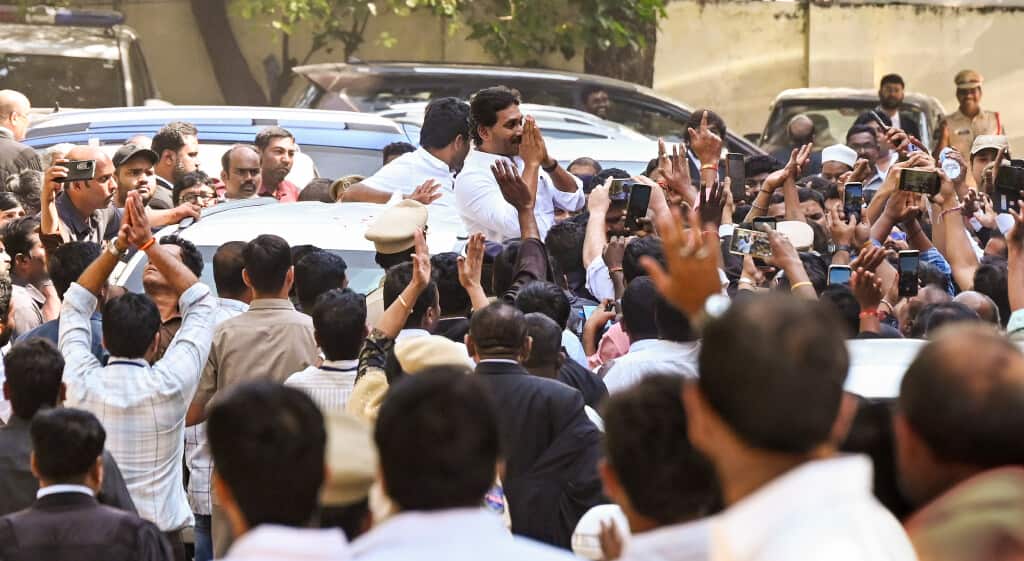 Jagan Reddy leaves after appearing before the ACB Court at Metropolitan Criminal Courts, in Hyderabad (PTI)
Earlier, the former Chief Minister paid homage at the BR Ambedkar Social Justice Memorial, tying the protest to the ideals of constitutional rights, social justice, and universal healthcare. He later told reporters that the YSRCP would turn to the courts if the government refused to back down, alleging that the PPP model would hand over profits and control to private players while leaving the government with only land and staff.
Jagan argued that the 17 medical colleges approved under the YSRCP were meant to open up affordable medical seats. He challenged the current government’s refusal to allocate the estimated Rs 5,000 crore needed for completion, despite a hefty budget of nearly Rs 2 lakh crore. Branding the PPP model a massive scam, he vowed to scrap it if the YSRCP regained power.
The ruling coalition has hit back with a fierce counterattack, accusing the YSRCP of delaying progress and whipping up outrage only when it serves their own interests.
TDP spokesperson and AP Swachh Andhra Corporation Chairman Kommareddy Pattabhiram brushed off the signature campaign as simple political theatre. He highlighted that YSRCP MP M Gurumurthy, a member of the Parliamentary Standing Committee on Health, had himself backed PPP development of medical colleges nationally. Pattabhiram further accused the YSRCP of financial misdeeds, alleging that funds earmarked for medical colleges were siphoned off during their rule.
NDA leaders reiterated these charges. Lanka Dinakar, Chairman of the 20 Point Programme, accused the YSRCP of sowing confusion by equating PPPs with privatisation. He pointed out that flagship healthcare schemes like Aarogyasri and emergency ambulance services, launched under the previous government, had quietly relied on PPP models even as they were showcased as government-run.
Chief Minister N Chandrababu Naidu addressed the issue directly at the fifth collectors conference, making it clear that the PPP model would not dilute government control. He said the medical colleges would operate as government institutions, even if built through PPP, and that the state would set all rules, academic standards, and norms for health service provision.
Naidu said 70 per cent of services in these colleges would be extended under the NTR Vaidya Seva scheme, and medical seats would increase. He rejected allegations of privatisation and argued that PPP was being misrepresented for political reasons. Pointing out that the Centre itself relies on PPP for several infrastructure projects, the Chief Minister said he was not afraid of criticism and that people needed to be told the truth.
He also took a swipe at the previous government, stating that Rs 500 crore spent on the Rushikonda structure in Visakhapatnam could have funded two medical colleges. Naidu said the YSRCP government had left the state financially strained, unable to pay salaries at times, and burdened Andhra Pradesh with loans taken at high interest rates of 13 to 14 per cent.
TDP MP Kesineni Sivanath added an aspect to the comparison between the two regimes. He accused the YSRCP of failing to deliver on its own promise of 17 medical colleges. According to him, against an estimated requirement of Rs 85,000 crore, the previous government spent less than Rs 1,000 crore over four years, resulting in extended delays and incomplete infrastructure.
Sivanath said the PPP model had been notified by the Department of Economic Affairs, recommended by the National Medical Commission and endorsed by the Parliamentary Standing Committee on Health. He accused the YSRCP of misleading students and parents by branding PPP as privatisation, clarifying that the government would retain ownership and regulatory control. At the same time, private partners would assist only in infrastructure creation. He said 50 per cent of seats would remain under the government quota with reservations intact, and 70 percent of hospital beds would be reserved for Ayushman Bharat beneficiaries.
The government has also issued detailed clarifications to address public concerns. According to official explanations, PPP is fundamentally different from privatisation. Ownership of land and assets remains with the government; academic control remains with Dr NTR University of Health Sciences; and all institutions will follow National Medical Commission standards. Fees for convener quota seats are capped by the Andhra Pradesh Higher Education Regulatory and Monitoring Commission, and reservation policies remain unchanged.
Officials contend that turning to PPPs is a pragmatic response to harsh fiscal realities. With each medical college demanding nearly Rs 1,000 crore a year to run, the state claims it simply cannot shoulder the cost alone.
By partnering with private players under strict regulation, the government argues it can revive stalled colleges, boost medical seats, and broaden hospital services without sacrificing the public good.
Discover the latest Business News, Sensex, and Nifty updates. Obtain Personal Finance insights, tax queries, and expert opinions on Moneycontrol or download the Moneycontrol App to stay updated!
Find the best of Al News in one place, specially curated for you every weekend.
Stay on top of the latest tech trends and biggest startup news.




