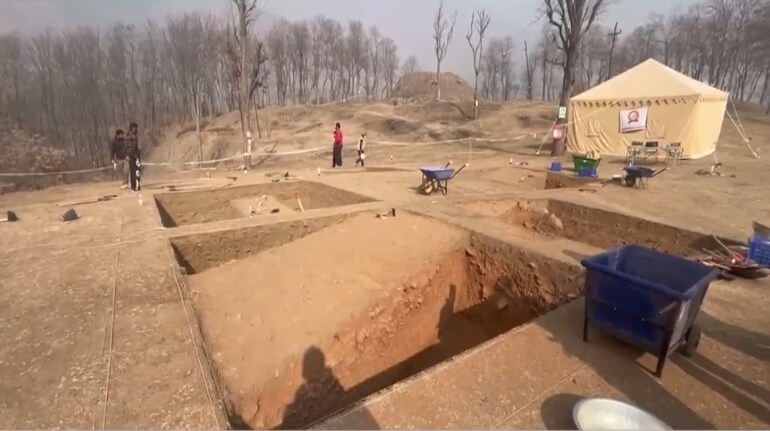

A quiet village in Jammu and Kashmir’s Baramulla district has unexpectedly emerged as a window into the valley’s forgotten Buddhist past, following the discovery of a 2,000-year-old archaeological site that Prime Minister Narendra Modi has called a "proud moment" for India’s cultural heritage.
The find at Zehanpora village came after archaeologists excavated a series of nondescript mounds, revealing stupas, monastic buildings and other structures dating back to the Kushan period. Together, they point to Kashmir’s deep-rooted Buddhist history, long overshadowed by more familiar historical narratives.
What set the discovery in motion was an unlikely clue. Blurry, decades-old photographs of three stupas preserved in a French museum caught the attention of researchers. Those images prompted fresh surveys in Zehanpora, eventually leading to the unearthing of a significant Buddhist complex that sheds new light on the region’s ancient civilisation.
Kashmir’s 2,000-year-old historyIn Baramulla, J&K, there is a place called Zehanpora. For years, people had been seeing some tall mounds there. A scientific study of these mounds was initiated. It turned out that these mounds were the remains of a large structure built by… pic.twitter.com/vMqqNtTQUa — MyGovIndia (@mygovindia) December 28, 2025
Experts believe Zehanpora may have functioned as an important Buddhist centre, possibly linked to the elusive Kushan capital of Huvishkapura. Drone surveys have confirmed that the village’s mounds are man-made rather than natural formations, strengthening the case for a planned settlement.
The site’s location adds to its importance. Zehanpora lies along an ancient trade and pilgrimage route that once connected Gandhara with Kashmir, suggesting the area played a key role in cultural and religious exchanges.
The excavation was jointly carried out by the Department of Archives, Archaeology and Museums, Jammu and Kashmir, and Kashmir University. Archaeologists say the stupa foundations and monastic cells closely resemble Gandharan architectural layouts.
An NDTV report citing officials described the discovery as a layered revelation that could reshape understanding of Kashmir’s ancient past. “Jehanpora rediscovery reinforces Kashmir’s historic place as a confluence of civilisations. It establishes Kashmir’s Buddhist heritage that was long overshadowed by familiar historical narratives,” the report said.
In his monthly radio programme, Man Ki Baat, Prime Minister Modi on Sunday said, "Three Buddhist stupas were visible in that photograph of Baramulla. From there, the course of discovery changed, and Kashmir's forgotten past began to reveal itself. This history goes back nearly 2,000 years."
The Prime Minister said the discovery has opened a window into Kashmir’s glorious past, dating back nearly 2,000 years, and described Jehanpora as a powerful reminder of the valley’s rich identity and historical legacy.
Discover the latest Business News, Sensex, and Nifty updates. Obtain Personal Finance insights, tax queries, and expert opinions on Moneycontrol or download the Moneycontrol App to stay updated!
Find the best of Al News in one place, specially curated for you every weekend.
Stay on top of the latest tech trends and biggest startup news.