






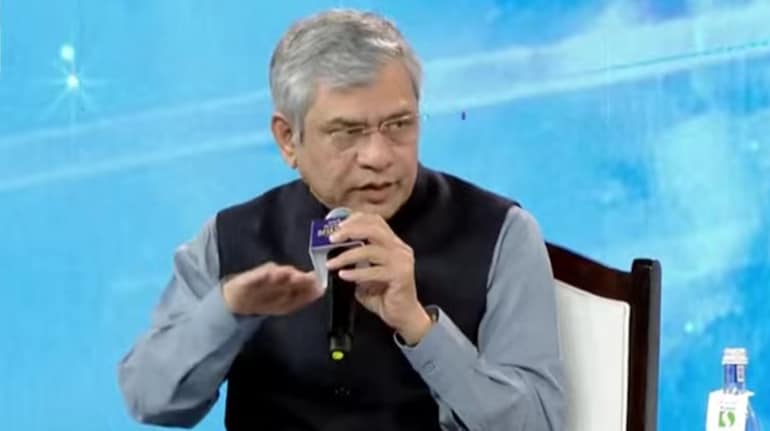
At a wide-ranging session during the Rising Bharat Summit at Bharat Mandapam on Friday, Union Minister Ashwini Vaishnaw spoke about India’s AI ambitions, semiconductor push, data centre expansion and sweeping railway reforms. Speaking to Network18's Group Consulting Editor Bodhisatva Ganguli and Moneycontrol's Chandra R Srikanth, Vaishnaw addressed concerns over job losses, platform regulation and revenue sharing for content creators, he outlined the government’s roadmap for balancing innovation with citizen protection in a rapidly evolving digital economy. Here's the full transcript of the conversation:
Chandra Srikanth:
Big round of applause, ladies and gentlemen. Good afternoon, everyone. You know, I was at the same venue last week, Bharat Mandapam and I can't tell you, it was overflowing with people who were just talking about AI, AI everywhere. And so globally they talk about AI diffusion, here AI diffusion has happened at the level of seven-year-olds and eight-year-olds. So I think we are safe.
Ashwini Vaishnaw:
Of course, AI diffusion in India is among the, if you look at all the economies which are comparable, we have probably the highest diffusion rate, both in the consumer sector as well as in the enterprise sector. And that is actually giving us a big strength, because our IT sector, of course, there is a lot of, at this point of time, the sector needs to understand how they will pivot fully, but they are pivoting very rapidly towards providing AI services. And in the consumer sector, lots and lots of new creators are coming up. So diffusion, of course, is very important and it's happening.
Bodhisatva Ganguli:
So I just wanted to start off with the, I think whoever holds the next AI summit, which is Switzerland, will have a steep target to meet. I don't think they'll be able to, because this was much bigger than the previous two in Paris and Bletchley Park. So you've set a really steep target for any other AI summits that come after it. And it's really put India at the center of the AI world in terms of the conversations around AI. The question was, but the one point though which people make is that India is still largely a consumer of AI and is not, for example, making large language models and so on and so forth. I mean, that's one criticism or slight negativity which comes up when one talks about India and AI.
Ashwini Vaishnaw:
So there are two different things here. First is, of course, the summit was very well received and very well recognized globally. The format of the summit was more on the World Economic Forum format, Davos format, where we had about 700 plus sessions where our students, they got an opportunity to listen to people like Nobel laureate Demis Hassabis, people like Dario, people like Sam Altman, people like Sundar Pichai. They got that opportunity to interact with the top AI brains in the entire world. So it was designed in a way that our young generation, I call it Generation Bharat, Gen Bharat. So the Gen Bharat basically gets the opportunity to create their future in the way they want it. That was the whole theme of this.
Regarding the AI strategy that India has, well-known five layers now, so I won't go into that. Key thing is to get the right solutions, which is where the ROI will come. So our focus is on that. And today, models have already become commoditized. There are like so good models which are just maybe four or five months or maybe six months behind the top most frontier models. They are now available in open source, which can be used to provide the solutions and provide the applications. So the focus has to be to get that infra in place, which is where the summit gave us the total investment of about $250 billion and about $17 billion for the deep tech startup ecosystem from the VC community. So that way, it was very fruitful.
Bodhisatva Ganguli:
So, as you said, $250 billion is not a small number, we saw big commitments from Indian domestic conglomerates and also from the likes of Microsoft, Google, Amazon, which came in during the AI summit. So India is certainly part of the AI conversation. But there is, of course, the other, what some say is the flip side to AI, and you know, one has to refer to that, which is the fear of job losses. For example, the IT stocks have been going down in the last several weeks. There is a scare, maybe exaggerated, but it's certainly there. And a lot of the Indian consumption story also depends on IT, let's say in places like Bangalore or Bengaluru or Pune, to some extent, Gurgaon, real estate, so what are your thoughts? What's the government's reaction to that?
Ashwini Vaishnaw:
The biggest strength of our IT sector, and especially the big IT companies that we have, their strength is to be able to go to an enterprise, understand how that enterprise works, and basis that provide the technology solution which will work in that enterprise. That's the strength. In the past, this strength was demonstrated when the Y2K problem came. We have seen how the transition from on-prem to cloud happened. That was also done by our IT sector. In the past, we have seen from the legacy systems to more modern programming language, more modern software architectures which happened. And this is now the transition where we are shifting from the coding to automatic coding, but using an architecture which is designed by the IT companies, by the teams out there.
The trust factor in deploying AI is very, very important. For example, if there is a banking company, that bank would not like to hand over the coding to either a software or any other person until and unless they trust it. An insurance company, a retail company, any company that you talk of, any enterprise that you talk of, they would like to have people who are trusted, who understand, who can be trusted with their data, with their internal architecture, with their business model. That is where the role of IT companies will significantly grow in the coming years. Yes, this will require a lot of effort.
From the Government of India side, we are putting huge focus on providing the talent pipeline. From the state governments, especially the state governments like Government of Karnataka, Government of Telangana, Government of Tamil Nadu, Government of Maharashtra, they will have to put in a lot of effort to make sure that their colleges in their states, they get reoriented towards AI based IT solutions. So, the responsibility will have to be taken by the IT industry as a primary and the state governments and central government. We will be there fully to support this transition. I am personally discussing with practically every IT industry leader and whatever support they need, we will provide. The state governments will also have to take a large part because the colleges are located within their jurisdictions. So, they will have to also take a large part of this work.
Chandra Srikanth:
Right, just to follow up to that sir, if you look at the pace of AI advancement, you know it's almost like gradually and then suddenly because in the last one month, there have been so many advancements. Every day we see one new industry or function getting disrupted whenever Anthropic makes some release for instance. So, while the industry grapples with this and they upscale employees, is it going to be a very painful transition period? What's the backstop that we have because this has been a huge source of employment for engineers and as Bodhi said, it will have second order effects on consumption, investment, basically the entire economy. So, should we prepare for a painful transition period say for the next one to two years before it's determined what new types of jobs are getting created?
Ashwini Vaishnaw:
We must be prepared. We must take it very seriously. This is once in a generation kind of transition which is happening. So, we must be prepared for it and we must take every action proactively. That's precisely the reason why we started the future skills program almost three and a half, four years ago and that was done in partnership with the IT industry so that they can rapidly start the upscaling work and of course, the numbers there are huge, almost 8 lakh IT industry professionals have been upscaled but that number has to be now scaled up at a much significantly higher level and that talent pipeline has to start getting created from the colleges onwards. That's why the Ministry of Education at central government level and the Ministries of Education at state government levels with the industry, we will all have to work in a very concerted manner and that's what we are attempting at this point of time.
Chandra Srikanth:
Right. Just one more question. You know, last week was also notable because I think we had five foundational model releases. Sarvam, of course, everybody would have heard but apart from that, we had four more startups which released foundational models and there are going to be five to seven more over the next twelve to twenty-four months. Are you happy with the kind of research and investments that happened, that's happening in the foundational layer in India and will it continue to take push from the government because what helped these first five models was the GPU access that the government provided, the investment that you provided. So, will that continue to be a big push because you've also announced, you know, India AI 2.0. So, what kind of outlay can we expect for that?
Ashwini Vaishnaw:
We'll have to scale up our investment, we'll have to scale up our compute to a significantly higher level. When we started the AI mission, that time 10,000 GPUs was the target. We have achieved already 38,000 and another 24,000, another 20,000 we are adding. But I think we'll have to go somewhere near 200,000 or even more than that. Then only we'll be able to do real, I mean, the kind of demand which is coming up. And that is why the recent budget announcement of tax break till 2047, that's very important because that basically provides that huge momentum to bring the entire world's data to India. We process it, we provide those services using that data in a secure and a trusted manner because one, India is trusted. As a country, the world trusts us. As an economy, the world looks at us as a trusted partner. So therefore, it's very important that we follow up on all these plans. We'll have to invest significantly higher numbers.
Apart from the big announcements which were there in the AI summit, there are many other people who did not decide to announce, but they have the plans to which they will keep unfolding in the coming months, where they would also like to set up significantly large infra facilities throughout the country so that the talent pool can get the infra which can be then used to provide the services.
Bodhisatva Ganguli:
Ashwiniji, if I can ask you another question. See, I think the argument that AI could cause job losses, therefore there should be some restraint is not a particularly valid argument. Any new technology, especially on a revolutionary scale, does cause job losses. But there are also adverse impacts. We spoke about this in the context of software. Now, yesterday, you talked about another segment, which is of great interest to our industry, which are content creators, you know, all of some of these large language models, these AI summaries that we get to read, essentially scrape of, you know, scrape information and stories and articles that have been created by a lot of content creators, including large media organizations. So, what are your views on that? What you said was very welcome for our industry, but what is the solution? Is it revenue sharing, or what is the government looking at?
Ashwini Vaishnaw:
Listen, the content creators and the media houses, you guys invest a lot in getting that entire network, where you have the journalist, you have the reporters, then there is an editorial check, and basis all that, finally, the content is published. So, it's very important that the hard work and the significant amount of effort that you are putting in, that needs to be rewarded in a fair way. So, that's why when I interact with the counterparts across the world, practically every country is today thinking that there has to be a fairer way of sharing revenue, because the revenue today is basically going to the platform first, then it comes to the content creator. And we have content creators across the country who are creating such a huge amount of good quality, high quality content, whether it is music, whether it is cooking, whether it is traditional culture, whether it is traditional folk songs, whether it is science, technology, very interesting ways of explaining things to the young generation, all that is happening today. So therefore, when this Gen Bharat, when they are the content creators, they must get the fair share of the revenue and the media, which has basically developed over more than a couple of centuries, that large base of trust in this institution, that needs to be properly recognized, that needs to be rewarded, and that needs to be further strengthened, in my opinion.
Chandra Srikanth:
Right, just one follow-up to that, sir. You made an important statement at the DNPA, a conference where you said, you know, social media platforms must share revenue, and now we've spoken about AI labs. Is there a way that the government will formalize this, institutionalize this in terms of how the revenue share should work with publishers, with media houses, with content creators? And is it pragmatic? Is there some way to work this out?
Ashwini Vaishnaw:
This needs to be done in a very consultative manner. All the past work that we have done, whether it is Telecom Act or DPDP Act, all these we have done in a very consultative manner. We'll do this also in a very consultative manner.
Bodhisatva Ganguli:
I think also the first semiconductor production in India, I think, starts in a few days of when some of the projects…
Chandra Srikanth:
Tomorrow, I think, Micron's plant is going on.
Ashwini Vaishnaw:
That's very satisfying. In a very short time frame, I think the foundation stone for Micron plant was done in 23. Yeah, it was done in 23. And here in 26, we are starting the commercial production. Tomorrow, Honourable Prime Minister will start the commercial production. He'll inaugurate the Micron semiconductor plant. And this is where the high bandwidth memory, the most advanced memory which is in huge demand now because of the AI revolution, and this memory is used in practically everything that we use — our laptops, our mobile phones, the cameras, the lighting arrangement, the speaker, everything, every electronics item, the large machines, defense sector, strategic sector, every sector, transportation sector, oil and gas sector, everywhere these memory chips are used. So, it's a very good start for the country. Three more plants have already entered pilot production. Their products are now getting qualified with the customers. And this year, we'll have, after Micron, we'll have two more commercial productions happening in quick succession. And fourth one will start somewhere around maybe November or December.
So, it's a very good journey. And the other plants are getting into now more like the machine tool room shifting kind of level where the civil construction is ending and the machines and plants and all other things are now coming in for getting the next phase of their commissioning. It's going on very well. Recently, Honourable Prime Minister laid the foundation stone in Uttar Pradesh for a plant which is HCL and Foxconn joint venture. They will be manufacturing the display control. So, every screen that you see, whether it is a screen on your X-ray machine or a screen on this television, right, this large screen, all these screens, they are driven by chips which are basically the driver module. So, they'll be manufacturing the driver module and it's going to be a very large plant, of course, in phases. But most of these plants will be meeting a substantial part of their global demand from these plants.
So, this is a very, very satisfying journey, I would say, because our country has been looking for a semiconductor industry for almost six decades now. After six decades, we have had this big break. And thanks to our Honourable Prime Minister's vision, he set the guardrails, he set the goal very clear for us and made sure that we look at the ecosystem. Honourable Prime Minister's focus was always, this has to be a multi-year journey. This cannot be a one-year program, five-year program. This has to be a minimum 20 years program. Second, always focus on getting the ecosystem. So, getting the ecosystem within three years, it was a herculean task, I would say. Most people initially were quite skeptical. But when we interacted with them, sincerely we followed up each and every input which used to be given by the industry participants. Our point to the industry was that, yes, it's a new industry for us. We don't have this thing in the past. We don't have the precedents. So, you help us, you guide us what needs to be done. They would give us inputs about power supply, about ultra-pure water, about 250-odd gases and chemicals, about the kind of welding talent, welding skill which is required. And it's very, very, very high-level skill, very extreme-level skill.
Normally, we are used to measuring in parts per million. Here, parts per billion is the norm. Parts per billion is the norm. And there are so many cases where they have to go even beyond that. Clean rooms, they operate at a totally different level. So, that level of skill development, that level of ecosystem development, it has required, it has been a humongous effort. I would like to thank Honourable Prime Minister for getting this industry into our country.
Bodhisatva Ganguli:
One quick follow-up question. Where are we on India's semiconductor mission, too? And secondly, this is an industry which can be cyclical. Is it possible that some of these semiconductors, when they enter the market, could face a demand problem?
Ashwini Vaishnaw:
Yes. Semiconductor industry has been very cyclical in the past. And the cycles have been vicious, for sure. But what we see, the trend today is quite different from the past. On two counts. Count one is, today the use of semiconductors has permeated significantly beyond the traditional electronics as a sector. It has gone, like practically every consumer item that we see today, all the white goods, all automobiles, all transportation sector, energy sector, power sector, every sector that we see today has semiconductors, the chips in them. So it has become a foundational industry, whereas in the past it used to be more like supply chain for the electronics industry. That's one big change. The second big change which has happened is, the cycles have significantly got compressed. For example, memory. The memory cycles used to be such vicious that practically every cycle, 60% of the industry would get consolidated into one company. That used to be the past norm. Those things have changed now.
Now the cycles are there. They are more like a typical business cycle where ups and downs are there. But the slope is, the gradient is consistently up. That is that up cycle over which there are smaller cycles. In fact, the industry was expecting $1 trillion size by 2031. Now that $1 trillion mark is now already advanced to 2029 or 2028 even. Some people call it even 2028. What we have done different is, one, of course, getting the ecosystem. Second, we are creating a huge talent pipeline. Today we have 315 universities where students are actually using the world's most advanced EDA tools from Cadence, from Synopsys, from Siemens. If you compare globally, outside India, rest of the world, including the developed countries, there are not even 20 universities where students will get the entire end-to-end capability of designing a chip, manufacturing it, validating it, and using it in a module.
And today we have universities in Assam, in Jammu and Kashmir, in Kerala, in Tamil Nadu, in Rajasthan, in Gujarat, every Chhattisgarh, Jharkhand, Odisha, where students are designing chips, getting them manufactured, getting the chips manufactured, chips validated, and using them. So the talent shortfall of about 1 million, which is there in the semiconductor industry globally, that entire talent pipeline will be met by India, in India, because today the world has developed that confidence. First, when I asked the CEO of AMD and CEO of Renesas and CEO of Arm about three and a half, four years ago, to bring their most advanced chip design work to India, their initial skepticism was quite obvious, but they believed us, they trusted us. And today, practically every large firm, whether it is Intel or AMD or ARM or Broadcom or NVIDIA, their entire design work is mostly done in India now. So that huge ecosystem is coming up.
Then the startup ecosystem, which has come, and startup, as well as the experienced people from other large companies, who are coming out and setting up their own companies, for creating that design ecosystem, that's phenomenally important for us. And that is where the initial push, that initial significant effort is required. That will grow like a hockey stick, like an exponential curve, because that large learning curve is now behind us. Now the time has come that inflection point in the S-curve is now upward. So that thing is very clearly in front of us.
Chandra Srikanth:
Right. I also wanted to ask you about data centers, where India has received significant investments in the last year. The budget also announced a huge tax holiday for people who are investing in data centers here. But people also have concerns about what this will do in terms of electricity consumption, water consumption. Will it create the proportionate amount of jobs? How would you respond to that, sir?
Ashwini Vaishnaw:
Very important point. Unlike many rich countries, we are having a grid which is practically rebuilt over the last decade. It's very different from the developed world, where the grids are maybe 30 years, 40 years, 50 years vintage. Our grid is designed for that ups and downs which come with the renewable energy. Because our Prime Minister put huge focus on getting the renewable energy capacity, and we are one of those very few countries where our renewable and power generation capacity is today 50% of the total power generation capacity. So that way our grid is substantially robust, first.
Second, so many innovations are happening which are reducing the power consumption. There is one startup which is now working on inference chip, which will reduce power consumption by about 70%. 70% kind of reduction which is possible today. I've seen their concept, and the concept looks very logical, and they have got VC funding also. So which means that it's going in the right direction. There are other people, somebody, one company met a few weeks ago where they are bringing a liquid cooling system which can practically reduce the requirement of water by 90%. So those innovations are continuously happening. What's important is getting the renewable energy sources, which in our country we have a very significant development over the last decade. Second, getting the grid to be more smart and robust, which is what our efforts in the last 10 years have paid off.
Bodhisatva Ganguli:
So Ashwiniji also wears his railways hat, but before we move on to railways, I just wanted to ask that one, if he could, you know, there was also an innovative protest, if one could put it that, held at the AI summit, which in some ways kind of-- is one of the, I don’t want to use the word highlight, but one of the unusual events of that summit.
Ashwini Vaishnaw:
So it's not surprising the way Congress has kind of gone to a level which basically is, today the entire country is kind of, nobody likes this kind of, when the entire world is assembled here, the entire world is coming to our country, they recognize the value that our country has, and that time doing that very mean thing was something I don't think, how many in the audience feel that they did the wrong thing? Practically the entire audience feels that they did the wrong thing, right? So this kind of behavior from the Congress is something which the Gen Bharat will not accept, for sure. A Gen Bharat, the young people will not accept this kind of mean behavior. The Gen Bharat is looking at the world from optimism, the Gen Bharat is looking at the entire world with lot of energy, with lot of positivity, with lot of enthusiasm. The Gen Bharat wants to create solutions for the world. The Gen Bharat is not into those negative, mean, small thinking kind of things which Congress has done, and Congress will basically be, the country has shown their place to them.
Bodhisatva Ganguli:
So just to go on to railways, you've talked about 52 reforms in 52 weeks. Tell us a little about that. Your CapEx I think is also doubled if my numbers are correct.
Ashwini Vaishnaw:
CapEx utilization is very high. Practically over the last many years now, CapEx has been increasing from just about 25,000 crore rupees a decade ago. Now it is about 2,72,000 crore and next year it will be 2,90,000 crore. And CapEx utilization is very high. Even in the current year we have, as of today we have done about 94% of our CapEx utilization and March has not even started, right? March will be late. So it's going on very well and the results are also visible. We have done about 35,000 kilometers of new railway tracks, practically electrified the entire railway network. More than about 50,000 kilometers of railway network we have electrified. We have upgraded almost 80% of our tracks. Almost 80% of our tracks we have upgraded to 110 kmph.
Kavach installation is going on at a very rapid pace. Stations are getting rebuilt, 1,300 stations out of that 170 already completed, maybe 190 already completed. This is a number one month back. So it's progressing very rapidly. More than 160 Vande Bharat trains are already in service. Complete bouquet of total new set of products, totally new generation of trains is there. We have done many reforms in the past, in the past 10 years series of reforms have happened. In this year we are planning 52 reforms. Already 4 reforms have been kind of rolled out and in the coming months we will be rolling out many more reforms. These reforms are focused at safety, at passenger convenience, passenger experience, at maintenance practices, at production, manufacturing, construction. Every aspect of railways will see reforms.
Chandra Srikanth:
I think we are out of time but I just want to speak in two quick questions for you sir. One is on the IT laws. In your DNPA address you also spoke about how the nature of internet itself has changed and how we are grappling with a completely new internet. We know that the government was working on a digital India bill. Is there a need for a complete overhaul of IT laws? And lastly, will India follow in Australia and France's footsteps in age gating social media platforms, restricting social media for people under 16, what has been decided?
Ashwini Vaishnaw:
See, in the Digital Personal Data Protection Act, we created a totally new template for the world which is recognized everywhere. So many ministers have told me across the world they would like to have this as the template rather than the European template with the GDPR template which is very prescriptive, which is very, very cumbersome and it basically doesn't have any scope for innovation to come up. We wanted innovation, pro-innovation but simultaneously the safety of citizens is very important. So we wanted to balance that and the same approach we will follow in our current thought process. The nature of internet has actually changed. When we were students in the last few decades, actually in the last 10 years, 15 years, the nature of internet has substantially changed. Platforms are the primary mode through which every kind of content, whether it is news or music or films or every content is basically today disseminated using the platforms.
So therefore, it's very important that we take the right measures for, one, protecting our children, two, the social institutions which are there, the institutions of family, the institutions in our society, the judiciary, the way our parliament functions, the way our constitution has created the institutions, they all have to be protected and strengthened so that the society remains harmonious. Three, there is a huge barrage of deepfakes, barrage of synthetically generated content where nobody's consent is taken. An anchor's deepfake, selling some medicine, let's say finance minister's deepfake, saying about some investments, those things have to be kind of checked. So deepfakes or rather any synthetic content, somebody's personality used to create some synthetic content, there has to be a consent of that person. So those constructs are today very important. There are so many misleading advertisements on the social media. There are issues about cyber crime. We have seen so many issues of cyber fraud and cyber crime where especially the people who are retired, they are basically digitally arrested and the bank accounts are kind of taken control of. Those things have to be controlled, those things have to be checked.
So that is where the role of the social media platforms and all other intermediaries has to become very important. We have seen how the rumours spread so rapidly so it's very important that those guardrails in the society are put in place at this point of time before the problem becomes too big and we are very closely interacting with the industry. Platforms have shown a lot of appreciation for this approach. In fact, without taking any names, all the top leaders that I met during this summit and in Davos previously, they all shared the concern. They also are parents, right? End of the day, CEO of a large tech platform is also a parent. They also have the same concern that any other parent would have. They also are living in the same society. They also have the same concerns that any other citizen would have. So they understand this. We have very clearly assured that for us, innovation is very important and citizens' protection in the online space is as important as innovation so that right balance is what we are driving at. Thank you very much.
Chandra Srikanth:
Great. On that note, thank you very much, sir. This was an amazing session. A huge round of applause for the minister who pulled off the largest AI summit in the world. Thank you very much.
Discover the latest Business News, Sensex, and Nifty updates. Obtain Personal Finance insights, tax queries, and expert opinions on Moneycontrol or download the Moneycontrol App to stay updated!
Find the best of Al News in one place, specially curated for you every weekend.
Stay on top of the latest tech trends and biggest startup news.




