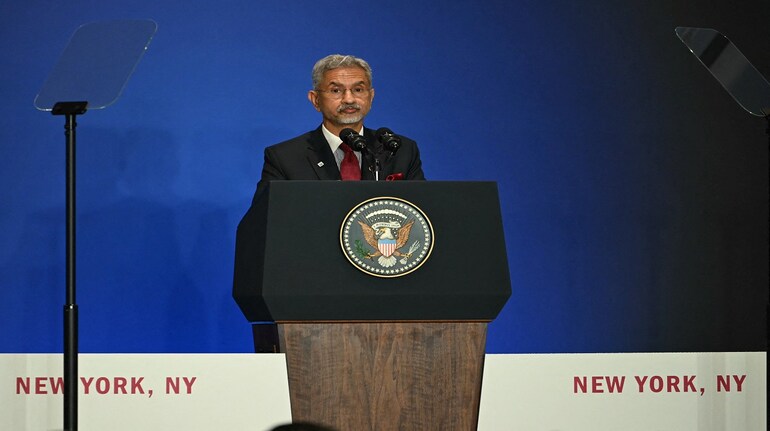
External Affairs Minister S Jaishankar, on Wednesday, addressed the ongoing border tensions between India and China, highlighting the challenging relationship between the two nations. Speaking at the Asia Society Policy Institute, Jaishankar recalled the significant violations by Chinese troops during the COVID-19 pandemic, when large numbers of forces were moved to the Line of Actual Control (LAC) in violation of existing agreements between the two countries.
Jaishankar revealed that while 75 percent of the disengagement process has been resolved, the more complex issues surrounding patrolling rights at the LAC still remain. “When I said 75 percent of it has been sorted out, it’s only of the disengagement. That’s one part of the problem. Some patrolling issues still need to be resolved. The next step will be de-escalation,” the EAM clarified.
Also Read | Jaishankar meets Bangladesh Foreign Affairs Advisor in first bilateral talks post-Hasina ousterThe minister further stressed that the relationship between India and China holds significant importance not just for Asia, but for the world. In his speech, he underscored the idea that in a multipolar world, Asia must also be multipolar, with India and China playing key roles in shaping global dynamics.
“Asia is very much at the cutting edge of that change. Within Asia, India is part of leading that change. But that change is today stretching the fabric of the global order. I think the India-China relationship is key to the future of Asia. In a way, you can say if the world is to be multipolar, Asia has to be multipolar. And, therefore, this relationship will influence not just the future of Asia but, in that way, perhaps the future of the world as well,” noted the EAM.
Reflecting on the strained history between the two neighbours, Jaishankar pointed to past border clashes, including the 2020 Galwan Valley incident, which saw casualties on both sides. He noted that this event has since cast a shadow over bilateral relations, and reiterated that restoring peace and stability at the border is crucial for improving the broader relationship.
"There was a clash, and a number of soldiers were killed on both sides....This in a way affected the relationship between the two countries," he noted.
"Despite clear agreements, during the pandemic, China violated these terms, leading to troop clashes. This has affected our relationship. Until peace is restored on the border and agreements are respected, it is difficult to carry on with the rest of the relationship,” Jaishankar remarked.
Jaishankar acknowledged the progress in disengagement but highlighted the need for further de-escalation. He pointed out that both nations have deployed large numbers of troops to the border, making the situation more precarious.
The minister concluded by strressing that resolving these disputes would allow other aspects of the India-China relationship to improve. The focus, he said, must remain on ensuring a peaceful and stable border through disengagement and eventual de-escalation.
Chinese Ambassador Xu Feihong, in response, called for mutual respect and cooperation, stressing the importance of viewing each other’s strategic intentions positively and accommodating core interests to enhance bilateral ties.
"We should follow the right direction and enhance mutual respect and mutual trust. President Xi Jinping and Prime Minister Narendra Modi have reached an important consensus that China and India are not rivals or threats to each other, but are partners in cooperation and development opportunities," Feihong noted.
"This provides a clear direction for our bilateral relations. We should firmly implement the important consensus reached by the two leaders, correctly view each other’s development and strategic intentions and mutually accommodate each other’s core interests and major concerns,” he remarked.
During the 79th session of the UNGA, the External Affairs Minister participated in a series of bilateral meetings with counterparts from countries such as Spain, Cyprus, and Moldova. Discussions focused on critical regional issues, including the conflicts in West Asia and Ukraine, while also seeking opportunities to strengthen bilateral cooperation.
Jaishankar, currently in the US for the high-level UN General Assembly session, is set to address the General Debate on September 28.
Discover the latest Business News, Sensex, and Nifty updates. Obtain Personal Finance insights, tax queries, and expert opinions on Moneycontrol or download the Moneycontrol App to stay updated!
Find the best of Al News in one place, specially curated for you every weekend.
Stay on top of the latest tech trends and biggest startup news.