The government’s decision to give coal-based power plants more time to meet emission standards for sulphur dioxide (SO2), a toxic greenhouse gas, has drawn sharp reactions from environmentalists, who say the move undermines efforts to tackle air pollution.
The environmentalists warn that repeated relaxations and dilution of norms only portray a lack of seriousness on the government’s part to eliminate dirty fuels and improve air quality in India, which has some of the world’s most polluted cities.
The new norms
This is the third extension after the norms were first notified by the ministry of environment, forests and climate change (MoEF&CC) in 2015. The first extension was given in 2017 and then again in 2021.
The latest extension, on September 5, comes 18 months after the previous relaxation and just two days before the International Day of Clean Air for Blue Skies, which is observed on September 7.
This time, the timeline has been extended till 2027 for retiring units and 2026 for those that continue to operate beyond that.
Power plants within a 10-km radius of Delhi-NCR (one of the most polluted regions in India) and cities with a population of more than a million get time till December 31, 2024, to execute the norms — a two-year extension from the previous deadline of December 2022.
For power plants within a 10-km radius of critically polluted areas specified by the ministry, the deadline has been extended to December 31, 2025, from December 31, 2023.
All other power plants that had a target of December 31, 2024, now get time till December 31, 2026 to install pollution-control technologies.
Power units that are retiring before December 31, 2027, will now be exempted from installing flue gas desulphurisation (FGD) units, a technology that helps in cutting sulphur emissions. Instead, they will just have to submit an exemption request to the Central Pollution Control Board and the Central Electricity Authority (CEA), citing the grounds for retirement.
The norms to control SO2, nitrogen oxide (NOx) and mercury (Hg), etc., were first set in 2015 and were initially supposed to be enforced in two years. Apart from the 2017 and 2021 extensions, norms on water consumption and NOx were diluted in 2018 and 2020, respectively.
Particulate matter (PM) and NOx emission standards, however, have not been given any more extensions.
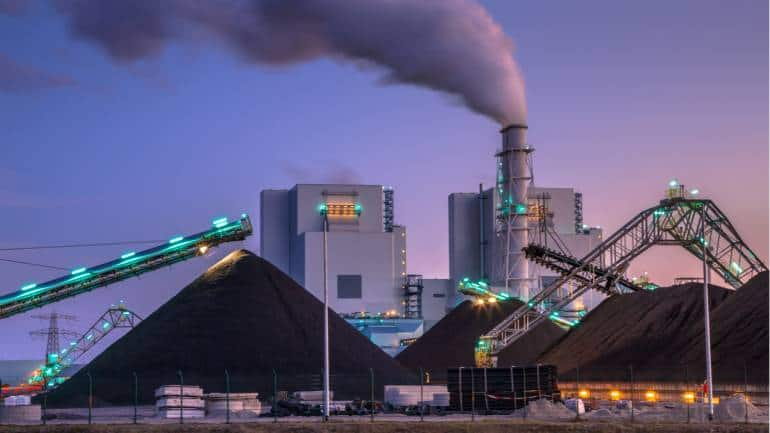 Coal-based power plants account for more than half the SO2 emissions in India: study. (Representational image)
Concern over repeated extensions
“This is the third extension. We will see a decade of relaxations (since the first deadline), which undermines all efforts to improve air quality. The decision is based on an IIT study but basically the power sector is reluctant to implement the norms,” Chandra Bhushan, CEO of the International Forum for Environment, Sustainability & Technology, told Moneycontrol.
“I am not sure if they will be able to meet the norms even with the relaxed deadlines,” Bhushan said, warning that the decision won’t do any good to air quality.
Voicing concern, Nivit Kumar Yadav, programme director (industrial pollution) of the non-profit Centre for Science and Environment (CSE), said it was unfortunate that implementation of the SO2 norms was getting delayed on some pretext or the other. “Last year it was Covid, now something else.”
“Hundreds of thermal plants and other industries are burning thousands of tonnes of coal, releasing a humongous amount of toxic sulphur dioxide into the air,” Yadav told this writer. “You just need common sense to know the ill effects of these toxic emissions.”
Sunil Dahiya, analyst at Centre for Research on Energy and Clean Air (CREA), a think tank, said that the emissions norms were put in place as coal-based power plants are a major contributor to air pollution and resultant mortality.
These extensions show that the interest of polluters prevails more than public health in India, and that needs to stop immediately, Dahiya said.
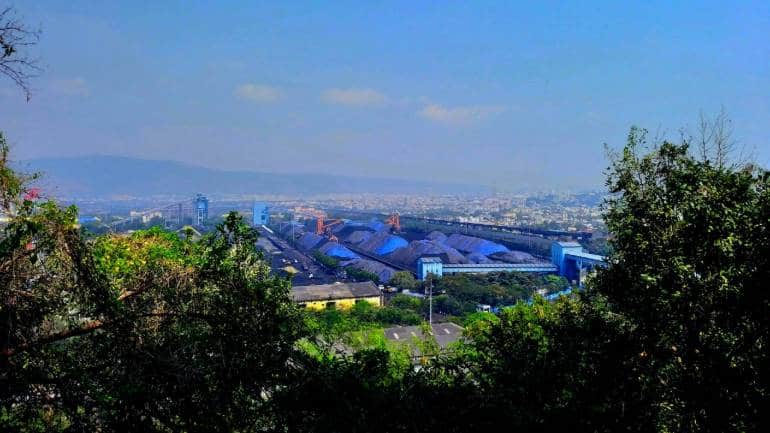 A coal handling terminal. (Image via Unsplash)
Little compliance with norms
Government data analysed by CREA shows that as of August 2022, of India’s total coal power capacity of 211.6 GW, only 85.7 GW or 40 percent had awarded bids to install FGD systems.
The power plants have to invite competitive bids from approved vendors to install FGD systems that meet all the technical requirements specified by the government. A large number of plants are yet to invite bids for the FGD systems, which are expensive - a major reason behind the reluctance.
Of this, only 8.3 GW had installed FGD units. This 8.3 GW includes 6 GW with FGDs installed before the 2015 notification.
If one takes into account the number of units, of the total 600 central, state and private units of coal-based power plants, 190 had awarded bids of which 20 had installed FGD systems, the government data showed.
There are 33 units at 11 coal-based power plants within a 300 km radius of Delhi-NCR, which remains in the grip of toxic air most of the year. One more plant, Goindwal Sahib, is just outside the 300 km radius, with two units.
Of the 35 units, only six have installed FGD or dry sorbent injection (DSI) tech till today since the notification of the emission norms, leaving 29 units without any SO2 controls, the CREA analysis said.
“Five power plants in Delhi-NCR were shut last year during winter because of their impact on pollution and public health, and, ironically, the same stations have been granted extensions after extensions,” Dahiya said.
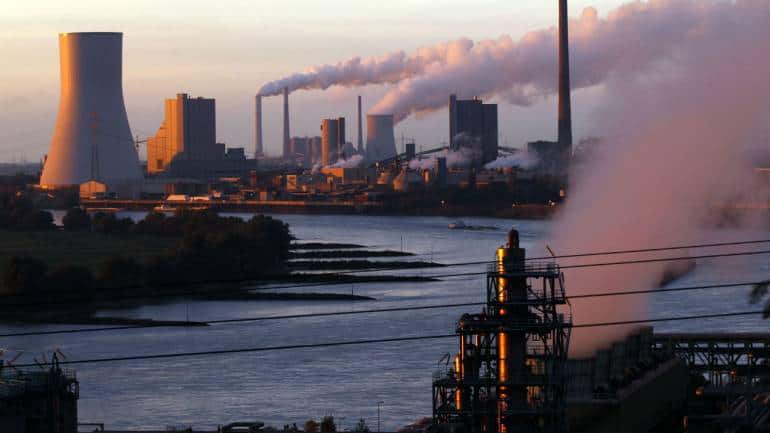 Of the 600 coal-based power plants in India, 20 had installed FGD desulphurization systems. (Image: Reuters)
A health hazard
According to a study by Indian Institute of Technology Delhi’s Centre for Atmospheric Sciences, coal-based thermal power plants account for more than 50 percent SO2, 30 percent NOx and about 20 percent PM emissions in India. Coal-fired thermal plants meet three-fourths of the country’s power needs.
The study, which assesses the compliance of thermal power plants to the SO2 emission norms and lays out a phased plan for FGD implementation, says emissions from these units have had an adverse impact on the environment and human health.
Industrial emissions are known to cause fatal respiratory diseases, acid rain and smog. Various reports have highlighted how sulphur dioxide can have severely deleterious effects on health.
Recent research showed that even a slight increase in sulphur dioxide concentrations in the ambient air affects sensitive groups such as babies, pregnant women and people suffering from asthma or chronic lung diseases. In addition, the pollutants accumulate in the air and are converted to secondary particulate matter, the CSE said.
Yadav said the environment ministry’s decision, in concurrence with the power ministry and CEA, to allow polluting power plants to continue implied that the health of the people and the environment were the least of its concerns.
Expressing similar views, Simi Mehta, CEO and editorial director of Impact and Policy Research Institute (IMPRI), said the extension of the deadlines indicates that public health figures way down in the government’s priority list. “This is the third time that the deadlines have been pushed in the last five years on one pretext or the other.”
Mehta said a coordinated stance of the overlapping mandates of different ministries — power, environment, coal, electricity, etc. — was urgently needed with the clear goal of meeting national ambient air quality standards.
“If this is not urgently done, then Delhi-NCR will continue to remain infamous as a 'gas chamber', as winter sets in and festivities knock at the door,” Mehta told Moneycontrol.
Compensation clause goes for a toss
If the new timeframe to install required equipment to cut sulphur emissions cannot be rolled back, then the polluter pays principle must be put into strict action so that industries remain watchful of their hitherto negligent emissions, Mehta suggested.
The new notification increases the maximum environmental compensation to be levied on non-complying units beyond the deadline from Re 0.20 to Re 0.40 per unit of electricity generated.
Non-compliance up to 180 days beyond the deadline will attract a fine of Re 0.20 per unit of electricity generated during that period; Re 0.30 for 181 to 365 days and; Re 0.40 for 366 days and beyond.
Anubha Aggarwal, programme officer, industrial pollution, CSE, however, said the extensions had rendered the compensation clause into a ‘paper tiger’.
CSE’s analysis showed that if the deadlines had not been extended again, 13 power plants under Category A would have been liable to cumulatively pay a fine of approximately Rs 1.4 crore per day until six months of operation.
But now, these plants can keep polluting for another two years without paying a penalty, CSE said.
Ritwick Dutta, an environmental lawyer and founder of Legal Initiative for Forest and Environment, claimed the extensions show that the norms would never be implemented.
Alleging that the environment ministry had become an advisory ministry rather than a regulatory ministry, Dutta said that rather than taking punitive action against violators, it was succumbing to the diktats of other ministries.
“It is clear that India's national clean air programme target of reduction of air pollution by 30 to 40% by 2024 will never be achieved given the repeated leeway the government is giving violators.” Dutta said, adding that a clear message had gone from the central government to all power companies that they should not take environmental norms seriously.
Discover the latest Business News, Sensex, and Nifty updates. Obtain Personal Finance insights, tax queries, and expert opinions on Moneycontrol or download the Moneycontrol App to stay updated!
Find the best of Al News in one place, specially curated for you every weekend.
Stay on top of the latest tech trends and biggest startup news.