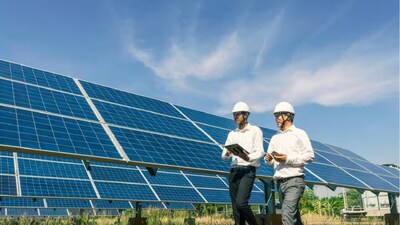
Rise in green energy projects fuels surge in unsigned power purchase deals: Centre
For 2024-25, the discoms had to purchase 29.92 percent renewable power from its total power purchased to supply to end consumers. In 2025-26, this target is set at 33.01 percent

Tata Power to foray into nuclear energy when govt opens up the sector, says CEO Praveer Sinha
Tata Power has set an ambitious target of achieving revenue of at least Rs 1 lakh crore and a profit after tax of Rs 10,000 crore by 2030
COP29 outcome highlights need for reframing climate finance question
Pulling up the Global North for emissions is a normative approach, but getting them to spend is an economic one
2024 will be the hottest year on record, EU scientists say
The previous hottest year on record was 2023
At least 42% households await subsidy under PM Surya Ghar scheme: MNRE data
Gujarat alone has 46 percent (2.9 lakh) of the total (6.34 lakh) rooftop solar installations across the country under the scheme.
Green Finance: Addressing misconceptions and urging immediate action
Green finance is an urgent necessity, not a distant goal. Despite misconceptions, it offers substantial economic and environmental benefits. Financial institutions must embrace comprehensive ESG strategies, assess green opportunities, and collaborate to drive sustainability, ensuring long-term growth and impact
Pollution complaints in Delhi-NCR surged by 33% in 2024: CPCB
The Municipal Corporation of Delhi (MCD) topped the list of complaints, receiving 3,238 grievances in 2024-an almost fourfold increase from 905 last year
Can the world unite to end the plastic pollution crisis?
Plastic production will jump about 60% to 736 million tons a year by 2040, according to the Organization for Economic Co-operation and Development
Consider restarting physical classes in schools, colleges in Delhi-NCR: SC to CAQM
A bench of Justices Abhay S Oka and Augustine George Masih said a large number of students did not have air purifiers at home and therefore there may not be a difference between children at home and those attending schools.
Make the best of the climate finance deal available
India is dissatisfied with the climate finance target set at COP29 in Baku. For sure, it’s inadequate to cope with the scale of the problem, but the Global South shouldn’t spend time and resources on complaining about how the climate finance script didn’t meet their expectations
KBC 16: Contestant Kunwar Nishat Khalid Khan gets teary-eyed as he takes the hot seat; says ‘call from the show came when my daughter was born’
“It took me 25 years to get here," latest contestant of KBC 16 emotions resonated deeply with host Amitabh Bachchan.
India drops two places but remains among top 10 climate performers: CCPI report
India's per capita emissions stand at 2.9 tons of CO2 equivalent (tCO2e), far below the global average of 6.6 tCO2e.
Is a new centralised carbon market under the UN the real deal?
COP29 has already recorded a success by getting countries to agree on strong standards for a centralised carbon market under the UN. Creation of this market has its usual share of costs and benefits. The big issue, however, remain unresolved. Will it deliver on global emission reduction or just be another distraction?
New climate finance goal must be based on climate justice: India at COP29
Delivering India's national statement at the UN climate conference in Baku, Union Minister of State for Environment Kirti Vardhan Singh also criticised the restrictive trade measures imposed by some developed nations.
India’s Green Hydrogen Revolution: Building an ecosystem for a sustainable future
India aims to decarbonize hard-to-abate sectors like steelmaking and oil refining by developing a green hydrogen ecosystem. Policy reforms, enhanced manufacturing, and demand-side interventions, along with infrastructure investments, can make India a global leader in green hydrogen, reducing carbon emissions and fossil fuel dependency
How does one crack the carbon tax conundrum?
India and China voiced protest over CBAM at the ongoing COP29, but Europe says it’s a trade matter that needs to be discussed at the WTO
Climate change poses severe threat to Kashmir’s cash crops
Kashmir's saffron and apple industries are severely impacted by climate change, with rainfall deficits and rising temperatures affecting crop yields and quality. The loss in the region is estimated in billions of rupees
COP29: Time to shift gears on climate change with carbon removal
COP29 must focus on carbon removal, not just emission reduction, to combat climate change. The current pace of mitigation is insufficient, and carbon removal technologies can achieve net negative emissions, making it a more urgent, effective, and fair strategy
Ramachandra Guha: History doesn't have to be about kings & winners, it can be about the losers who had the right idea all along
From Rabindranath Tagore's engagement with nature at Santiniketan to JC Kumarappa's rural renewal, and from Patrick Geddes' neotechnic cities to Union Minister KM Munshi's Vana Mahotsava—Ramachandra Guha gives brief biographies of 10 people who thought about different aspects of human-nature interactions in India.
Is COP29 a Trojan Horse?
Since 1850, developed nations journeyed their way to prosperity through carbon emissions. They now account for more than 76 percent of cumulative CO2 emissions. To expect emerging economies like India to bear a disproportionate share of energy transition in the name of fighting climate change is unfair. It does lead to the question if climate summits are a covert way to main economic hegemony
Climate concern — Is COP29 doomed from the start?
Trump’s re-election and absence of heavyweight world leaders at the Baku climate summit do not hold out hope for concrete action
Can COP29 walk the talk on climate commitment?
The Baku summit should focus on actions to ensure that emissions don’t spiral out of control
Climate set to warm by 3.1 C without greater action, UN report warns
Current climate policies will result in global warming of more than 3 degrees Celsius (5.4 degrees Fahrenheit) by the end of the century, according to a United Nations report
Delhi hospitals report 30-40% spike in respiratory cases as city grapples with rising pollution
Health experts have advised people to avoid stepping outside and minimise exposure to dust.
Why India can’t stop adding new coal-based power plants
As COP29 approaches, India faces pressure to phase out coal amid rising emissions. While committed to renewable energy, challenges include integration costs and affordability. To aid India’s decarbonisation, developed countries should provide concessional financing