




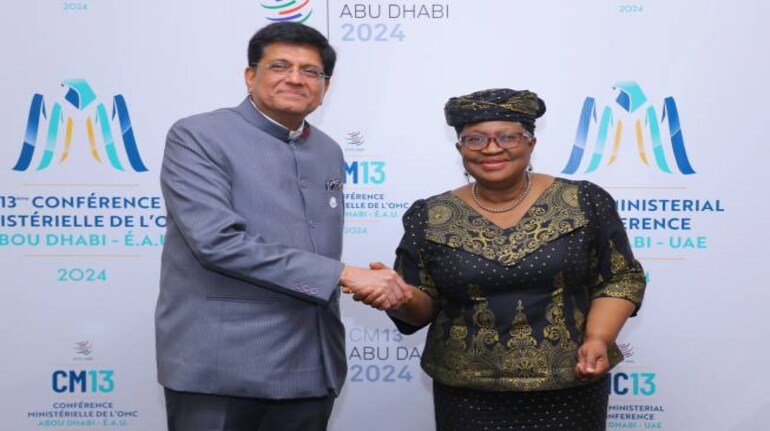
After more than five days of fierce negotiations among some 4,000 ministers, senior trade officials, and delegates from the World Trade Organization's 164 members and observers, the WTO's 13th Ministerial Conference (MC13) in Abu Dhabi ended in the wee hours of March 2 without a consensus on key issues, including the Agreement on Fisheries Subsidies and public stockholding (PSH) for food security.
Differences remained on PSH concerning timelines, expected outcomes, and the flexibility to be provided on export restrictions for food imports by the most vulnerable countries.
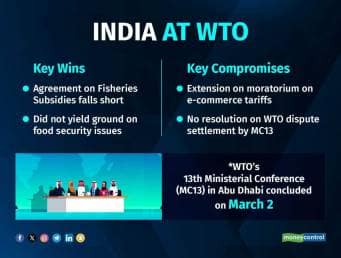
Regarding the Agreement on Fisheries Subsidies, though South Africa's nod at the closing session put the number of formal acceptances from member nations at 71, it is still short of 39 countries. For the agreement to become operational, two-thirds of members have to deposit their “instruments of acceptance” with the WTO.
"In the second wave of fisheries subsidies negotiations, you narrowed some outstanding gaps, but several more remain," said WTO's Director-General Ngozi Okonjo-Iweala. "While I had hoped that we could finish these negotiations in Abu Dhabi, you have prepared the ground for its conclusion at the next ministerial conference, if not earlier. The livelihoods of 260 million people, who depend directly or indirectly on marine fisheries, are at stake," she added.
The fate of discussions on farm issues at the WTO also continues to hang in balance. Okonjo-Iweala recalled that this has been in the works for over two decades. "At MC12, we couldn’t even agree on a text. Even though there are challenges, for the first time we have a text. We couldn’t finish the work on it here. So let us get back to Geneva and deliver!" she said at the closing session of MC13.
India's stand
New Delhi's stance on both these issues has remained the same for many years. On fisheries subsidies, India has continued to bat for a permanent carve-out for nations that practise low-income fishing in a bid to protect the livelihoods of poor fishermen, while on PSH, the country has been seeking a permanent solution.
At MC13, New Delhi again urged WTO members to introduce a moratorium on subsidies by Distant Water Fishing Nations for fishing or fishing-related activities beyond their Exclusive Economic Zones (EEZs) for at least 25 years. India said that members should not lose sight of the harmful effects of subsidies for large-scale fishing on sustainable fishing, and management of marine resources.
Adopted by consensus at the WTO's 12th Ministerial Conference (MC12) held in Geneva from June 12-17, 2022, the Agreement on Fisheries Subsidies aims to curb harmful subsidies, which are seen as a key factor in the widespread depletion of the world's fish stocks. In addition, the agreement recognises the needs of developing and least-developed countries and provides for the establishment of a fund to provide technical assistance and build capacity, to help them implement their obligations.
India has not become a part of the agreement in line with its long-standing position that developing countries and small economies should be free to provide subsidies for the fisheries sector.
On food security, India pushed for better terms than the 2013 Bali peace clause, whereby developing countries were allowed to provide subsidies under public stockholding programmes. A public stockholding programme is a policy tool used by governments to meet food security needs.
While certain WTO members have expressed concerns over India's minimum support price (MSP) scheme for key agricultural products, and export restrictions on commodities such as rice, New Delhi maintains that the country has to protect the interests of the poor and vulnerable farmers, and take care of its domestic food security needs.
India's stated position has been that the country would be willing to discuss issues around export bans only if member nations holistically address the matter of PSH for food security, and the support provided for the same in all shapes and sizes. However, some countries, like the United States, had indicated before the ministerial conference that an agreement on this may not be possible at MC13.
"We were disappointed with the lack of breakthroughs in other areas. The European Union (EU) engaged intensively on fisheries subsidies, agriculture, and WTO reform. Agreements were within reach, supported by a big majority, but ultimately blocked by a handful of countries — sometimes just one," European Trade Commissioner Valdis Dombrovskis said on X (formerly Twitter) on March 2.
While the EU was disappointed about the absence of a breakthrough on these crucial issues, India's Commerce Minister Piyush Goyal was satisfied with the outcome, rather, the lack of it.
"We have not lost out on anything. I go back happy and satisfied," Goyal reportedly said as talks started to wind down on March 1, and added, ``India successfully pushed the food security issue and the country did not yield any ground on protecting the interests of poor farmers and fishermen, as well as on other issues."
But the lack of a permanent solution on food security, a key demand from India, continues to be a hurdle for New Delhi.
The resolutions
The conference did witness several ministerial decisions, including renewing the commitment to have a well-functioning dispute settlement system by 2024 and to improve the use of the special and differential treatment (S&DT) provisions for developing and least developed countries (LDCs).
The Abu Dhabi Ministerial Declaration adopted a decision to review the S&DT provisions for developing and least developed countries to make them more precise, effective, and operational. "This is a win for development, one that will help enable developing countries, especially LDCs, fulfill their WTO commitments, exercise their rights, and better integrate with global trade," said Okonjo-Iweala.
MC13 also saw new regulations on services, which are expected to lower trade costs by over $125 billion worldwide, come into force. Supported by 72 WTO members, this joint initiative is designed to facilitate services trade by streamlining and simplifying regulatory procedures. It includes the first-ever commitment in a WTO agreement ensuring non-discrimination between men and women when they seek permits to supply services.
As many as 123 member nations agreed to the finalisation of the China-led Investment Facilitation for Development (IFD) Agreement, which looks to improve the investment and business climate by making it easier to invest, conduct business activities, and expand operations. But, countries like India and South Africa objected to this deal, citing that this matter is outside the mandate of the WTO.
Perhaps the biggest breakthrough for WTO is an agreement to maintain the current practice of not imposing customs duties on electronic transmissions until the 14th Ministerial Conference (MC14), or 31 March 2026, whichever is earlier. The moratorium will expire on that date.
India was initially pushing for an end to the moratorium on levying customs duties on digital goods, citing that it unfairly benefits a few developed nations. The decision to extend the moratorium on imposing tariffs on digital goods has not gone India's way.
"We wish to put on record that the current moratorium on custom duties on electronic transfers is against the interests of developing countries in general, and India in particular. This is not only impacting job creation in the electronics sector but also revenue generation. Therefore, we strongly recommend that the WTO works towards ending this moratorium on imposing custom duty on e-transmission," said Ashwini Mahajan, National Co-convenor of Swadeshi Jagran Manch on X (formerly Twitter) on March 1.
Other than all the above, the MC13 also admitted two new members — Comoros and Timor-Leste.
However, despite a few compromises, the absence of a consensus on farm and fisheries is a relief for a country like India that provides subsidies to the poor, including free food grain to around 81 crore unprivileged citizens.
As Goyal told reporters after an end to a gruelling ministerial conference in the United Arab Emirates' (UAE's) capital city, "We maintain full control over supporting them (poor fishers and farmers) without any restrictions."
Discover the latest Business News, Sensex, and Nifty updates. Obtain Personal Finance insights, tax queries, and expert opinions on Moneycontrol or download the Moneycontrol App to stay updated!
Find the best of Al News in one place, specially curated for you every weekend.
Stay on top of the latest tech trends and biggest startup news.