




Last week, FICCI organised a webinar to look at cargo corridor potential between India and the Central Asian republics. Since the republics became independent in 1991 after the fall of Soviet Union, every government in the country has tried to have an outreach with the five “stans”.
While some of the ambitious projects like TAPI (Turkmenistan-Afghanistan-Pakistan-India) pipeline haven’t taken off, trade and lately tourism has zoomed upwards. In this context, comments by the chief strategy and revenue officer of IndiGo were also widely reported with the hope that India’s largest airline could potentially explore flights to Central Asia when things normalize.
While India has direct connectivity to all five republics—Kazakhstan, Uzbekistan, Tajikistan, Turkmenistan and Kyrgyzstan—it is a shame that it is all driven by carriers from those countries. Indian carriers have been reluctant to venture into any of these countries.
The recent repatriation flights shed light on what they have been missing. Air India, SpiceJet and IndiGo, which fly to some points in these countries, raised eyebrows when a large number of students, workers and white-collar workers were repatriated from places beyond the capital cities.
Current Connectivity
Kazakh airline Air Astana started operations to India in 2004 and has come a long way investing in the network over the years. In the early days, Air Astana, Uzbekistan Airways and Turkmenistan Airlines were looked at cheaper flight options from North India in general and Punjab in particular. Tajikistan-based Somon Air launched non-stop flights between capital Dushanbe and New Delhi in December 2019 while Avia Traffic Company operated flights between Bishkek, the capital of Kyrgyzstan, and New Delhi.
Air Astana announced services to Mumbai while Uzbekistan Airways had already launched services until COVID-19 struck the aviation market. The last two years have not been particularly great for the connectivity since 2019 saw disruption due to airspace closure by Pakistan. Indian carriers currently operate charters and few flights under Vande Bharat Mission and Air Astana and Uzbekistan Airways are operating cargo-only flights to India.
Pre-COVID-19, Uzbekistan Airways and Air Astana had become carriers of choice for students, business traffic and tourists to Central Asian as well as travellers to parts of Russia and the erstwhile USSR due to its extensive network.
Not just transit!
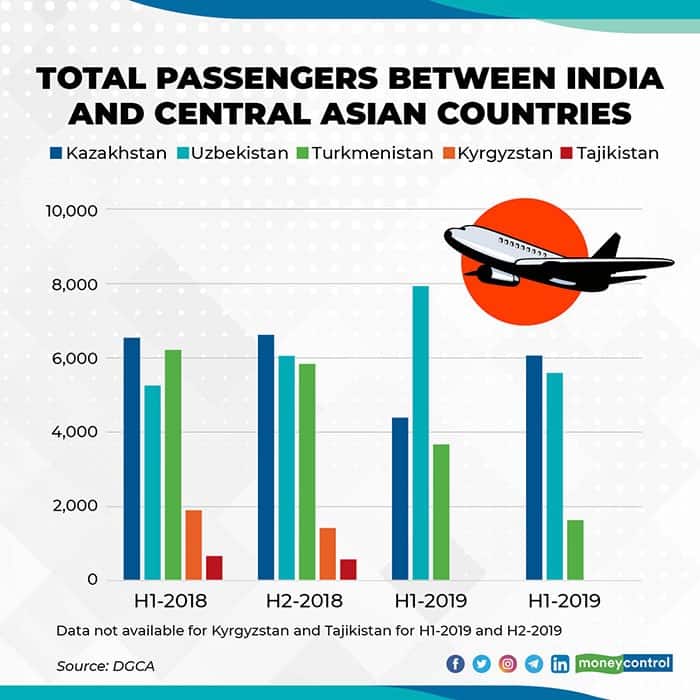
Starting with a popular and cheaper transit point, growing trade and tourism have seen an increase in flight frequencies as well as capacity on the routes—primarily to Kazakhstan and Uzbekistan.
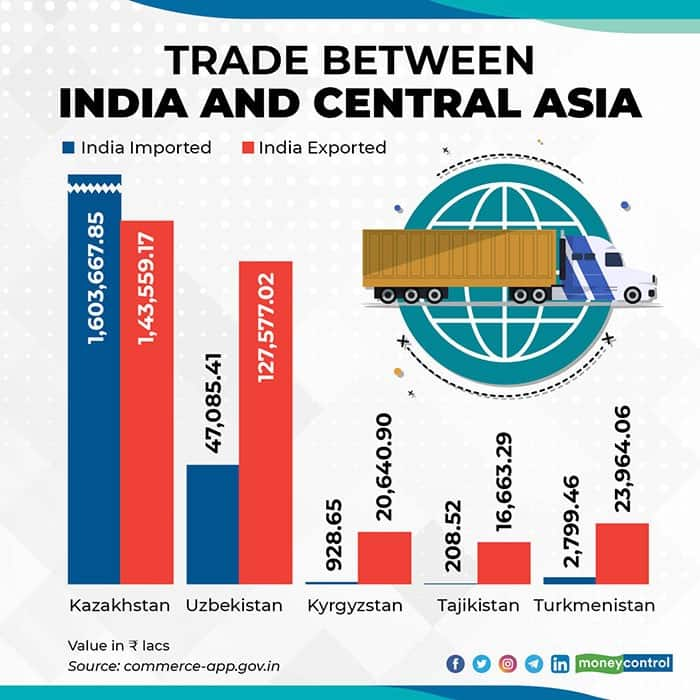
The trade template remains the same though. Pharma, textiles, spices, tea, coffee and machinery are exported. But pharmaceutical products are the mainstay. The significant imports are mineral oil, pearls and Silk. In addition to this, the traffic between some of these cities and New Delhi is fuelled by medical tourism.
A significant number of Indian students and Indian community is present in Kyrgyzstan and Kazakhstan.
The Central Asian republics were considered too restrictive for comfort. As Kazakhstan and Uzbekistan opened up for tourism, it coincided with Indians becoming more adventurous and having a sizable disposal income. This led to a considerable increase in tourism. While the numbers were still small as compared to other places, the growth was rapid. Pristine and unique destinations closer home at affordable rates became attractive. The cherry on the top was transit holidays which Air Astana launched. Not only did it help the airline grow over 25 percent year-on-year it also increased frequencies, added capacity and connected another destination!
What will it take for Indian carriers and where could they go?
The biggest advantage for any carrier which would fly to the Central Asian republics is cargo —specifically pharma exports. With all five countries landlocked, there is little scope for alternative transport and thus air cargo has higher opportunity than other geographies. The mountainous regions across these countries or unstable countries at its border also make air cargo the only option in most cases.
An effective hub at New Delhi to carry passengers and cargo onwards to South East Asia and Maldives, which is a large market for perishable produce, will further the cause of any carrier willing to start the service.
While Turkmenistan is the weakest link, Kazakhstan and Uzbekistan are the strongest. Data indicates that Indian LCCs can sustain operations to Almaty and Tashkent.
Who would be the first mover? With 250+ aircraft in the fleet, will IndiGo take the lead or will it be SpiceJet with its penchant for Blue Oceans strategy?
(Ameya Joshi runs the aviation blog Network Thoughts)
Discover the latest Business News, Sensex, and Nifty updates. Obtain Personal Finance insights, tax queries, and expert opinions on Moneycontrol or download the Moneycontrol App to stay updated!
Find the best of Al News in one place, specially curated for you every weekend.
Stay on top of the latest tech trends and biggest startup news.