
India is showing signs of yet another surge in COVID-19 cases and active infections, potentially due to Omicron subvariants BA.4 and BA.5, whose presence in the country was recently confirmed by the genomic surveillance programme for coronavirus.
This time, according to officials in the Union health ministry and the Indian Council for Medical Research, the cases being reported are mostly breakthrough infections (COVID-19 disease in those covered with full vaccination) and also involve a lot of people who have received their booster shots.
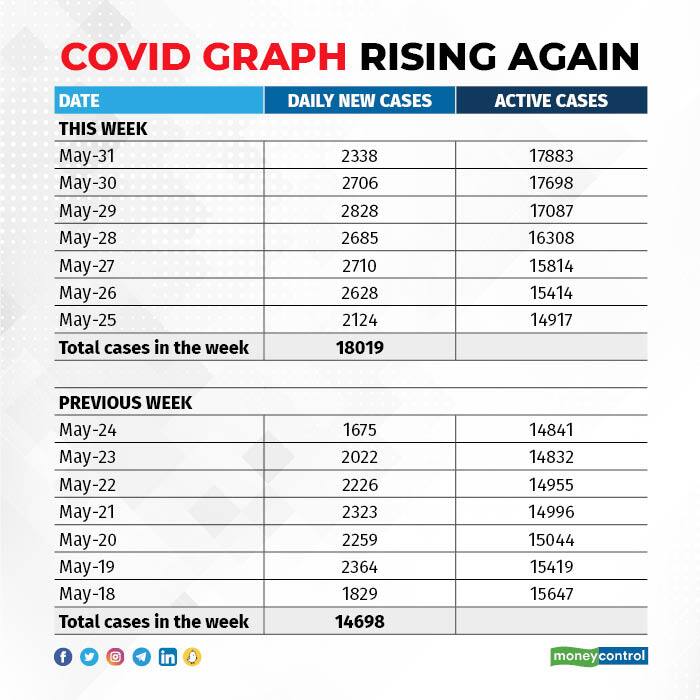
On Tuesday, a total of 2,338 cases were confirmed in the country while active infections rose to 17,883.
This is the 8th day in a row that India has registered over 2,000 cases in a 24-hour period. Active cases have risen for the ninth consecutive day.
Over the last week 18,019 new cases have been reported in the country, with the total number of cases rising 20.3 percent higher over the previous week.
The daily test positivity rate, which was 0.42 percent on May 18, has doubled over the last two weeks but still remains under 1 percent.
The surge assumes significance and underlines the need to closely monitor emerging clusters of coronavirus cases and hospitalisation patterns, officials in the Union health ministry said.
Only last week, a bulletin released by the Indian SARS-CoV-2 Genomics Consortium (INSACOG) said that a 19-year-old female in Tamil Nadu, without any travel history, was found to have been infected with the BA.4 variant of SARS-CoV-2. Before this case, a South African traveller was found to be positive for the BA.4 variant on arrival at Hyderabad airport.
According to the bulletin, a man in Telangana, also with no travel history and fully vaccinated, was found infected with the BA.5 Omicron strain.
This bulletin confirmed that the BA.4 and BA.5 variants of Omicron were already in community transmission in India.
BA.4 and BA.5 subvariants elsewhereBoth the BA.4 and BA.5 strains were detected in South Africa in January for the first time and triggered a fifth COVID-19 wave in that country. Later they were reported from various countries across the world.
Scientists say that these Omicron subvariants share many of the same mutations as the original Omicron variant of the SARS CoV 2 virus but have more in common with the BA.2 subvariant, which had dominated India’s third coronavirus wave this January.
Also read I Medicines take lion’s share of personal healthcare spending in India, study finds
They also possess various additional mutations, some of which could change their characteristics. The two sub-variants are often discussed together because the mutations in their spike protein gene are identical, even though they differ from mutations found elsewhere.
There is, however, no evidence yet that these strains are more capable of causing severe COVID-19 disease than other Omicron sub lineages.
‘Need to stay cautious’Experts stressed that even though the current surge may be at a comparatively low level, it was important for people to stick to COVID-19 appropriate behaviour.
Dr Viswesvaran Balasubramanian, consultant (interventional pulmonology and sleep medicine) with Yashoda hospitals in Hyderabad, said that reported cases of COVID 19 infections in India secondary to omicron subvariants BA.4 and BA.5 have raised serious concerns about another surge.
“The surge may be a realistic possibility due to waning immunity from past infection and prior vaccination status or enhanced transmissibility of these mutant variants. Both BA.4 and BA.5 harbour mutations in their spike protein gene that facilitate the entry of viruses into cells,” he said.
According to Balasubramanian, these subvariants also carry the L452R mutation, as in prior Delta variants, and this may increase their ability to evade immune response.
So, ensuring booster doses of vaccination, adherence to norms such as physical distancing, hand hygiene and appropriate use of masks, especially among those with increased susceptibility to serious forms of COVID 19 infection (such as the elderly or those with low immune status) should be emphasised, he said.
Early identification of symptoms, self-quarantine and preliminary home testing can help in curbing the transmission.
Some other experts are more hopeful.
Gautam Menon, a biophysicist with Ashoka University, pointed out that thanks to recent studies, it is known that the BA.4 and the BA.5 variants are more transmissible and more immune evasive than the other subvariant that is currently widespread (BA.2.12.1).
Also read I Guidelines meant to stop cross pathy by doctors stir a hornet’s nest
This can be expected to drive a rise in cases, he said. However, given that most of the population has been vaccinated or has sustained a prior infection or both, the consequences, on average, might be mild, he added.
“It is likely that we will not see a strong surge in detected cases or in hospitalisations, given this,” Menon said.

Discover the latest Business News, Sensex, and Nifty updates. Obtain Personal Finance insights, tax queries, and expert opinions on Moneycontrol or download the Moneycontrol App to stay updated!
Find the best of Al News in one place, specially curated for you every weekend.
Stay on top of the latest tech trends and biggest startup news.