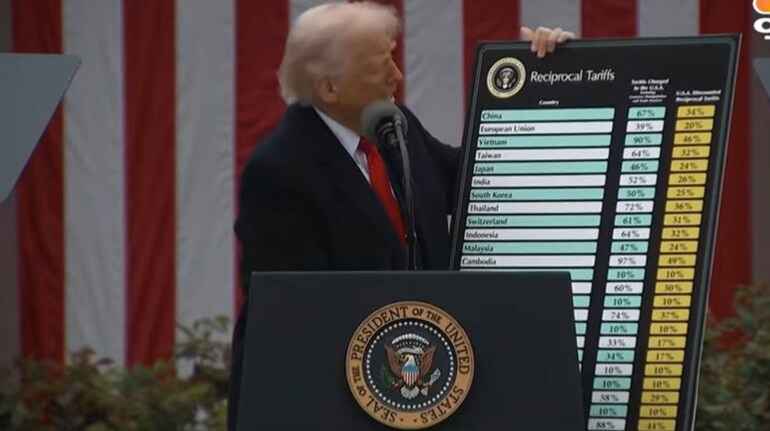
US President Donald Trump on Wednesday announced a 25% tariff on vehicles not assembled in the US, effective April 3. This new tariff will apply to all cars made outside the U.S., including those built in Canada and Mexico, likely leading to significant price increases.
Even foreign-made components used in vehicles assembled domestically will be subject to these tariffs, complicating the supply chain for many automakers. While some brands will experience minimal effects, others will be heavily impacted.
How these tariffs will affect car manufacturers worldwide.Tesla and Honda are well-positioned to weather the impact due to their high levels of U.S. production. Tesla’s Model 3 Performance (87.5% domestic content) and Model Y (85%) lead the charge, while Honda boasts 63% total domestic content, surpassing American manufacturers like Ford and GM.
The Honda Passport stands out with 76.5% domestic content, according to the 2024 American-made index from the Kogod School of Business.
Other brands with significant domestic content, like Jeep, Volkswagen, and General Motors, will also be impacted, with the Jeep Wrangler at 76% and Volkswagen’s ID.4 electric SUV and GM’s Chevrolet Colorado and GMC Canyon close behind at around 75.5%.
Interestingly, dealers—who primarily profit from vehicle repairs—are expected to be less affected by the price hikes, as automakers are likely to absorb the higher vehicle costs, rather than dealers.
Automakers most vulnerable to the tariffs.Leading European and Japanese automakers with substantial U.S. exports will take the hardest hit. In 2024, cars made up 28.3% of Japan’s total exports to the U.S., making Japanese automakers particularly susceptible.
Stocks for major Japanese automakers, including Nissan, Toyota, and Honda, dropped 2.2%, 2.7%, and 3.0%, respectively, following Trump’s announcement. South Korean automakers Hyundai and Kia also felt the pressure, with their stocks dipping by 4.0%.
Over a dozen global automakers with European ties—such as GM, Mercedes-Benz, BMW, Hyundai, and Toyota—operate nearly 40 plants in Mexico.
In 2024, Mexico exported nearly three million vehicles and provided 40% of U.S. auto parts, employing 2 million people in the industry and generating $200 billion in exports.
It’s not just European and Japanese automakers that are at risk. Companies manufacturing vehicles in the U.S. for global markets are also bracing for the impact of retaliatory tariffs. Ford, GM, Toyota, BMW, Honda, Mercedes, and even Tesla could be affected as trade tensions escalate.
The rising tariff costs may also reduce R&D budgets, making it harder for automakers to compete with China’s rapidly advancing auto industry.
On Monday, Trump posted a list on social media of companies expected to invest trillions of dollars in the U.S. and create thousands of jobs, including car manufacturers like Honda, Nissan, and Hyundai, which he claimed were planning to shift production to the U.S.
Meanwhile, Ford, General Motors, and Stellantis are lobbying for exemptions on specific low-cost car parts from the new tariffs, with executives reportedly meeting with White House, Commerce Department, and U.S. Trade Representative officials.
Although these talks remain private, automakers are also stockpiling vehicles in the U.S. as consumers rush to buy cars before the tariffs take effect. The full impact of this surge will become clearer with the release of first-quarter sales reports.
Detroit’s automakers are prepared to pay tariffs on finished vehicles and major components. However, they warn that tariffs on parts could cost billions, lead to layoffs, and undermine Trump’s objective of boosting the industry. With the deadline fast approaching, top automaker executives are converging on Washington, pushing for relief from the impending tariffs.
Discover the latest Business News, Sensex, and Nifty updates. Obtain Personal Finance insights, tax queries, and expert opinions on Moneycontrol or download the Moneycontrol App to stay updated!
Find the best of Al News in one place, specially curated for you every weekend.
Stay on top of the latest tech trends and biggest startup news.