






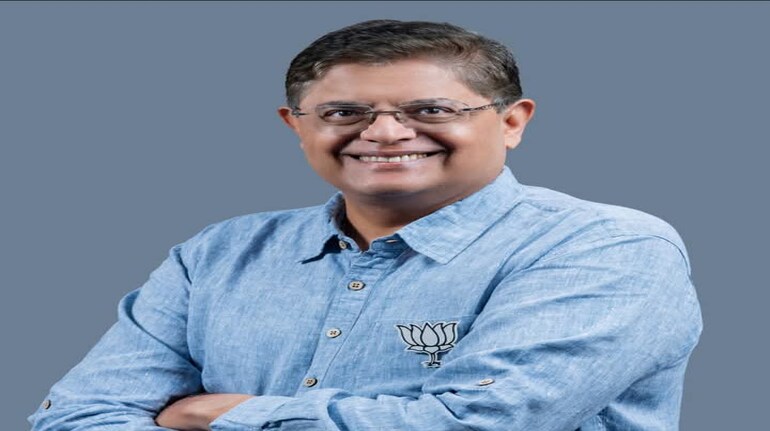

The revamped insolvency and bankruptcy code is a "reboot" of the insolvency ecosystem, which will help to dramatically reduce the time taken to conclude the resolution process, and enhance recoveries for the creditors – to the extent of doubling it, Baijayant Panda, chairperson of the Parliament’s Select Committee on IBC told Moneycontrol on Wednesday.
In an exclusive interview, Panda said that in the new Act, the timelines are "strictly-spelled" for each stage of the resolution process. "In the last three-four years, on an annual basis, Rs 50,000-60,000 crore was being recovered by banks from bad assets, in which IBC played a big role. My guess is, this figure can double, once the amended IBC law is enacted."
Panda chaired the 24-member Select Committee of the Parliament--formed in October 2025--which examined 68 amendments introduced in the Principle Act of 2016, through the new Bill – introduced in the Parliament on August 12, 2025.
The most crucial suggestion of the Committee was to impose a three-month timeline on the National Company Law Appellate Tribunal (NCLAT) for disposing of IBC-appeals. At present, no timeline for NCLAT exists. The Committee in its report said that the "effectiveness of the Code rests on a strict time-bound framework, the Committee therefore emphasize that undue appellate delays risk undermining the efficiency and certainty of the insolvency resolution process."
The Insolvency and Bankruptcy Code (IBC) prescribes a 330-day timeline for the conclusion of the entire corporate insolvency resolution process (CIRP) – which ends with approval of the resolution plan by the National Company Law Tribunal (NCLT).
However, according to Insolvency and Bankruptcy Board of India’s (IBBI) newsletter, as of March 2025, the average time taken for approval of resolution plan by the NCLT was 717 days – way more than the 330-day timeline prescribed in the Code.
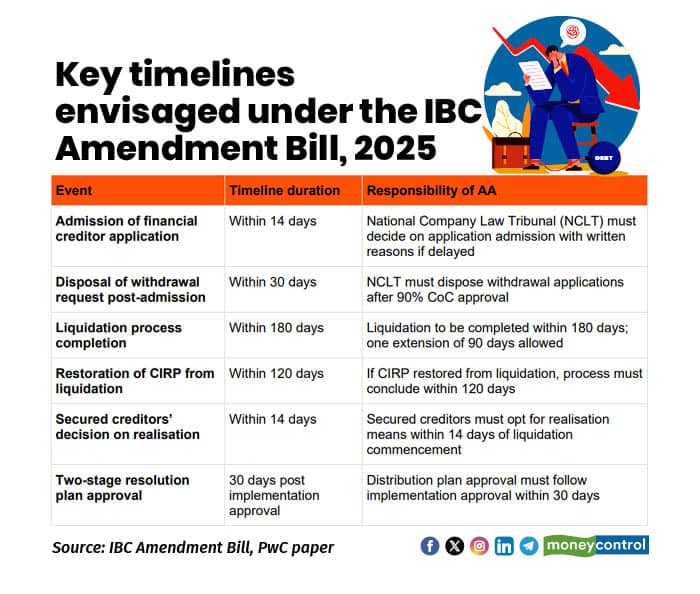
To address, the new IBC Bill has imposed timelines in "stages", said Panda. According to provisions of the new bill, the NCLT should decide on the application of admitting a case for resolution process within 14 days. Any withdrawal application for the resolution process must be decided within 30 days. And post acceptance, the liquidation process must be concluded in 180 days. In case, the resolution plan is restored in place of liquidation, that process should conclude in 120 days (see chart).
Panda said that the single biggest issue the Committee had to deal with was timelines. "The general consensus was that IBC is doing a great job – with respect to resolution and recoveries--but it is taking longer than envisaged for the process to conclude."
Clean-state principle
The other aspect that the Committee looked into was the "clean-state principle". Panda noted that the Committee has reiterated that it is a fundamental tenet of the IBC, and should not be violated by any entity – including government agencies.
The clean slate principle is a judicially recognized doctrine which ensures that once a company (Corporate Debtor) is successfully sold or revived through a resolution plan, the new owner starts with a completely "fresh slate". This means the new management cannot be burdened with any "surprise liabilities" or claims that originated before the takeover, but were not included in the final approved plan.
"Unfortunately, it has been seen that many claimants, including government agencies, keep seeking their due even after the resolution plan has been approved. The Supreme Court of India and other courts have ruled many times in favour of the clean slate principle…but we have seen it has not been followed," Panda noted.
"We have made an attempt to clarify this ambiguity in our suggestions," he said.
Operational creditors
On the aspect of operational creditors not getting adequate dues from liquidation, the Member of the Parliament said that "nowhere in the world there’s any special arrangement for operational creditors".
"If they want their dues back. They have other avenues, such as SARFAESI Act or Debt Recovery Tribunals. It’s important to understand that long-term secured debt can’t be equated with unsecured business advances. When banks fund a project for a 10-15 year period, they take a certain risk. It’s a loan, it’s treated differently than a business advance – which OCs give," he explained.
"The Committee has not changed anything in the waterfall mechanism. The IBC has to do with insolvency and bankruptcy of the companies, and not with debt recovery. Debt recovery is happening as a by-product of the process. Primary purpose is resolution of the company, or else, liquidation," said Panda.
Discover the latest Business News, Sensex, and Nifty updates. Obtain Personal Finance insights, tax queries, and expert opinions on Moneycontrol or download the Moneycontrol App to stay updated!
Find the best of Al News in one place, specially curated for you every weekend.
Stay on top of the latest tech trends and biggest startup news.





