







Funding into artificial intelligence (AI) startups in India has picked up, with investors allocating more capital to the sector. At least 16 venture capital funds are now exclusively backing AI firms or have identified AI as a key focus area that will attract a disproportionate share of their capital.
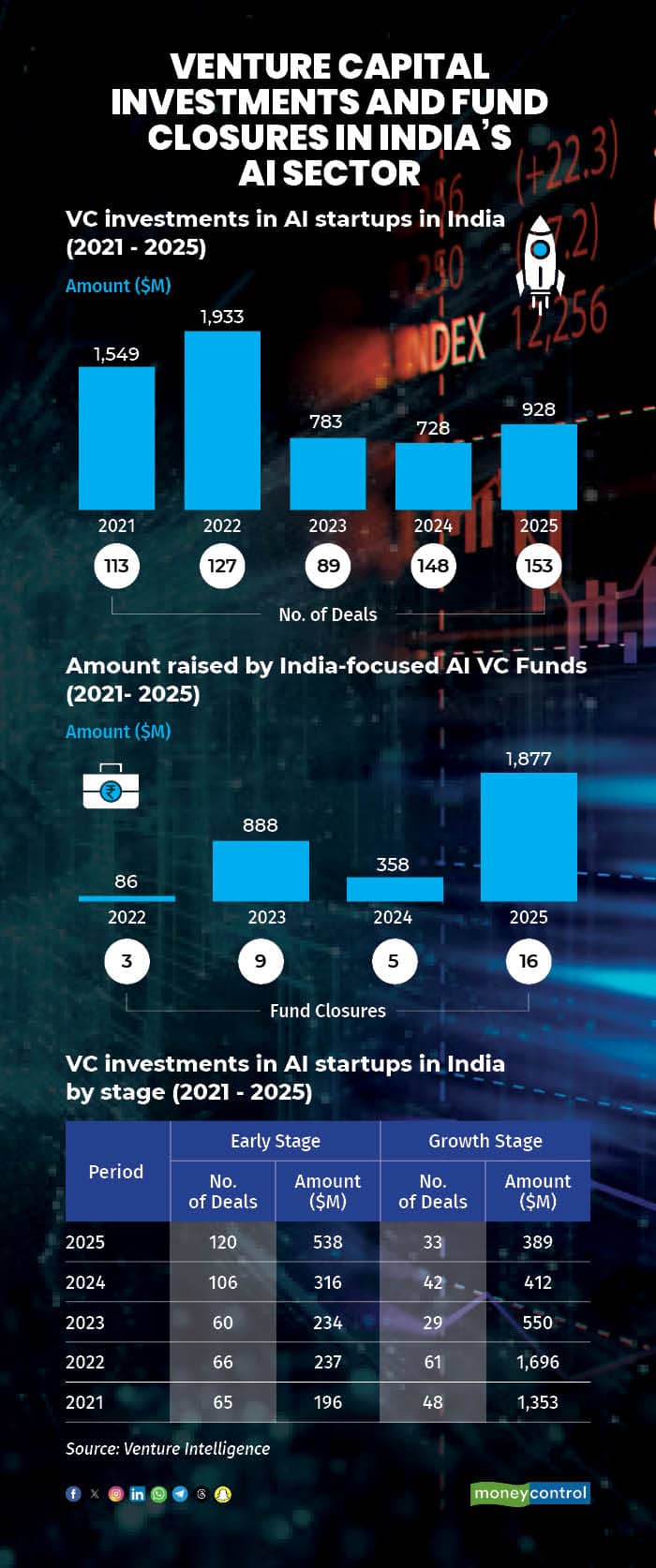
In 2025, 16 AI-focused venture capital funds closed their fundraise and secured a total of $1.87 billion compared with just five funds that raised $358 million in 2024, expanding the total capital pool for the sector, according to data Moneycontrol sourced from Venture Intelligence (VI), a private market intelligence platform.
These funds span both large, multi-sector venture firms and standalone vehicles built around the AI opportunity. Venture firms such as Bessemer Venture Partners, Nexus Venture Partners, Accel, Lightspeed Venture Partners and Stellaris Venture Partners, among several others, have launched funds this year with AI as a key investment theme. In addition, AI-focused vehicles have emerged, including Aakrit Vaish’s Activate, Natasha Malpani’s Boundless Ventures, and more, as per VI data.
An increase in fund-level activity has resulted, and also coincided, with a rise in startup funding. AI startups in India raised a total of $928 million across 153 deals in 2025, up 27 percent year-on-year from $728 million across 148 deals in the previous year, VI data showed.
Investors told Moneycontrol that activity is accelerating as AI becomes central to how new products and businesses are built. This shift is prompting investors to back companies earlier in their lifecycle and raise dedicated capital ahead of the emergence of clear market leaders.
“What’s really happening is that AI is becoming the default lens through which companies are built. Even companies that aren’t positioned as ‘AI-only’ still have deep AI at the core,” said Krishna Mehra, AI Partner at Elevation Capital.
"If you look at what’s getting built today, a lot of new companies are inherently AI-native. So the share of AI-only or AI-first companies is naturally going up," he added.
Early-stage deals dominate the funding mix
This shift in investor behaviour is reflected in where capital is being deployed. AI funding activity remains heavily concentrated at the early stage.
According to VI data, seed-to-series A rounds accounted for nearly 80 percent of all AI deals in 2025, up from just over 70 percent a year earlier, while growth-stage transactions remained limited.
In value terms, early-stage AI funding rose as much as 70 percent to $538 million in 2025 from $316 million in 2024, accounting for the bulk of capital deployed into the sector.
The early-stage skew is also reflected in the volume of companies currently in the fundraising pipeline. Moneycontrol reported earlier that over a dozen AI startups, including Claim Health, Cubic, Theta Software, Cua, Coinvent AI, ScalarField, Sookti AI and Synth Bio, are in talks to raise seed rounds from investors such as Peak XV Partners and Elevation Capital, as venture firms step up early-stage deployment.
Mehra said the rise in early-stage activity is being driven more by the scale of the opportunity than by the maturity of companies. “Because of the promise of AI, there’s much more white space today than five years ago,” he said. “That’s driving early-stage activity.”
And rightly so. Investors who come in at later stages, around Series B or so, are waiting on the sidelines before deploying capital into AI-first companies.
“We typically invest in companies that are in the $15-20 million revenue range and those opportunities are largely absent in the Indian startup ecosystem currently,” Navin Honagudi, Founder and Managing Partner at Elev8 Venture Partners had told Moneycontrol in an interview earlier when asked why late-stage activity in AI is yet to pick up.
What kinds of AI businesses are attracting capital?
The early-stage skew is also shaping the kinds of businesses drawing investor interest, with venture firms backing a mix of AI-led services and AI-native products rather than standalone tools.
Naman Lahoty, partner at early-stage investment firm Stellaris Venture Partners, said the firm is seeing strong momentum in AI-led services, particularly in areas where accuracy and reliability are critical.
“We’re seeing a wave of startups building AI-led services in categories where accuracy is critical. Here, AI significantly enhances productivity but is paired with human expertise to deliver consistently high-quality outcomes,” he said.
Alongside this, Lahoty said Stellaris is also backing AI-native companies where the technology sits at the centre of the product. “We’re also seeing AI applications reimagine solutions for both existing and new problems, with AI at the core,” he said.
That conviction is reflected in how the firm is allocating capital. Stellaris’ recent $300 million Fund III has earmarked around half its corpus for AI bets.
Even for large global funds, operating in India, AI is taking centre stage.
At the later end of the capital curve, growth-stage investors are tracking a narrower set of AI opportunities. Sumer Juneja, Managing Partner at Softbank Investment Advisers, which typically invests at the growth and late stage, said deal flow in AI-first companies has been improving steadily.
“Over the last 18 months, the deal flow has been improving quite a bit on AI-first companies,” Juneja said in a recent interview with Moneycontrol. He said activity is clustering around three areas: AI companies building products for global markets from India, AI-first consumer companies gaining traction and reaching meaningful scale, and traditional sectors such as B2B enterprises being reshaped by AI, alongside infrastructure plays.
Juneja added that the improving quality and volume of AI-led opportunities is one of the key reasons the Japanese investment giant plans to step up investing in India again from 2026, after a pause, as it builds conviction around a pipeline of AI-driven deals.
AI-focused funds see a sharp rise in closures
The growing emphasis on AI is increasingly visible at the fund level as well, as venture firms move to ringfence capital for the theme rather than deploy opportunistically from generalist pools.
As per VI data, as many as 16 India-focused AI funds were closed in 2025, raising $1.87 billion, compared with five funds that closed at $358 million in 2024, marking a sharp expansion in AI-specific dry powder.
“We will see more AI-focused funds, because this wave is structurally different: deeper tech, faster iteration, globally ambitious founders,” said Natasha Malpani, founder and general partner at Boundless Ventures — a Rs 200 crore fund launched in August last year to back early-stage AI startups.
“AI-native no longer means pure-play AI; it’s being layered into every business model,” she added.
Together, the data suggests India’s AI funding market remains in a build-out phase, with capital moving earlier in the lifecycle and venture firms closing more AI-focused funds to secure exposure ahead of category formation.
As more dedicated capital comes online and growth-stage investors begin tracking maturing opportunities, AI is increasingly shaping how venture capital is deployed rather than emerging as a standalone bet.


Discover the latest Business News, Sensex, and Nifty updates. Obtain Personal Finance insights, tax queries, and expert opinions on Moneycontrol or download the Moneycontrol App to stay updated!
Find the best of Al News in one place, specially curated for you every weekend.
Stay on top of the latest tech trends and biggest startup news.






