








The idea of a “SaaSocalypse”, a term gaining popularity on X to describe the possible decline of traditional software as a service (SaaS) is no longer limited to online chatter. It has entered boardrooms and investor discussions.
Zoho founder and chief architect Sridhar Vembu said the stock market is already turning negative on SaaS companies as AI-assisted coding becomes more powerful.
“Well before the AI revolution, I have said the SaaS industry is ripe for consolidation,” Vembu wrote on the social media platform X, pointing to years of heavy spending on sales and marketing rather than product and engineering.
“The venture capital bubble and then the stock market bubble funded a fundamentally flawed, unsustainable model for too long,” he said. “AI is the pin that is popping this inflated balloon.”
Why this conversation has intensified now
AI developer Anthropic's launch of a legal AI tool triggered fresh discussions around SaaS disruption.
The debate has sharpened after recent AI model upgrades that focus on coding and autonomous agents.
These systems can break down tasks, execute them end-to-end and improve continuously, raising questions about the need for UI-heavy applications.
The reassessment erased an estimated $285 billion in market value in a single day, reports said. TrendSpider data showed HubSpot was down 72 percent, Atlassian 64 percent, Snowflake 39 percent and Microsoft about 26 percent from their 52-week highs.
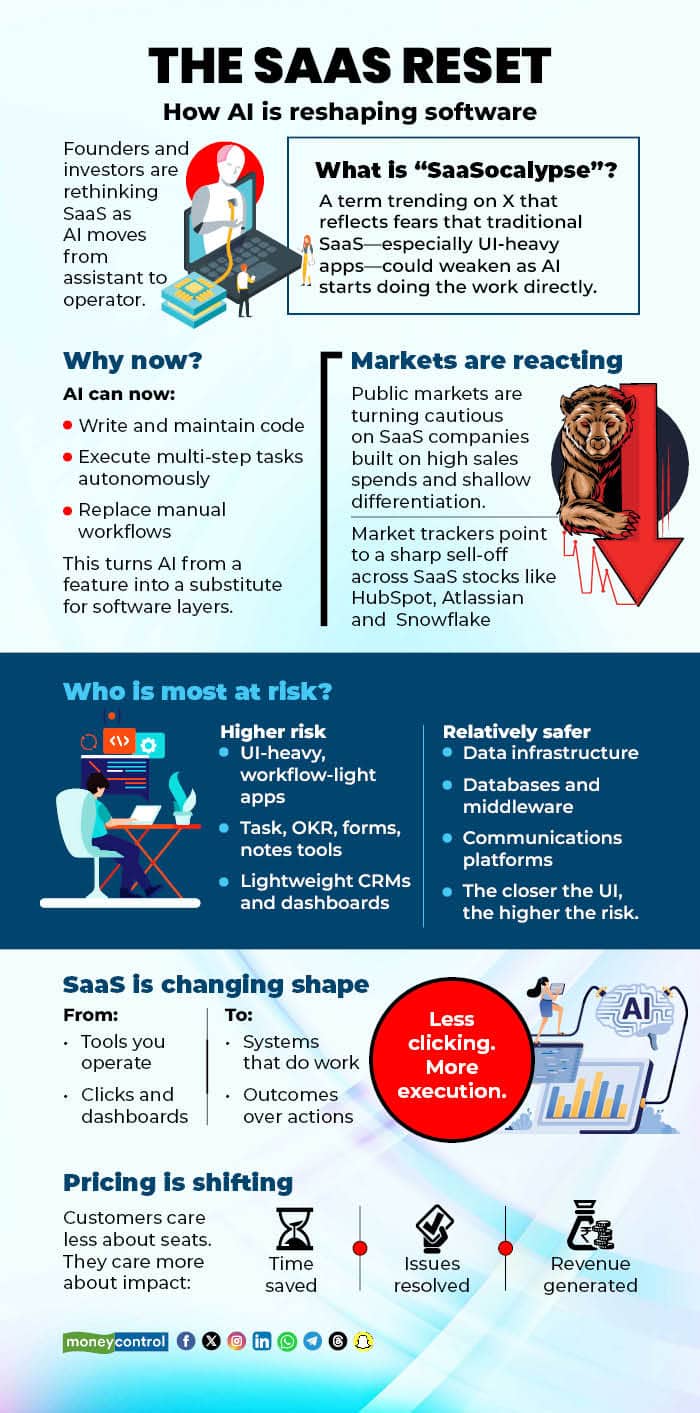 The SaaS Reset
Investors push for reassessment
Investors say this is the moment when abstract fears are turning concrete.
Manav Garg, founding partner at Together Fund, said consolidation in SaaS had been expected for some time but AI automation has made the impact easier to see.
“What has changed is that announcements like this make the implications much more tangible,” Garg told Moneycontrol, referring to Anthropic's AI tool.
“The conversation has shifted from abstract debate to concrete possibility.” He added that SaaS in its traditional form will face a reset and companies will have to adapt or be disrupted.
Founders need to reassess their models quickly
“This feels like a bloodbath. The old playbook of selling seats and workflows just isn’t holding up in an AI world,” said an investor in SaaS and enterprise tech who asked not to be named.
“The market is signalling that products have to think beyond dashboards and clicks, it’s about autonomous value now,” he added.
App-layer SaaS feels the most heat
Market data and stock movements suggest that not all software companies face the same level of risk.
Amit Ranjan, co-founder of SlideShare, pointed to a “meltdown in SaaS and software stocks” and highlighted clear patterns.
He wrote on X that companies doing relatively better tend to operate in data and infrastructure layers, which are harder for AI to replace.
“App-layer SaaS seems most impacted, as AI can replicate UI or features most effectively,” Ranjan said.
He added that communications tools appear more resilient due to network effects, while inward-facing layers such as data, infrastructure and middleware are relatively safer than customer-facing software.
Markets care about the future story
Even strong execution has not shielded companies from falling valuations.
“You can execute well, hit the numbers and deliver free cash flow and still watch multiples compress week after week,” Vijay Rayapati, founder and chief executive of Atomicwork, said.
He added that markets appear less focused on recent performance and more on the story investors want to believe over the next decade. For founders, he said, execution has become table stakes, not a differentiator.
SaaS does not disappear, it changes
Operators argue that AI is not killing SaaS outright but forcing it to evolve quickly.
Arvind Parthiban, founder and chief executive of SuperOps, said AI models are challenging products that rely mainly on clicks and workflows.
“Pure UI-driven, workflow-heavy products will struggle if all they do is orchestrate steps,” Parthiban said.
SaaS will shift from tools users operate to systems that do work on their behalf. “Less clicking, more outcomes,” he said.
Parthiban also expects pricing models to change, with customers caring less about seats and more about measurable impact such as time saved or issues resolved. “SaaS doesn’t disappear,” he said. “It becomes quieter, more autonomous, and more opinionated.”
Founders prepare for a reset
For companies such as Zoho, adaptation is no longer optional.
Vembu said survival depends on accepting hard realities. “I always ask our employees to calmly contemplate our death,” he wrote, adding acknowledging this possibility allows teams to plan without fear.
Across the SaaS ecosystem, founders are rethinking product design, automation depth and where they sit in the software stack. Investors are reassessing defensibility, especially for UI-heavy products.


Discover the latest Business News, Sensex, and Nifty updates. Obtain Personal Finance insights, tax queries, and expert opinions on Moneycontrol or download the Moneycontrol App to stay updated!
Find the best of Al News in one place, specially curated for you every weekend.
Stay on top of the latest tech trends and biggest startup news.







