






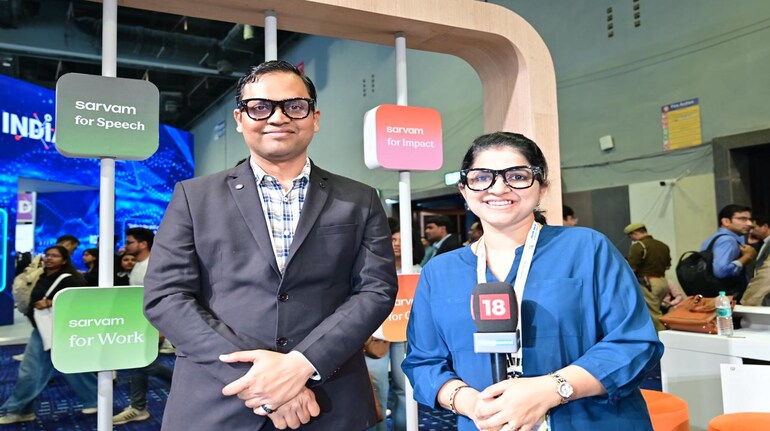

The government’s grant under the IndiaAI Mission played a crucial role in helping Sarvam train its large language models, but the startup does not intend to “mindlessly” scale up model sizes, co-founder Pratyush Kumar told Moneycontrol on February 20 in an interview at the India AI Impact Summit.
“I think the government’s grant in lieu of stake in Sarvam was an important catalyst to go train these models,” Kumar said, adding that belief and momentum matter deeply in frontier technology.
At the same time, he clarified that bigger is not always better.
“We don’t want to mindlessly go and say we want to train a 10 times bigger model. We want to do that in a very careful way, what does the country need? What do we want to learn as an R&D team? And then scale up from there,” he said.
Kumar said India is in the early years of a massive technological shift and needs “hundreds of companies which are innovating at the foundational layers, building models.”
He pushed back against the idea that India should limit itself to smaller systems.
“We should not be bucketing India into saying a Small Language Model country. We should build all kinds of things that bring real business value,” he said.
Kumar's words come in as Sarvam had a packed week at the summit, announcing multiple releases under the IndiaAI Mission, including a 30 billion parameter model, a 105 billion parameter model positioning itself as one of the key startups building India’s sovereign AI stack.
Lightspeed and Peak-XV-backed Sarvam AI has emerged as a key player in India’s sovereign artificial intelligence (AI) push. The IndiaAI Mission, backed by a Rs 10,000 crore fund to build India’s sovereign foundational model, has disbursed Rs 111 crore in GPU subsidies so far.
The biggest winner to date is Bengaluru-based Sarvam AI, which bagged a record 4,096 NVIDIA H100 SXM GPUs via Yotta Data Services, receiving nearly Rs 99 crore in subsidies.
Also Read: Inside Sarvam AI’s rapid-fire launches ahead of the India AI Impact Summit
Small team for a large model
The core large language models at Sarvam AI were developed by a 15-member team over two years. “It’s a two-year journey to build the muscle,” Kumar said, noting that “blood, sweat, tears went into building it.”
He acknowledged that skepticism surrounded the effort but called it fair. “You don’t suddenly start running. You crawl, you walk, and then you run,” he said, explaining that the company deliberately built capabilities from the ground up.
Sarvam runs a dual strategy, an R&D-heavy model-building arm and a product-focused business. Kumar said its voice AI platform already serves “multiple million minutes a day,” while its APIs process “multiple million” requests daily.
AI glasses and consumer push
At the summit, Sarvam also unveiled Kaze, its AI-powered smart glasses built and manufactured in India. “The goal is the models that we are training, how do you experience that as a consumer?” Kumar said.
The glasses feature speakers, microphones, cameras and a companion ring that allows users to tap or scroll for control.
“The intention is that the friction people have to access intelligence, you want to reduce. Imagine having intelligence on the move,” he said.
Sarvam plans to bring the glasses to market in May and said the pricing will be affordable.



Discover the latest Business News, Sensex, and Nifty updates. Obtain Personal Finance insights, tax queries, and expert opinions on Moneycontrol or download the Moneycontrol App to stay updated!
Find the best of Al News in one place, specially curated for you every weekend.
Stay on top of the latest tech trends and biggest startup news.







