






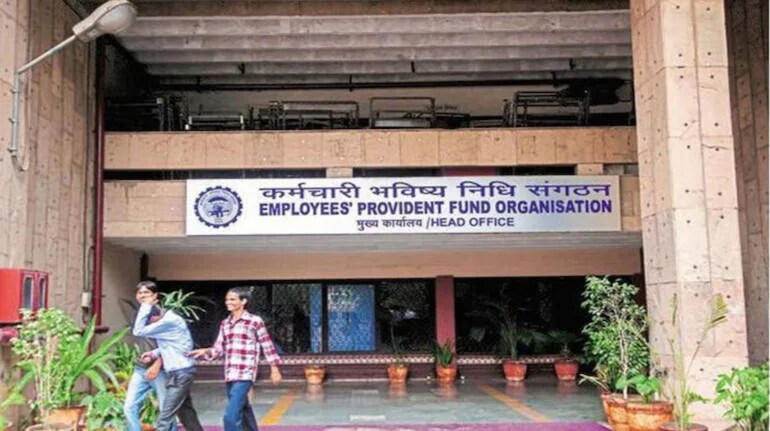
Barely days after Portfolio Management Services (PMS) data showed a 92% collapse in September net inflows, the October print is being read as a sharp rebound. But a closer breakdown of the two biggest EPFO-linked PMS managers — SBI Funds Management and UTI AMC — shows that the entire recovery is being propped up by mandatory EPFO allocations, not fresh HNI money.
Net PMS inflows jumped from just Rs 1,224 crore in September to Rs 22,011 crore in October, an 18-fold surge, while total industry AUM rose from Rs 43.89 lakh crore to Rs 44.67 lakh crore, driven by a mix of market gains and deployment.
SEBI portfolio disclosures reviewed by Moneycontrol show that SBI PMS AUM rose from Rs 2.8 lakh crore in September to Rs 2.88 lakh crore in October, and UTI PMS AUM rose from Rs 1.54 lakh crore to Rs 1.57 lakh crore. But nearly the entire incremental rise sits inside their EPFO-managed portfolios, not in discretionary PMS mandates.
This means the headline October improvement — both in flows and total industry AUM — is institutionally driven, not a sign of sentiment revival.
Together, SBI and UTI added over Rs 23,000 crore inside EPFO-linked schemes — more than covering the industry-wide uptick captured in the APMI compendium. When two EPFO-executing managers account for the bulk of month-on-month AUM change, the “industry recovery” is concentrated and brittle.
A senior institutional fund manager in the alternates space, speaking off record, said the bounce should not be misread. “HNI sentiment hasn’t improved in 12–18 months. Strip out EPFO, and PMS hasn’t grown at all in October.” He added that macro worries — including an April–October tax revenue shortfall against budget — are keeping wealthy investors conservative.
The October data corroborates this. While discretionary PMS inflows did rise to Rs 12,287 crore from Rs 1,468 crore in September, industry officials say these are concentrated in a few large houses that either redeployed prior cash or manage institutional mandates. Non-discretionary flows rose to Rs 9,724 crore, almost entirely from EPFO-linked activity. This is redeployment-heavy, not broad-based HNI onboarding.
New client additions slowed sharply from 3,490 in September to 1,257 in October. Onboarding duplication has also been highlighted as a noise factor (client counts are not clean indicators). So the Rs 12,300 crore non-EPFO discretionary uplift reflects existing-client flows — not a surge in fresh HNI participation.
September’s near-zero net flows created a tiny base; any institutional transfer in October looks huge in percentage terms — this is why the “18x” framing is misleading without context (Rs 1,139 crore in September to Rs 22,011 crore in October). October inflows rose 50% MoM to Rs 45,506 crore, while outflows fell 20% MoM to Rs 23,495 crore.
To this, Akshat Garg of Choice Wealth, added, "EPFO-linked PMS players benefit from consistent inflows, allowing them to build long-term portfolios without worrying about redemption pressure. This is why they dominate the growth numbers." Another layer of reasoning Garg identified behind this growth, is of HNIs still being hesitant to invest with boutique PMS managers, even if the strategy is strong. “Big-ticket investors tend to stick with established names for security and trust.”
Kamal Manocha, Co-Founder, PMS AIF World, warned against reading too much into month-end AUM swings, especially when a handful of large institutional mandates can distort industry-wide figures. “AUM is a misleading measure. One sovereign or EPFO allocation can make an entire month look strong. PMS should be analysed quarterly, not month-on-month.”
He also pointed out that even client addition numbers are inflated due to repeated onboarding of the same investor across schemes.
Where October did see genuine deployment was from fund managers who had been sitting on cash through the early part of the year. Abhishek Jaiswal of Finavenue said: “Q2 earnings surprised on the upside. A lot of October’s fresh deployments are post-result flows, not a broad-based surge.”
He noted that several PMS managers who held cash until mid-September are now fully invested — but the shift remains “selective, not industry-wide”.
Further breakdown of the October data reveals that derivatives AUM spiked 56.1% MoM in October. Thus, suggesting that managers unwound hedges built earlier in the volatility-heavy September, rebuilt leverage into the festive/earnings-led up-move, reflecting short-duration risk-taking rather than structural positioning. It also heightens near-term volatility sensitivity in PMS returns.
Pre-IPO and unlisted allocations stayed muted in October. Unlisted equity AUM fell 0.8% MoM in October after a 63% surge in Sept. Overall unlisted assets dropped in both equity and plain debt categories.
This indicates that some of the incremental capital is being diverted to AIFs, private credit and negotiated deals, rather than into PMS unlisted or pre-IPO sleeves.
Discover the latest Business News, Sensex, and Nifty updates. Obtain Personal Finance insights, tax queries, and expert opinions on Moneycontrol or download the Moneycontrol App to stay updated!
Find the best of Al News in one place, specially curated for you every weekend.
Stay on top of the latest tech trends and biggest startup news.




