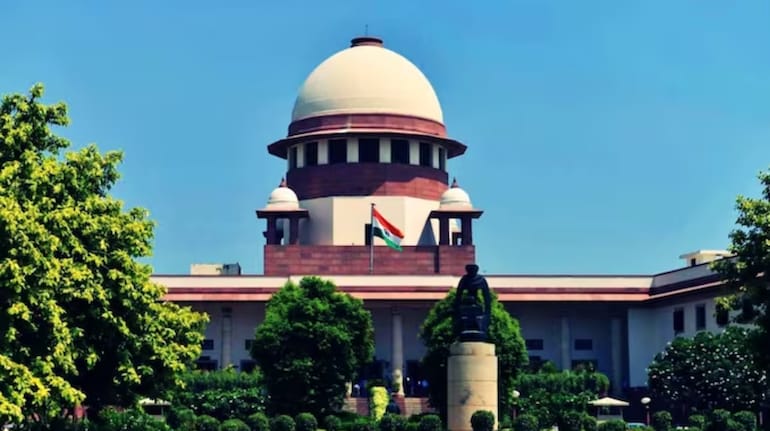

The Supreme Court has clarified that a daughter-in-law who becomes a widow after the death of her father-in-law is still legally entitled to seek maintenance from his estate, provided she is unable to maintain herself from other sources.
What is the case about
The judgment came in Kanchana Rai vs Geeta Sharma & Ors., a dispute among the heirs of late Dr Mahendra Prasad, who died in December 2021. Dr Prasad had executed a registered will in 2011, appointing his daughter-in-law, Kanchana Rai, wife of his predeceased son, as executor, while bequeathing his properties to her two sons and excluding his other sons.
After Dr Prasad’s death, Geeta Sharma, the wife of another son Ranjit Sharma, sought maintenance from her father-in-law’s estate under the Hindu Adoptions and Maintenance Act, 1956. At the time of Dr Prasad’s death, her husband was alive; he passed away later, in March 2023.
The Family Court dismissed her plea, holding that she was not a ‘widow’ on the date of her father-in-law’s death and therefore not a dependent. The High Court reversed this finding, ruling that her petition was maintainable and directing the Family Court to decide the amount of maintenance.
Dissatified with the High Court’s decision, Kanchana Rai — the executor of Dr Prasad’s will and the wife of his late son, Devinder Rai, who had predeceased him — moved to the Supreme Court, challenging the maintainability of Geeta Sharma’s plea for maintenance.
Separately, Smt. Uma Devi also approached the Supreme Court, asserting that she had been in a live-in relationship with Dr Prasad for over four decades and contending that Geeta Sharma was not entitled to seek maintenance from his estate. The apex court, however, refrained from expressing any view or passing a ruling on Uma Devi’s claims relating to maintenance or inheritance.
What did the Supreme Court say?
“We are clearly of the opinion that ‘any widow of the son’ of a deceased Hindu is a dependant within the meaning of Section 21 (vii) of the Act and is entitled to claim maintenance under Section 22 of the Act,” the Court said.
The Supreme Court has made it clear that the liability to maintain a widowed daughter-in-law does not stop with the son alone but travels with the estate itself. “Every legal heir who inherits the father-in-law’s property can be called upon to contribute proportionately, because the obligation under the Hindu Adoptions and Maintenance Act is estate-centric rather than person-centric, as reaffirmed by the Supreme Court,” said Raheel Patel, Partner, Gandhi Law Associates.
“Section 22 of the Hindu Adoptions and Maintenance Act, 1956, casts the maintenance obligation upon ‘all the heirs of the deceased Hindu,’ requiring them to maintain dependants out of the estate inherited. This applies universally to anyone succeeding to the estate, regardless of their gender or relationship to the deceased, thereby widening the category of potential obligants beyond traditional conceptions of liability,” said Prerna Robin, Principal Associate, B. Shanker Advocates.
How do courts determine the quantum of maintenance — does it depend on the size of the inherited estate or the number of dependants?
The amount of maintenance is determined under Section 23 of the Act, which provides guiding principles for both dependents (Section 23(3)) and certain claimants, such as spouses, children, or parents (Section 23(2)).
For dependants under Chapter III (including widowed daughters-in-law), Section 23(3) mandates regard to the following factors:
Discover the latest Business News, Sensex, and Nifty updates. Obtain Personal Finance insights, tax queries, and expert opinions on Moneycontrol or download the Moneycontrol App to stay updated!
Find the best of Al News in one place, specially curated for you every weekend.
Stay on top of the latest tech trends and biggest startup news.