








For the government, the long-term goal of personal taxation is clear: a simplified but exemption-free system. The new tax regime is now the default, slabs have been made more attractive over successive budgets, and compliance has been simplified by removing exemptions and deductions. Yet, the old tax regime refuses to fade away.
“There is a significant proportion still about 28 to 29 percent that is still well invested under the old regime,” said Nitin Bajal, Executive Director at Deloitte India. That number tells even as most taxpayers migrate to the new regime for its simplicity, a meaningful minority continues to find real tax savings under the old framework.
So who are these taxpayers and why does the old tax regime still work for them?
Why has old regime not lost relevance?
The old tax regime’s strength lies in one word: deductions. While the new regime offers lower slab rates, it takes away popular exemptions such as House Rent Allowance (HRA), Section 80C deductions, health insurance deductions under Section 80D, and home loan interest benefits under Section 24. For taxpayers who actively use these provisions, the old regime can still result in lower tax outgo.
Bajal said the old regime remains beneficial for salaried individuals with structured compensation. “It is still relevant for people who are well invested from an HRA perspective. We see a lot of HRA as part of employee compensation, and that continues to matter,” he said.
Beyond HRA, deductions on savings and protection products also tilt the balance. Contributions under Section 80C, health insurance premiums and interest on home loans-especially the Rs 2 lakh deduction on self-occupied property — are all advantages that disappear under the new regime.
Another big deduction is education loan. Under the old tax regime, deduction for an education loan is available under Section 80E and is one of the most powerful tools for large tax savings. There is no upper monetary limit on the interest deduction, unlike most other sections.
The entire interest paid on a loan taken for higher education, for self, spouse or children, can be claimed for eight consecutive years starting from the year repayment begins. This makes Section 80E especially valuable for high-ticket professional or overseas education loans, where interest outgo is substantial and long-lasting.
Breakeven deduction limit: Old vs New Tax Regime
Consider this: At Rs 30 lakh of gross income, tax under the new regime is about Rs 5 lakh, compared with Rs 7.41 lakh under the old regime assuming insufficient deductions. At Rs 60 lakh, the gap widens further.
However, these headline numbers can be misleading if viewed in isolation. For taxpayers who are able to claim substantial exemptions especially HRA, education loan and home loan interest the old regime can still narrow or even reverse this gap.
According to Deloitte India’s analysis, the break-even point, the level of deductions where tax liability under both regimes becomes equal, rises sharply with income. For a gross salary of Rs 24.75 lakh, the break-even point stands at roughly Rs 8.5 lakh. Above this level, the old regime starts delivering tangible savings.
“If someone is earning about Rs 25 lakh and has deductions and exemptions of around Rs 8.5 lakh or more, that person should seriously consider the old tax regime,” Baijal said.
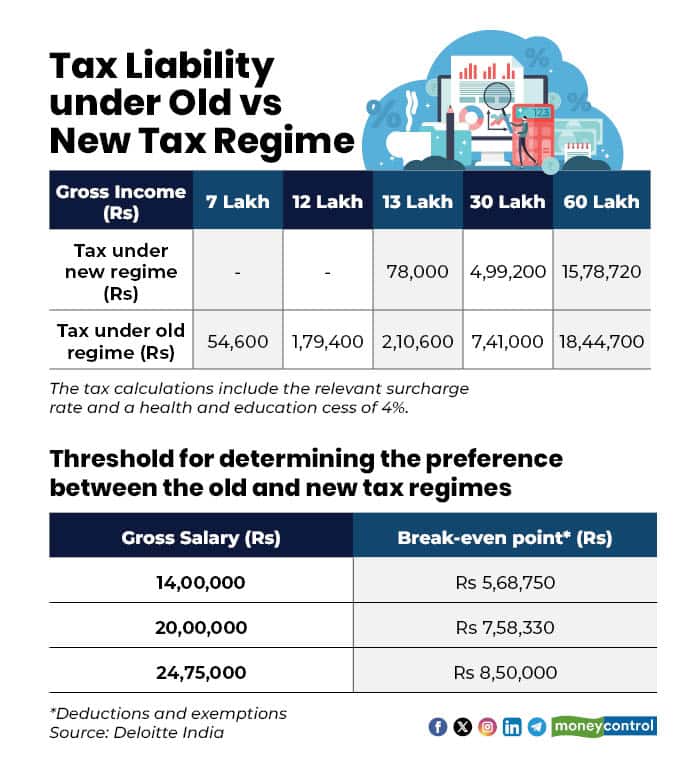
At lower income levels, the new regime clearly dominates. For example, up to Rs 12 lakh, tax under the new regime is nil under the proposed structure, making the old regime largely irrelevant for most taxpayers in this bracket.
The takeaway for taxpayers
The government may eventually phase out the old tax regime but it remains relevant today for a specific profile of taxpayers. The key is not ideology but arithmetic. Taxpayers should compute their liability under both regimes each year before filing returns.
"Based on repeated statements and clarifications from the Finance Ministry, there has been a consistent assurance that the old tax regime will not be abolished. In line with these assurances, it is reasonable to expect that the option to continue under the old tax regime will remain available for individuals who prefer it, even if only few percentages of individuals are still opting for it," said Neeraj Agarwala, Partner, Nangia & Co LLP.
Discover the latest Business News, Sensex, and Nifty updates. Obtain Personal Finance insights, tax queries, and expert opinions on Moneycontrol or download the Moneycontrol App to stay updated!
Find the best of Al News in one place, specially curated for you every weekend.
Stay on top of the latest tech trends and biggest startup news.





