








Most investors want growth and not panic, especially when markets fall. Portfolios often drift to extremes, either playing it too safe and falling short of long-term goals or chasing high-growth funds and panicking during corrections.
The core-and-satellite approach offers a practical way to balance stability with growth without complicating investing decisions. Instead of relying on a collection of “good” products, it provides a framework for how each part of the portfolio should behave.
Once essentials such as emergency funds and insurance are taken care of, the next question is how to invest surplus money without taking unnecessary risk so that it grows steadily. This is where the core-and-satellite portfolio structure fits in.
Rather than expecting every investment to do everything, the strategy assigns two clear roles, one focused on stability, the other on growth.
What the “core” does in a portfolio?
The core typically accounts for about 60-70 percent of the portfolio. Its role is straightforward: deliver market-linked returns with lower volatility and help investors stay invested during market corrections.
What goes into the core?
Large-cap equity funds
These invest in established companies with proven business models. They tend to fall less than mid- and small-caps during market downturns.
Flexi-cap funds
These allow fund managers to move between large, mid, and small caps, based on market conditions, adding diversification.
Hybrid funds (equity + debt)
These balance growth and stability. The equity portion captures upside, while debt cushions falls and provides stability during volatile phases.
According to Kirang Gandhi, a Pune-based financial mentor, “A core-and-satellite portfolio strategy balances stability and growth. The core portfolio is invested in low-cost, diversified mutual funds for long-term wealth, ensuring consistency and peace of mind.”
Even then, the core is not risk-free. For instance, between October 2024 and February 2025, markets fell about 14 percent. Core funds fell, too, but far less than riskier segments and recovered over time.
Where does satellite investments fit in?
Satellite investments usually make up the remaining 30-40 percent of the portfolio. This is the growth engine but also the riskier part. “The satellite portfolio allows tactical exposure to high-growth sectors, themes, or strategies,” says Gandhi.
This is where you can take measured risks to boost overall returns.
What fits here?
Mid-cap and small-cap funds for higher growth potential. International equity funds to diversify beyond India.
These segments can deliver strong returns but are volatile. Sharp drawdowns are common and underperformance can last years. That’s why keeping satellites smaller is critical.
Why the core-and-satellite portfolio structure works?
The real strength of the core-and-satellite approach is balance. The core part of the portfolio does the heavy lifting. It helps most of the money grow steadily and stay invested through different market cycles. The satellite portion adds extra growth potential, without putting the entire portfolio at risk.
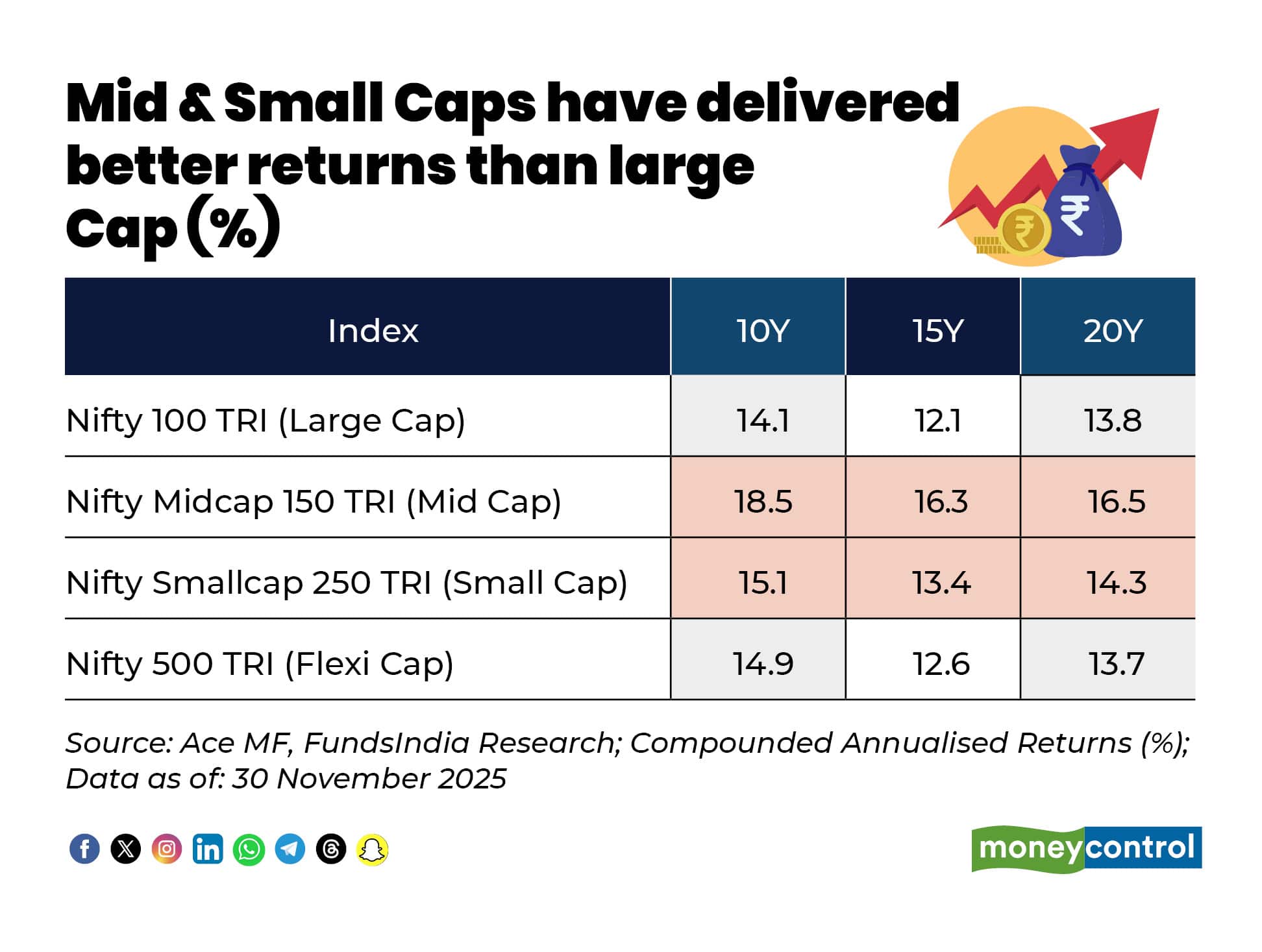
Over long periods, mid-cap and small-cap indices have delivered strong returns. In fact, over the past 20 years, these segments have generated around 14-17 percent annualised returns, clearly outperforming large-cap indices.
That said, higher returns don’t come easy.
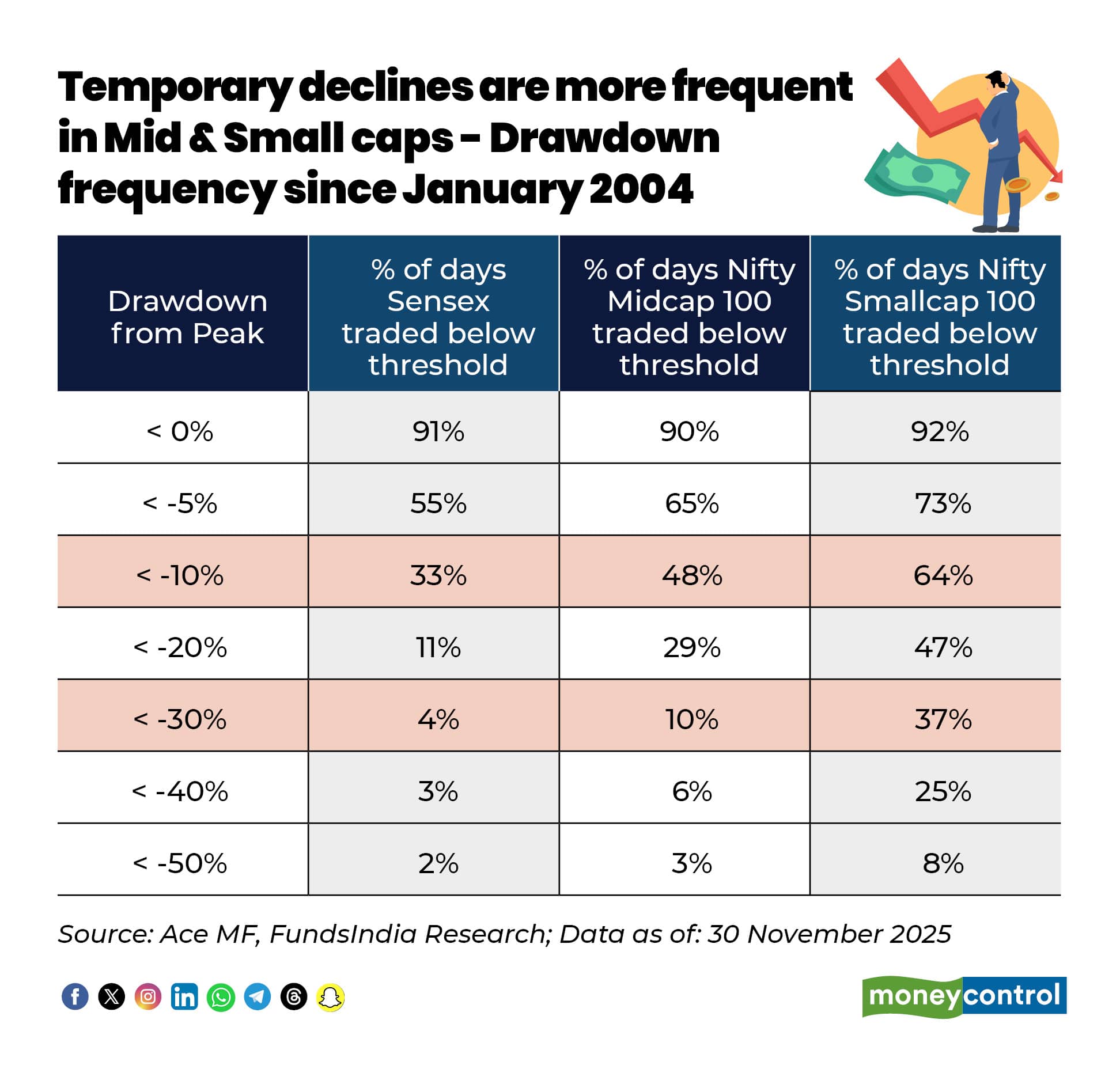
Data from FundsIndia November report shows that over the past two decades, temporary declines are more frequent in mid and smallcaps. The mid and smallcap funds have spent much more time in market declines compared to largecap.
Falls are more frequent in mid and smallcaps — 48 percent and 64 percent of the days it is down more than 10 percent from their peak. Moreover, large falls are more frequent in smallcaps. Data shows 37 percent of the days, they are down more than 30 percent from their peak.
While this kind of volatility can be uncomfortable, it’s also a normal part of investing in mid and smallcaps.
This is where the core-and-satellite strategy really helps. By spreading investments across market capitalisations, geographies and risk levels, investors get diversification without making portfolios complicated.
Industry experts point out that instead of constantly reacting to short-term market moves or switching funds, this approach helps investors stay disciplined, invested, and focused on the long term.
Takeaway for Investors
For long-term investors, the goal is not to find the highest-returning fund each year but to build a portfolio that they can stay invested in for decades. A core-and-satellite strategy provides that framework.
“For Indian investors, this approach combines safety with smart opportunity, avoids overexposure, and reduces emotional investing mistakes, especially during market highs or crashes. It brings structure, discipline, and clarity to long-term wealth building without chasing trends,” Gandhi said.
Successful investing is less about prediction and more about structure, and the core-and-satellite approach offers one of the simplest structures to get it right.
Discover the latest Business News, Sensex, and Nifty updates. Obtain Personal Finance insights, tax queries, and expert opinions on Moneycontrol or download the Moneycontrol App to stay updated!
Find the best of Al News in one place, specially curated for you every weekend.
Stay on top of the latest tech trends and biggest startup news.





