







The Securities and Exchange Board of India has announced a 10-20 basis points cut in mutual fund expense ratios, a change that could slightly lower the cost of investing for retail investors.
The changes, approved at SEBI’s board on December 17, apply across equity, debt, index funds, ETFs, fund of funds (FoF) and closed-ended schemes. The markets regulator has also simplified cost disclosures by introducing the Base Expense Ratio (BER), which separates a fund’s core expenses from taxes and statutory charges.
Which mutual fund categories will see lower costs?
Index funds and ETFs will now have a base expense ratio of 0.9 percent, down from 1 percent earlier. Fund of funds investing in liquid schemes, index funds or ETFs will also see their costs come down from 1 percent to 0.9 percent.
For fund of funds investing at least 65 percent of their assets in equity-oriented schemes, the expense cap has been lowered from 2.25 percent to 2.10 percent, while other FoFs will now have a limit of 1.85 percent compared to the earlier 2 percent.
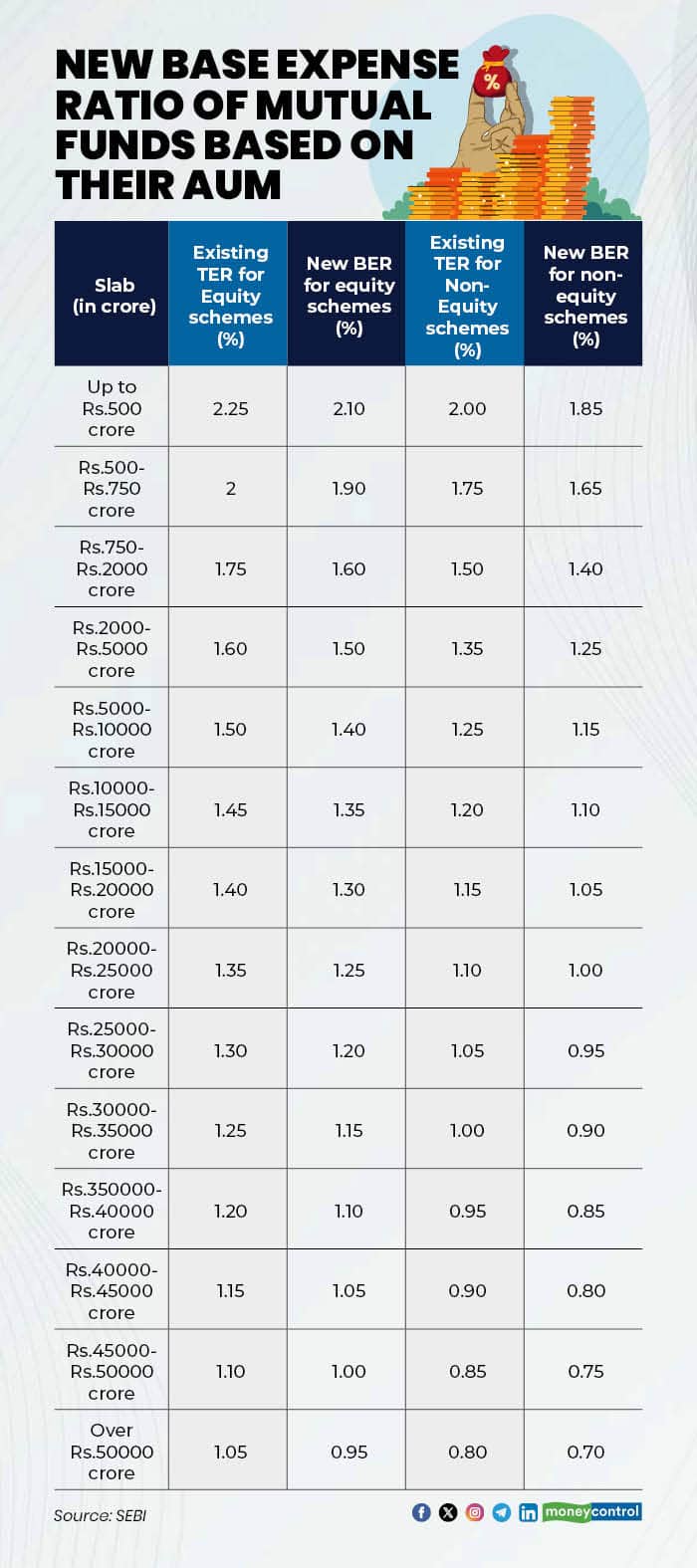 New Base Expense Ratio Of Mutual Funds Based On Their AUM
Why even the small cut matters?
SEBI’s cut may appear marginal but its impact builds over time. On the surface, the cut looks negligible but investing is not a sprint, it is a long, steady march. When costs come down, more of an investor’s money stays invested and continues to compound.
For instance, on a Rs 10 lakh lump sum investment growing at a hypothetical 12 percent CAGR (before expenses), a 20-basis-point reduction in expense ratio over 20 years can translate into nearly Rs 2.95 lakh of additional wealth. This gain comes purely from lower costs, money that remains invested instead of being deducted as expenses.
Time to switch funds?
With costs coming down, the question investors face is it time to switch funds?
Switching funds purely to save a few basis points can be counterproductive, experts say. “Replacing a well-performing, consistent fund just for marginally lower costs is like changing a reliable engine for slightly cheaper fuel,” said Col Sanjeev Govila (retd), a certified financial planner and CEO of Hum Fauji Initiatives.
While expense ratios do affect returns, their impact is often smaller than factors such as a fund’s investment strategy, portfolio construction and consistency across market cycles. A 10-20 basis point difference in costs may not meaningfully improve outcomes if the new fund underperforms or follows a different risk profile.
There are also practical costs to switching. Capital gains tax, exit loads and the risk of poor timing can easily outweigh the benefit of slightly lower fees. As Niharika Tripathi, Head of Products and Research at Wealthy.in, said, “The revised expense framework is better seen as a tool for clearer cost monitoring rather than a trigger to churn portfolios.”
When does switching actually make sense?
Switching may be worth considering only when:
“Often, staying invested in a consistent performer remains the smarter choice,” Govila said.
Lower expense ratios are a clear positive for investors but they are not a standalone decision-making tool. Costs matter but they matter in context.
The question is not which fund is cheapest, but which fund delivers the best risk-adjusted returns after all expenses, consistently over time. A slightly higher-cost fund that performs well and manages risk effectively can be far more valuable than a low-cost fund that underdelivers.
In short, use SEBI’s expense ratio cut to track costs better, not to rush into switching.
Discover the latest Business News, Sensex, and Nifty updates. Obtain Personal Finance insights, tax queries, and expert opinions on Moneycontrol or download the Moneycontrol App to stay updated!
Find the best of Al News in one place, specially curated for you every weekend.
Stay on top of the latest tech trends and biggest startup news.




