







While the US and Canada once dominated Indian students’ overseas education choices, rising costs and growing visa uncertainty have led to a sharp drop in preference for these destinations, according to a recent study by Gyandhan, an ed-fintech platform headquartered in New Delhi.
At the same time, European countries such as Germany and Ireland are gaining traction, emerging as attractive alternatives due to lower tuition fees and student-friendly visa regimes.
The study also reveals that only a small fraction of students who went abroad in 2022 have returned home after completing their studies, highlighting the growing disconnect between education costs and employment outcomes in traditional destinations.
According to Gyandhan, Germany has emerged as a strong destination for STEM aspirants, owing to low tuition and clear post-study work policies. Ireland is gaining momentum for its tech and finance ecosystems, offering up to two years of work rights after completion of studies and strong opportunities across IT, finance and medtech sectors.
“Governments across Europe and Asia, including Germany, Ireland, Japan, and South Korea, are attracting Indian students through friendlier visa regimes and employment-linked education models. Future shifts will depend on how the US and Canadian policies evolve,” said Ankit Mehra, Co-founder and CEO of Gyandhan.
The UK and Australia continue to attract students, whereas only 2.3 percent of overall students chose Canada as a study destination. Overall, Germany, Ireland, and France saw a notable increase among students choosing abroad studies, as per Gyandhan data.
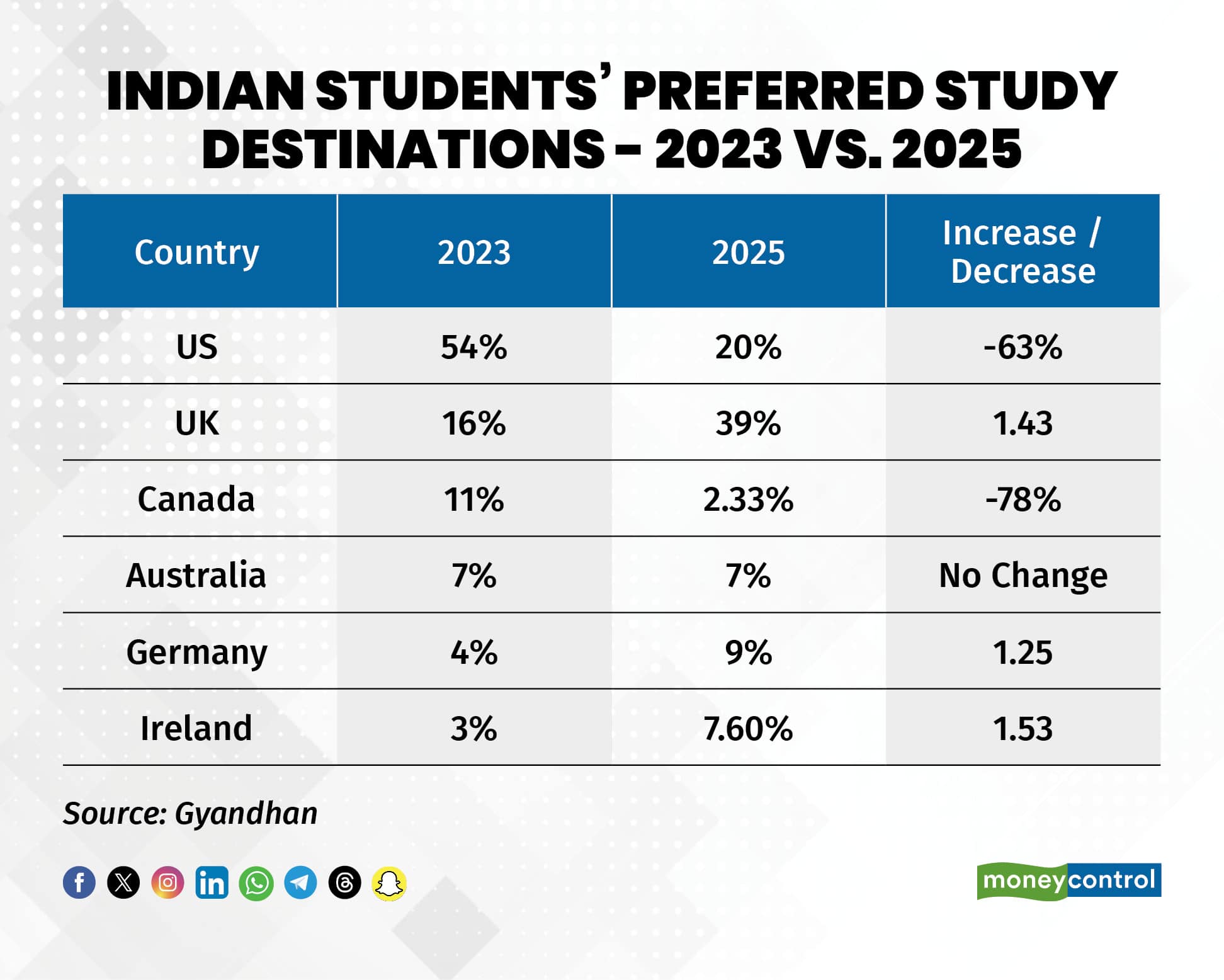
The data that analysed applications from 33 cities across 14 states of India further noticed a 63 percent decline among students going to the US for higher studies, which is a fall from 54 percent in 2023 to 20 percent as of September 2025.
The report cited visa delays, rising costs, and uncertainty around post-study work and immigration pathways as reasons for the decline in students choosing the US for abroad studies. It added that recent H-1B visa fee hikes and OPT (optional practical training) policy reviews have also intensified these concerns.
Why are Indian students turning away from US, Canada as preferred study destinations?
According to Mehra, some students face challenges in the final placement part. In certain universities, especially in the UK, the employment outcomes are not favourable for students who complete their education.
“We are noticing a lot of students deferring their plans of going to the US or opting for alternative destinations due to several uncertainties. Students are making pragmatic, RoI-driven choices. They are willing to look beyond traditional destinations and choose countries that offer clear pathways to work and stability,” said Ankit Mehra, co-founder and CEO of Gyandhan.
More than 40 percent of students going abroad are from Tier 2 and Tier 3 cities of India. While most students opted for STEM subjects, other areas that are picking up include healthcare management, physiotherapy, nursing, pure sciences, psychology, artificial intelligence (AI) and machine learning (ML) courses.

Discover the latest Business News, Sensex, and Nifty updates. Obtain Personal Finance insights, tax queries, and expert opinions on Moneycontrol or download the Moneycontrol App to stay updated!
Find the best of Al News in one place, specially curated for you every weekend.
Stay on top of the latest tech trends and biggest startup news.




