







The Employees’ Provident Fund Organisation (EPFO) has simplified its withdrawal framework to make it easier for members to access their savings. Earlier, withdrawals were divided into 13 different categories; this has now been streamlined into three broad heads—Essential Needs, Housing Needs, and Special Circumstances.
Members are now allowed to withdraw up to 100 percent of their eligible Provident Fund balance, covering both employee and employer contributions in these situations:
-Retirement and career end
-After reaching 58 years of age
-On voluntary retirement
-Due to permanent disability or total incapacity to work
-Before migrating abroad for permanent settlement
-Withdrawal during unemployment
During a period of unemployment, you can withdraw up to 75 percent of your PF balance right away, while the remaining 25 percent becomes accessible after 12 months of continued unemployment.
Partial withdrawal
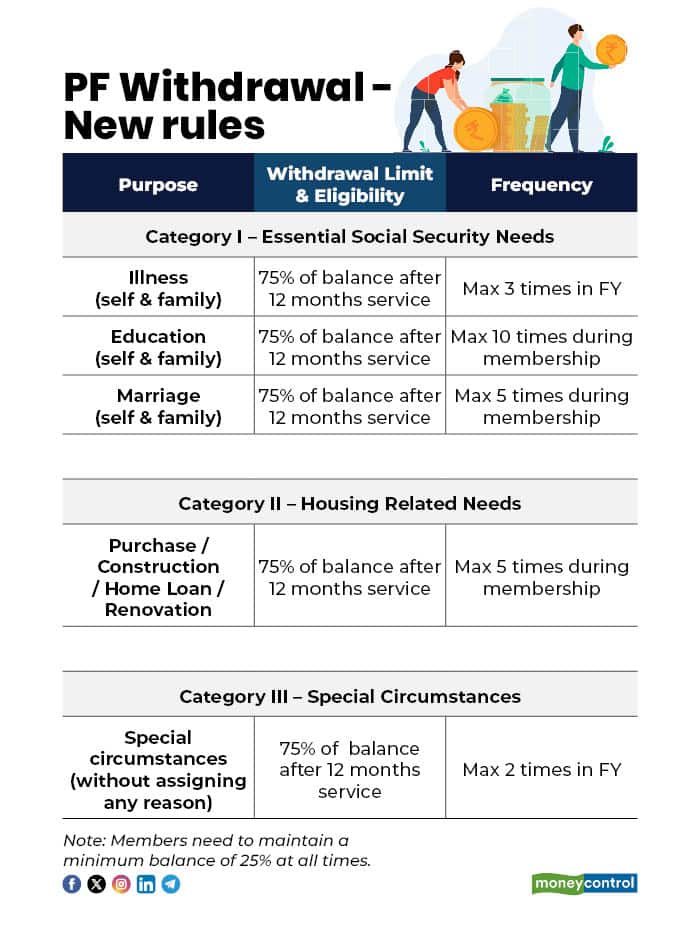
Partial withdrawal limits have been relaxed significantly. Members can withdraw up to 75 percent of the balance for illness, education, marriage, and housing needs, after 12 months' service.
Withdrawals for education can be availed up to 10 times, while marriage-related withdrawals are permitted up to 5 times, compared with the earlier combined cap of three withdrawals.
Withdrawal for medical treatment can be availed for self, spouse, children, or parents, covering serious illnesses like cancer or TB. 12-month minimum service is required, and withdrawals are permitted up to three times per financial year.
Withdrawal can be availed for house purchase, construction, renovation, or loan repayment, with property in the member's, spouses, or joint name. Frequency allows up to five times over the service period.
Under new provision, it is mandatory to maintain minimum balance of 25 percent of total contributions in the member’s account. This ensures continued compounding at EPFO’s prevailing interest rate (currently 8.25 percent per annum), helping members build a stronger retirement corpus while still allowing liquidity.
Earlier, members were permitted to withdraw their pension corpus after just two months, which often resulted in the loss of eligibility for future pension benefits. Under the revised rule, EPS withdrawals are allowed only after 36 months, nudging members to stay invested in the pension system for a longer period.
Special Circumstances
Under the ‘Special Circumstances’ category, members are no longer required to specify reasons such as natural calamities, unemployment, or epidemics. Claims can now be filed without justification, reducing rejections and grievances.
EPFO has also introduced Passbook Lite, a simpler way for members to view their PF details. Instead of accessing a separate passbook website, members can now check a concise snapshot of their PF passbook directly on the main member portal.
PF withdrawal through UPI
EPFO subscribers will be able to withdraw their employees' provident fund (EPF) directly to their bank accounts through UPI payment gateway by April this year, according to a report by PTI.
The labour ministry is working on a proposal under which a portion of EPF savings would remain locked in, while a significant part could be withdrawn directly into bank accounts through the Unified Payments Interface (UPI), sources told PTI.
Discover the latest Business News, Sensex, and Nifty updates. Obtain Personal Finance insights, tax queries, and expert opinions on Moneycontrol or download the Moneycontrol App to stay updated!
Find the best of Al News in one place, specially curated for you every weekend.
Stay on top of the latest tech trends and biggest startup news.





