






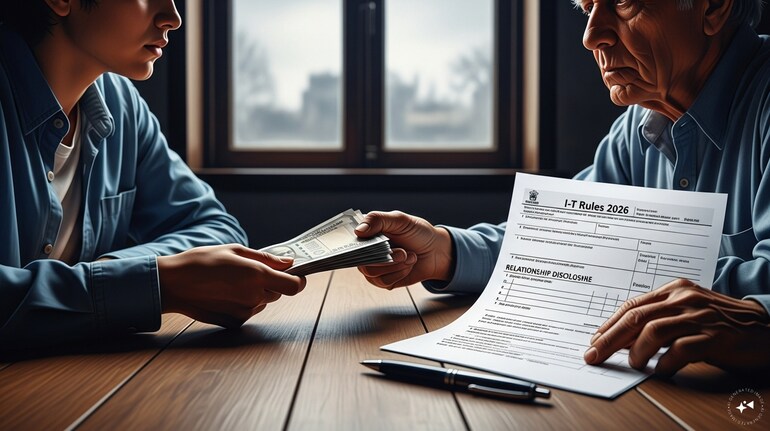

If you are paying rent to your spouse, parents or any other family member to claim house rent allowance (HRA) under the old tax regime, you may have to soon disclose your relationship with your landlord under the changes proposed to new tax laws to verify the legitimacy of the claim.
The draft income-tax rules, 2026 requires salaried individuals to disclose their “relationship with the landlord” in Form 124, where the aggregate rent paid during the tax year exceeds Rs 1 lakh.
Tax experts clarify that draft rule does not bar tenants from paying rent to family members. Salaried individuals can continue to claim HRA for rent paid to parents, spouses or other relatives, provided the arrangement is genuine.
This means there must be a valid rental agreement, rent should be paid through proper banking channels, and the landlord must report the rental income in their income-tax return.
What documents need to be disclosed?
Name of landlord/landlords
Address of the landlord/landlords
Permanent Account Number (PAN) of the landlord/landlords
Relationship with the landlord
Why this disclosure reshapes HRA filing
Mandatory disclosure of relationships for rent payments to relatives now triggers deeper tax scrutiny, making it easier for tax departments to use analytics to verify the legitimacy of such transactions.
Mandatory relationship disclosure now acts as a direct trigger for deeper tax authority scrutiny.
Authorities can use analytics to cross-verify income matching, property ownership, and fund flow through banking channels.
This makes it algorithmically visible at scale what was previously difficult to detect.
In short, what was once difficult to monitor at scale can now be identified and examined through algorithm-driven systems.
What may be the consequences of not disclosing relationship with the landlord
Non-disclosure of the relationship with the landlord amounts to withholding a material fact that is required to be reported under the prescribed rules.
“If such non-disclosure is deliberate and aimed at claiming a fictitious HRA exemption, and the arrangement is later detected by the department, it may be treated as misreporting of income. In such cases, a penalty of up to 200 percent of the tax sought to be evaded can be levied under Section 439 of the Income Tax Act, 2025,” said Chandni Anandan, a tax expert at ClearTax.
If you are genuinely paying rent to your spouse or parents and maintaining proper documentation, disclosing the relationship for claiming HRA should not be a cause for concern. The key is that the arrangement must be real and well recorded.
To prevent any future issues, the person receiving the rent, whether a spouse or parent, should also report the rental income in their Income Tax Return.
Discover the latest Business News, Sensex, and Nifty updates. Obtain Personal Finance insights, tax queries, and expert opinions on Moneycontrol or download the Moneycontrol App to stay updated!
Find the best of Al News in one place, specially curated for you every weekend.
Stay on top of the latest tech trends and biggest startup news.





