








The dream of a global degree is facing a harsh reality check as the Indian rupee’s slide turns into a "silent fee hike." While university tuition remains stable in foreign currency, the depreciating Rupee is inflating costs by lakhs.
According to recent data by Global Reach, a student heading to Harvard (USA) now faces a total cost of Rs 68–75 lakh, a jump of Rs 5–6 lakh from last year.
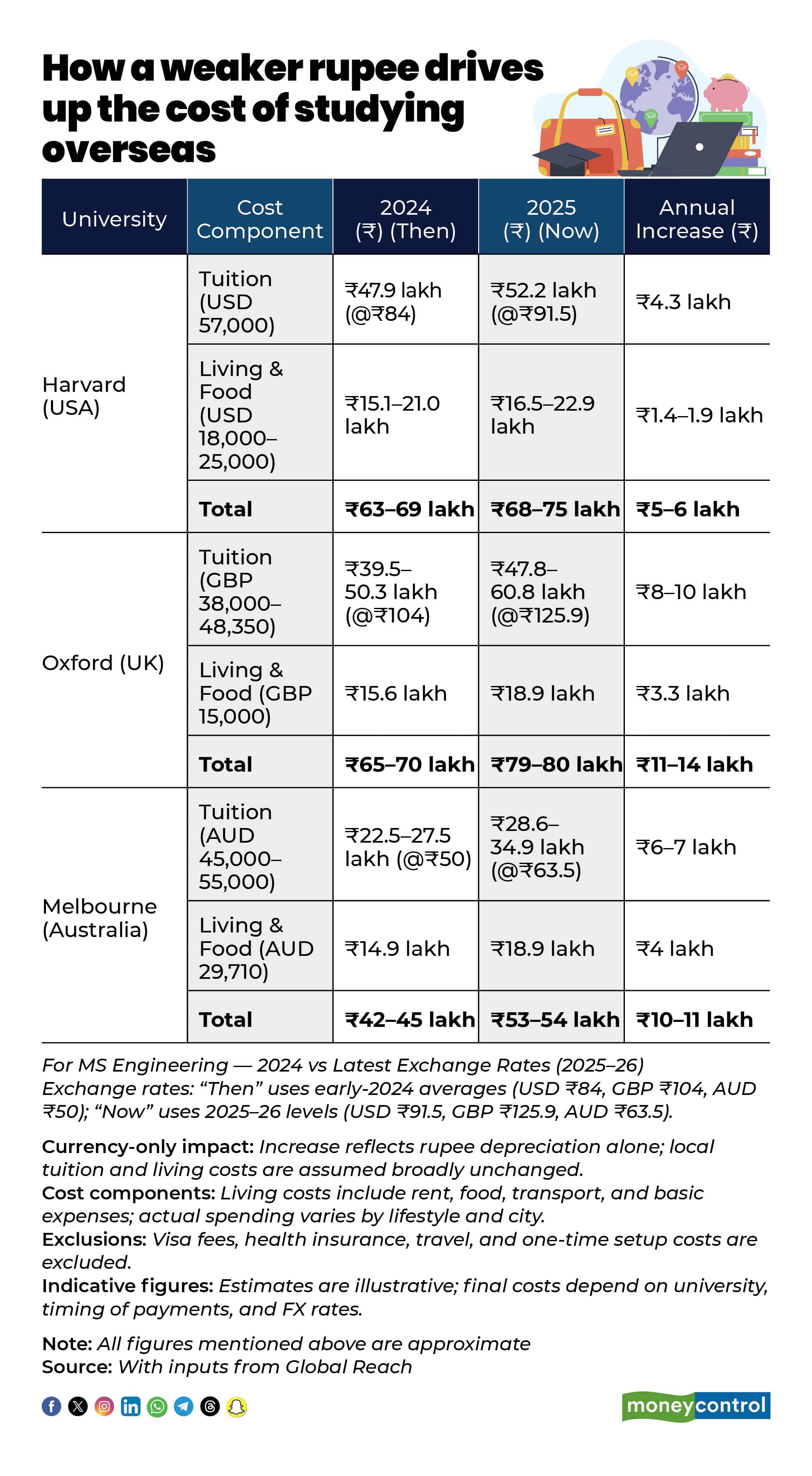 The sting is even sharper for Oxford (UK) aspirants, where expenses have surged by Rs 10–14 lakh to reach Rs 79–80 lakh. Even in Melbourne (Australia), costs have climbed to Rs 53–54 lakh, an increase of Rs 9–12 lakh. These figures prove that currency volatility is now as critical a factor as grades when planning a career abroad. Data is as of Jan 26, 2026.
With the rupee weakening 9 percent against the dollar and around 21 percent against the pound over the past year, not just tuition but everyday expenses- accommodation, groceries, local travel, and international airfares- automatically become costlier in rupee terms.
Even without fee hikes by universities, Indian families are paying several lakh more each year, tightening budgets and forcing a rethink of funding strategies, affordability, and long-term returns on overseas education.
The Hidden Currency Hit on Education
The INR has weakened against the USD, GBP, and AUD over the last year -e.g., USD crossing Rs 90+ recently compared with Rs 84-86 previously, marking about 9 percent depreciation over a period of one year.
Depreciation has been observed against GBP and AUD over last year too. “We have consistently positioned education overseas as an investment rather than an expense. However, the question of ROI (Return on Investment) arises when, over the past year, the cost of education has increased at an unprecedented rate. This rise is not solely attributable to the escalation of tuition fees but also to the depreciation of the rupee against the dollar, which has resulted in an additional 10 percent increase in actual costs,” says Ravi Lochan Singh, MD of Global Reach, a study abroad consultant.
Cutting Overseas Education Currency Risk
Some of the possible strategies would include building dollar assets, exploring cost-effective alternatives or applying for scholarships.
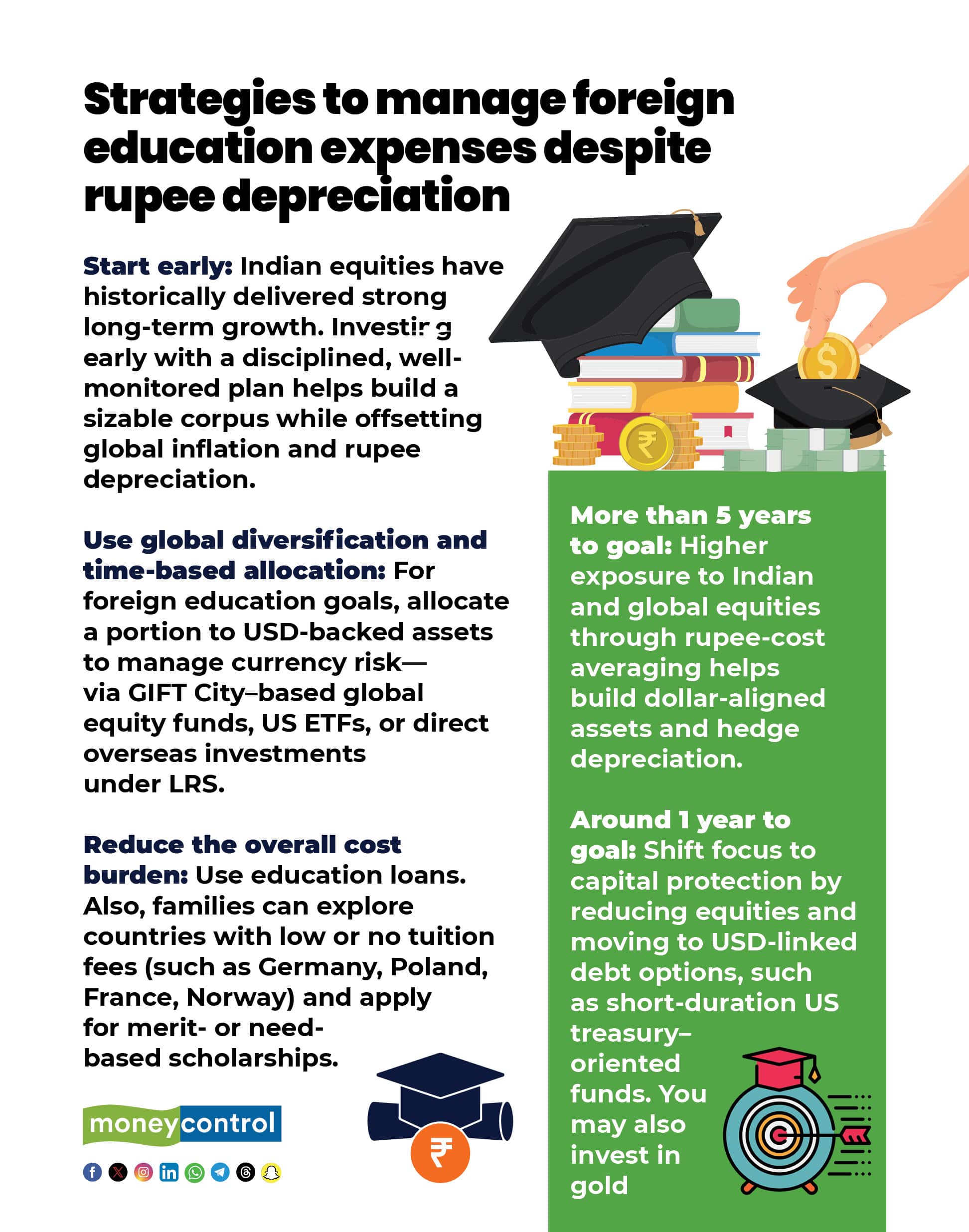
“With the depreciating rupee, parents may opt for a larger chunk of the funds to be taken out of an education loan, ” says Anirban Sircar, Chief Executive, APS Consultancy Services. This is a sensible choice, especially when post study work opportunities would soften the blow of a weakened rupee.
One can mitigate the risk of currency depreciation by investing in dollar denominated assets. “Parents could plan ahead and invest in USD-denominated assets, US ETFs, or global equity mutual funds via rupee-cost averaging and natural hedging against depreciation,” says Saurabh Bansal, founder, Finatwork Investment. This works when the goal is five years or more away. Also, over longer periods, gold funds tend to mirror the dollar because gold is fully imported. It works well as a dollar hedge, though you do take gold price risk. These investments work when the goal is five years or more away.
“Around two years before the education expense is due, we typically move the money into a US Treasury bond–linked fund. The aim isn’t to chase returns- there are periods when returns can even be lower than liquid funds- but to protect against rupee depreciation. Since the underlying investments are US government bonds, the fund closely aligns with dollar movements, which helps neutralise currency risk when fees and living costs have to be paid in dollars,” says B. Srinivasan, director and founder, Shree Sidvin Investment Advisors.
For short durations like six months to one year, don’t worry about returns at all. The intention is only to mitigate dollar risk.
“In any such scenario, many students aspiring to study overseas would choose a destination that is easier on the pocket, like Germany or France vs Canada or Australia,” says Sircar.
One could also apply for merit- or need-based aid to cover tuition, living expenses, and travel.
As the rupee’s slide turns global degrees into costlier investments, families must pivot from simple saving to strategic hedging. By building dollar-denominated assets or choosing affordable hubs, students can protect their ROI against currency volatility and secure their academic futures.
Discover the latest Business News, Sensex, and Nifty updates. Obtain Personal Finance insights, tax queries, and expert opinions on Moneycontrol or download the Moneycontrol App to stay updated!
Find the best of Al News in one place, specially curated for you every weekend.
Stay on top of the latest tech trends and biggest startup news.





