







Market volatility tend to unsettle investors, particularly when their portfolios slips into the red. Such drawdowns are a common in equity markets and happen even in years that eventually deliver strong gains, long-term data shows.
Recent global developments, which resulted in the worst Indian market fall in 10 months, are a reminder of how quickly sentiment can shift. Crude prices surged past the $100-a-barrel mark on March 9, as escalating West Asia conflict rattled energy markets.
The Brent crude jumped on fears of supply disruptions and even hit four-year high of $120 in intraday trading. By March 10 morning, crude eased back to around $90, highlighting how quickly commodity markets can reverse after geopolitical-driven spikes.
The Sensex and Nifty, which a day slipped into a technical correction a day earlier after falling more than 10 percent from record highs of January 5, opened higher on March 10 , signalling early stabilisation.
For investors, these sharps drops make them wonder about continuing with SIPs. Is it time to pull money out of equities?
Even positive years see sharp declines
A recent report by FundsIndia, an online investment and wealth management platform, shows that market corrections in a year are far more common than investors often assume.
Since 1980, the Sensex has delivered positive calendar-year returns in 37 out of 46 years but the gains rarely came in a straight line. Most of those years saw significant declines at some point before eventually ending higher.
Data shows that in nearly 87 percent of the years that ultimately finished with gains, the market experienced double-digit corrections.
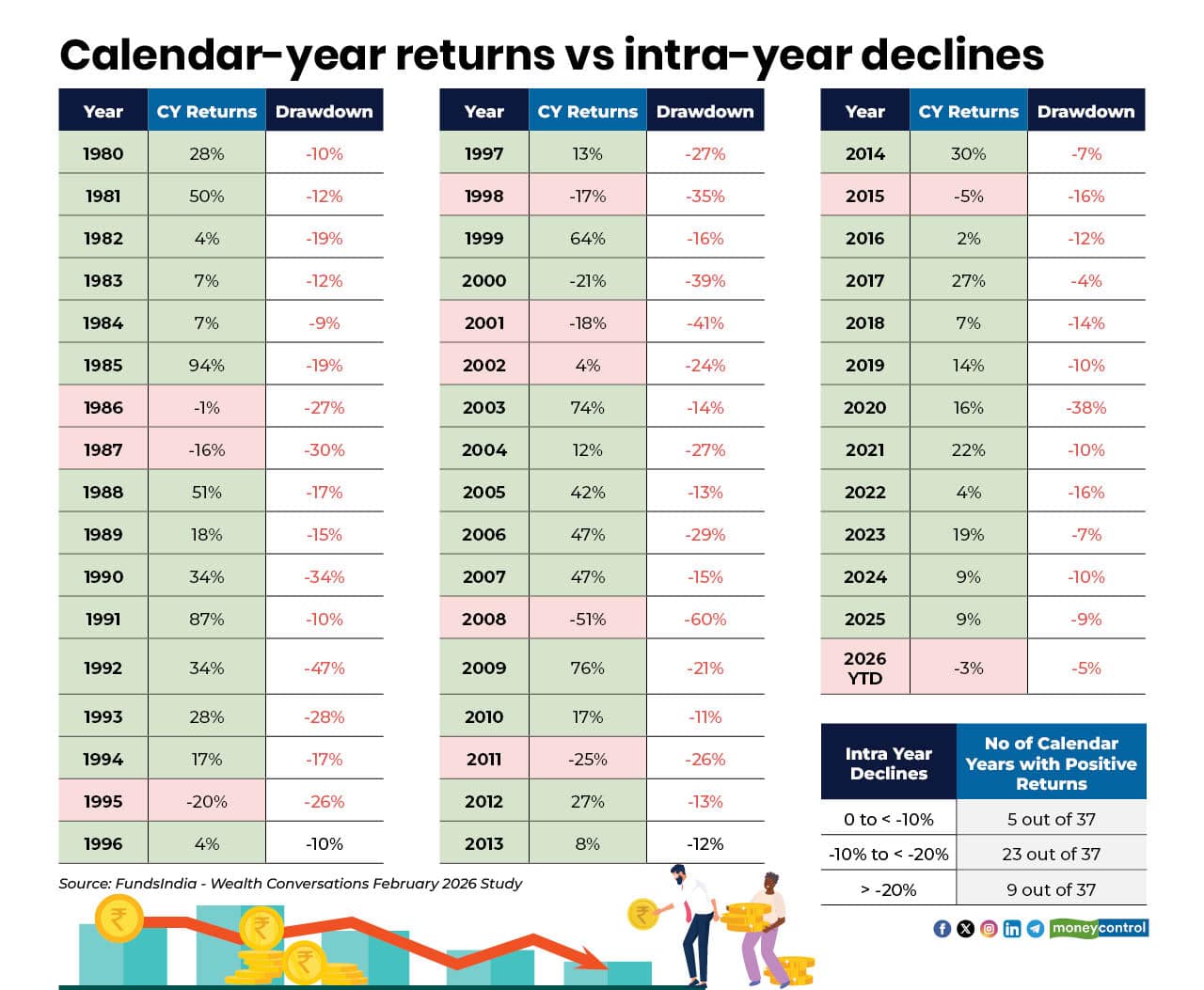
Put simply, market corrections during the year have historically been the norm rather than the exception.
In 1985, for instance, the market delivered a remarkable 94 percent annual return despite a nearly 19 percent decline. Similarly, in 1991 the Sensex ended the year up 87 percent even though markets had corrected about 10 percent along the way.
More recently, in 2014, the market gained around 30 percent despite witnessing a temporary pullback during the year.
Major crashes have also been part of market history
While many corrections are relatively moderate, markets have also experienced deeper drawdowns during periods of global financial stress or economic disruption.
Indian equities have witnessed several declines of more than 30 percent, often triggered by major global events.
The steepest fall occurred during the global financial crisis, when the Sensex plunged more than 60 percent from its peak as markets around the world collapsed.
Similarly, the selloff during the COVID-19 saw markets tumble in early 2020, as the pandemic brought global economic activity to a standstill.
Such periods are often marked by intense uncertainty, prompting investors to reassess risk and temporarily pull back from equities.
Markets recover
Despite the severity of these declines, markets have historically recovered from every major downturn.
According to an analysis by FundsIndia, major market drawdowns have typically been followed by recoveries.
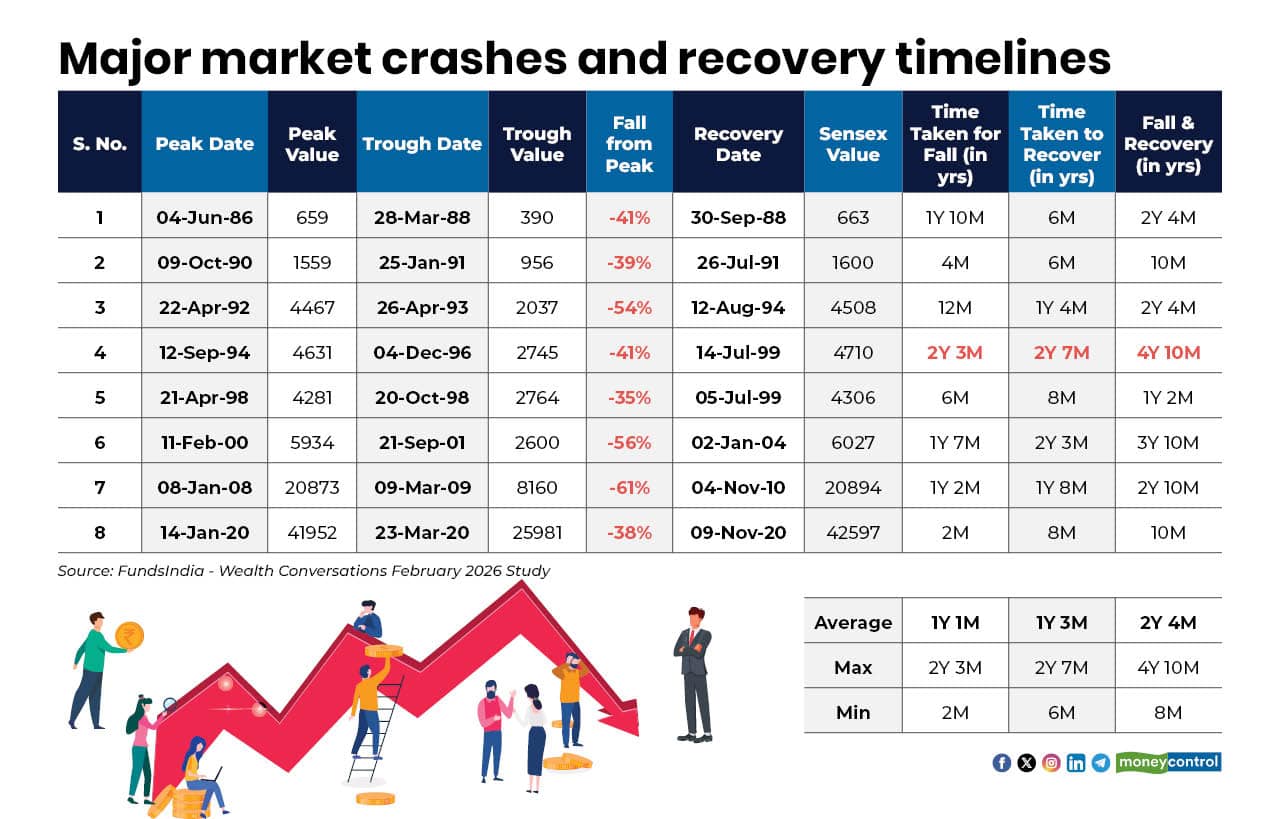
The data shows that declines of more than 30 percent typically unfold over a little more than a year on average. The recovery phase takes roughly another year.
In total, the full cycle, from peak to decline and eventual recovery, has historically averaged around two to three years.
Recovery timelines, however, vary across market cycles. Some downturns, such as the pandemic-driven crash in 2020, saw markets rebound within months as policy support and liquidity stabilised financial systems. Other corrections, including those seen in the mid-1990s, took longer.
Volatility is part of long-term investing
Corrections, both moderate and severe, occur regularly, often testing investor patience along the way. For long-term investors, the broader trajectory has historically remained upward despite these intermittent shocks.
Volatility is not a flaw of equity investing. It is the price investors pay for long-term wealth creation.
Periods of geopolitical tension, economic shocks or global crises have periodically triggered steep corrections but , markets have navigated these turbulent phases and moved higher, as economic activity and corporate earnings recover, say experts.
Disclaimer: The views and investment tips expressed by experts on Moneycontrol.com are their own and not those of the website or its management. Moneycontrol.com advises users to check with certified experts before taking any investment decisions.Discover the latest Business News, Sensex, and Nifty updates. Obtain Personal Finance insights, tax queries, and expert opinions on Moneycontrol or download the Moneycontrol App to stay updated!
Find the best of Al News in one place, specially curated for you every weekend.
Stay on top of the latest tech trends and biggest startup news.





