
Over the last few years, the debate over passive investing has been gaining ground in India, thanks to the underperformance of active large-cap equity funds against indices such as the Nifty 50. Barring a few, funds in the active large-cap category delivered lower returns compared to the return of large-cap indices, across timeframes.
Mirae Asset Large Cap Fund (MALF) is one of those very few schemes in the category that have managed to surpass its benchmark and peers by a notable margin.
The scheme is mandated to invest at least 80 per cent of its portfolio in large-cap stocks as per SEBI’s classification norms. As per the recent AMFI classification as of June 2020, large-cap stocks are those with market capitalisation of Rs 26,677 crore and above.
Changed categoriesThe name of MALF was changed twice within the last three years. First, it was changed from Mirae Asset India Opportunities to Mirae Asset India Equity after SEBI’s re-categorisation in early 2018. Then, in May 2019, it was rechristened as Mirae Asset Large Cap. Though the fund was part of the multi-cap category prior to the re-categorisation, it has been running a large-cap heavy portfolio of investing at least 75 percent of the assets in such stocks over the past six years. MALF is currently benchmarked to the Nifty 100 TRI. Gaurav Misra and Harshad Borawake jointly manage the fund.
Large-cap companies are well-established entities and are strong players in their respective industries. Given their robust financials, they tend to react mildly to market volatility. Hence, they are relatively less risky in comparison to mid and small-cap stocks. During market corrections, large-cap stocks tend to fall less than the mid and small-cap stocks, while in rallies, the upside is limited in large-cap stocks compared to their mid and small-cap counterparts.
PerformanceMALF has managed to deliver better risk-adjusted return over the long run when compared to the benchmark and also the large-cap category, as also its previous multi-cap category. Over the last one-year, three-year and five-year time periods, the scheme has given 11.8 percent, 8.5 percent and 13.4 percent returns, respectively. The large-cap category has generated 12.3 percent, 7.3 percent and 10.4 percent, respectively, during these periods. The Nifty 100 TRI has delivered 13.3 percent, 9.7 percent and 12.7 percent, respectively.
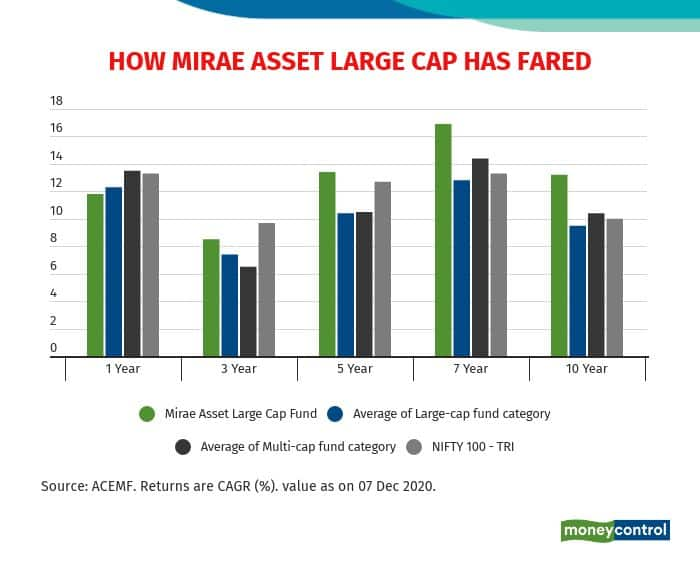
MALF has registered a marginal underperformance as compared to the peers and benchmark over the last one year. Gaurav Misra, fund manager of MALF attributes, “over the last few months, the equity market registered a strong sharp liquidity-driven rally. Around 25-30 percent of our portfolio is in the value bucket, which has not participated much in the rally. “
However, rolling returns are a better way to assess consistency of a fund’s performance as they cover multiple entry and exit points. We took the scheme’s five-year rolling returns over a total time period of seven years. So, MALF gave 12 percent returns, as opposed to the large-cap category average return of 8.3 percent and multi-cap category of 8.7 percent. The Nifty 100 total returns index gave 9 percent returns in the same period.
Making a choice in large-caps: Passive versus active investingOver the last few years, most of the active large-cap funds struggled to beat the Nifty 50 index. One of the main reasons cited was that the markets went up largely on the back of very few companies doing well, as opposed to a secular run-up. Large-cap funds that had a focussed/high conviction strategy of holding 25-35 stocks in their portfolio such as Axis Bluechip, BNP Paribas Large Cap and LIC MF Large Cap managed to outperform large-cap indices. It is worth noting that MALF was the only scheme that managed to outperform the large-cap index by holding a diversified bucket of 55-65 stocks in its portfolio.
On the prospects of active large-cap funds over passive large-cap index schemes, Misra says, “India is a growing economy and a GDP of USD 2.7 trillion will become USD 5 trillion. This kind of absolute growth, which will unfold, cannot be captured by just the mid and small-cap companies but would also be done so by some of the well-managed large-caps in the bucket of the top 100 companies. There is a scope for active fund managers to choose the winners from among them. Similarly, there are emerging categories such as platform-based technology companies and wellness insurance wherein the active manager can identify such opportunities and be ahead of the index. Also, there is scope for the fund manager to deploy the 20 percent portion in good mid or small-cap ideas, apart from the 80 percent prescribed limit for large-cap allocation.”
Portfolio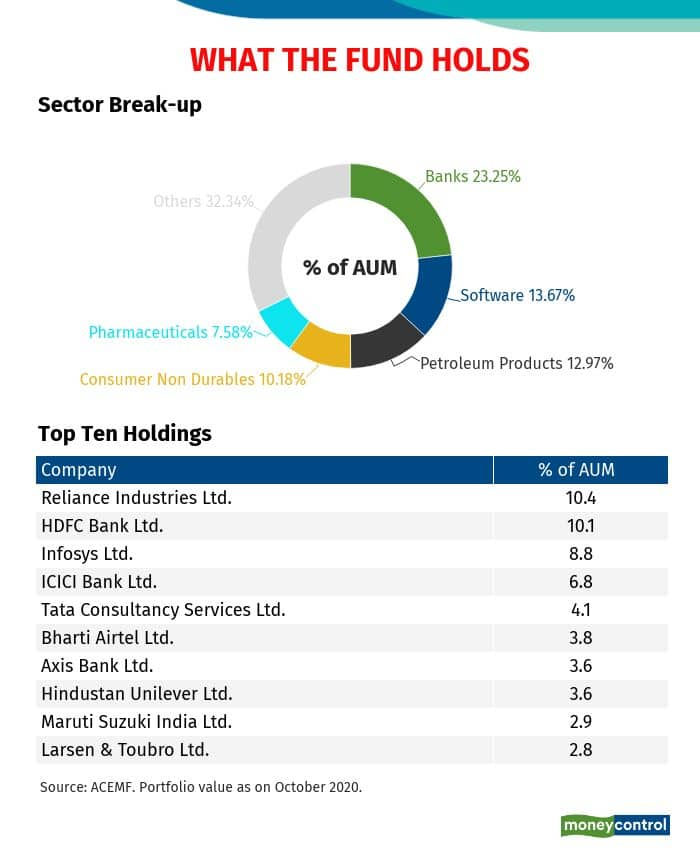
MALF has a well-diversified portfolio. It also allocates 12-13 percent of the portfolio to mid- and small-cap stocks, which has pushed up the fund’s return. The investment philosophy of the fund is built on three core principles: quality businesses with stable earnings, strong management, and attractive valuation. The top 10 holdings account for 57 percent of its portfolio. The scheme’s top three equity holdings are Reliance Industries, HDFC Bank and Infosys. The top three sectors are banks, software and petroleum products. Expense ratio of the regular plan of the fund as of October 2020 was 1.67 percent, which is lower as compared to the category average of 2.28 percent.
Assess your portfolio allocation and check if the fund would be a suitable addition to your holdings. The fund has delivered robust risk-adjusted returns over the long term. In general, investments in equity funds would need a horizon of at least five years or more for healthy returns.
Discover the latest Business News, Sensex, and Nifty updates. Obtain Personal Finance insights, tax queries, and expert opinions on Moneycontrol or download the Moneycontrol App to stay updated!
Find the best of Al News in one place, specially curated for you every weekend.
Stay on top of the latest tech trends and biggest startup news.