







If investing more often really boosted returns, a daily SIP should have clearly beaten a monthly one. After all, putting money to work 365 times a year versus just 12 sounds like a huge advantage.
But here’s the surprise: over the long term, it barely makes a difference.
Surprised? Let’s check with some numbers.
Different Frequencies, Same Money
To check whether SIP frequency really improves outcomes, we ran a simple experiment. We compared daily, monthly, and quarterly SIPs, all invested in the Nifty 50 index over a 15-year period, from December 1, 2010 to December 1, 2025.
To keep the comparison fair, we fixed one key variable: the total amount invested. No matter how frequently the money went in, the final investment had to be exactly the same.
Here’s how we structured it. In the daily SIP, Rs 1,000 was invested per installment, adding up to 3,719 installments over the period. For the monthly SIP, the amount was adjusted to Rs 20,547 across 181 installments. And in the quarterly version, the contribution rose to Rs 60,967, spread over just 61 installments. The investment rhythm changes dramatically, but the total money invested stays the same.
The final results are strikingly similar. The daily SIP grows to about Rs 1.15 crore with an XIRR of 13.83 percent. The monthly SIP ends slightly lower at Rs 1.14 crore, delivering 13.80 percent returns. The quarterly SIP once again reaches around Rs 1.15 crore, with an XIRR of 13.80 percent.
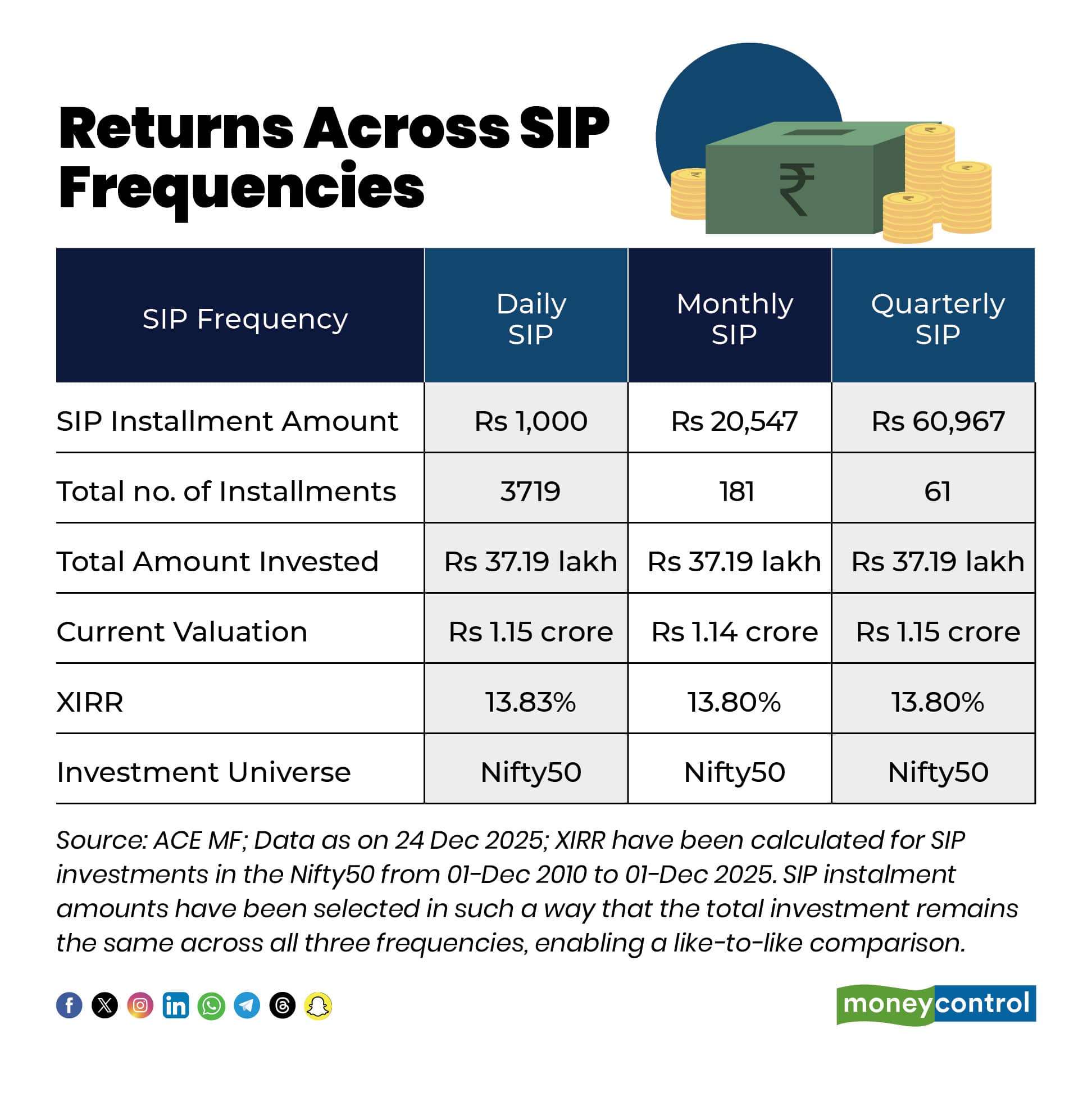 Returns Across SIP Frequencies
In short, even though the money goes in at very different intervals, the long-term returns barely move.
Yes, one option may appear marginally ahead at times, but the gap is just a few basis points. In real-world terms, that difference is negligible. In real-world terms, it’s negligible, and easily within the margin created by cash-flow timing and market noise.
One small caveat: the SIP amounts used here are not rounded because they were derived to keep the total investment identical. In practice, investors can invest in multiples of Rs 100.
Why SIP Frequency Barely Moves the Needle
Over long periods, time in the market matters far more than how often you invest.
All three SIPs stay invested through the same market cycles, rallies, corrections, and recoveries. The real driver of returns is how long the money compounds and how markets perform over decades, not whether investments happen daily, monthly or quarterly.
SIPs work primarily because they build discipline and keep investors invested. Once that discipline is in place, increasing frequency doesn’t magically improve outcomes.
So, What’s the Best SIP Frequency?
When returns are nearly the same, the decision stops being about optimisation and starts being about practicality.
For most investors, a monthly SIP makes the most sense:
Daily SIPs may sound sophisticated, while quarterly SIPs demand stronger cash-flow discipline. Monthly SIPs strike the most comfortable balance.
The Bottom Line
The data is clear: SIP frequency doesn’t materially change long-term returns when the total investment is the same.
Instead of overthinking frequency, investors are better off focusing on what actually moves the needle, staying invested, increasing SIPs over time, and resisting the urge to exit during market volatility.
In investing, simplicity usually wins. And in this case, a plain monthly SIP does the job just fine.
Discover the latest Business News, Sensex, and Nifty updates. Obtain Personal Finance insights, tax queries, and expert opinions on Moneycontrol or download the Moneycontrol App to stay updated!
Find the best of Al News in one place, specially curated for you every weekend.
Stay on top of the latest tech trends and biggest startup news.




