






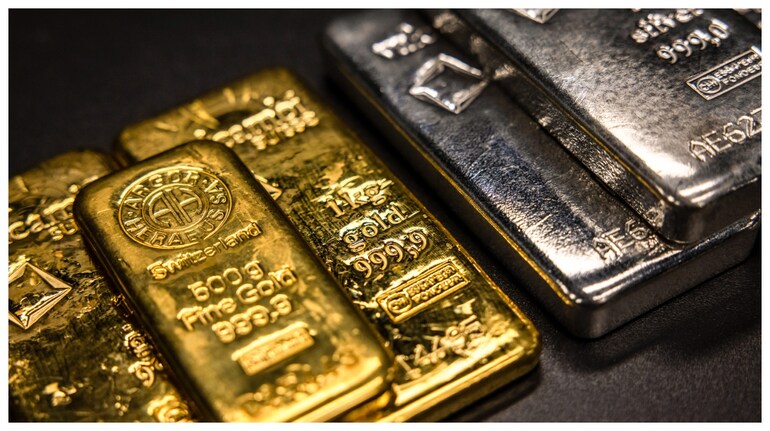

As investors grapple with persistent global uncertainty ranging from geopolitical tensions to sticky inflation and volatile equity markets precious metals are once again finding a central place in portfolios. But instead of choosing between gold or silver, there is also another option of turning to a mix gold and silver fund of funds (FoFs) that invest in gold ETFs and silver ETFs, seeking a balance between stability and growth.
The logic behind these FoFs rests on the fundamentally different, yet complementary, roles that gold and silver play in a portfolio.
Gold for stability, silver for growth
Gold has long been viewed as a financial safe haven. It tends to perform well during equity market downturns, periods of geopolitical stress and phases of currency weakness. Over the past few years, gold prices have been supported by aggressive central bank buying, de-dollarisation trends and demand for portfolio protection. As a result, gold has delivered steady returns while cushioning portfolios during sharp equity drawdowns.
Silver, by contrast, is far more cyclical. While it is also a precious metal, nearly 50 percent of silver demand comes from industrial uses, including solar panels, electric vehicles, electronics and semiconductors. This gives silver a stronger growth linkage to the global economic cycle and new-age technologies. When precious metals enter a bull phase, silver has historically outperformed gold but with significantly higher volatility.
This divergence is precisely what makes a combination of the two attractive.
Why gold and silver work better together
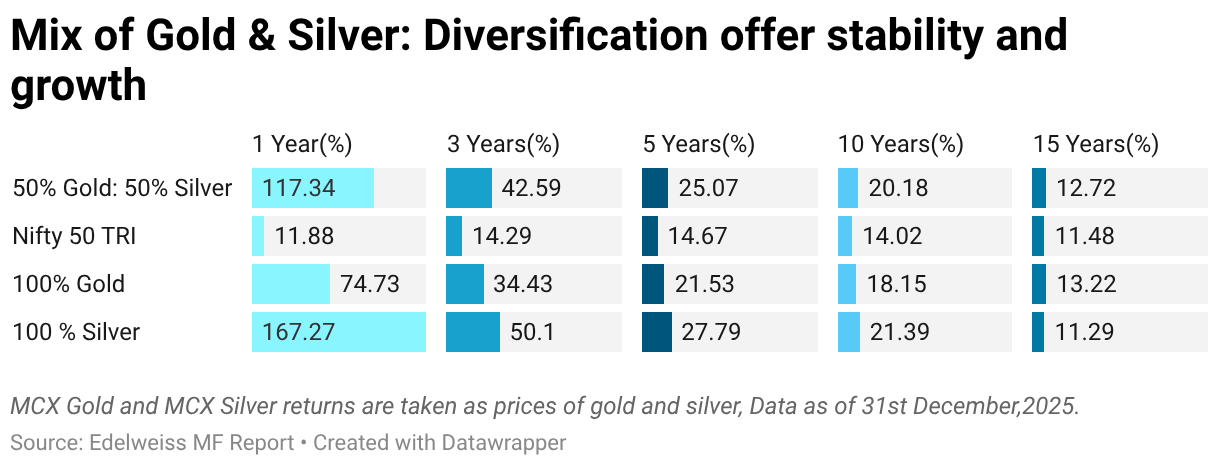
Data from Edelweiss Mutual Fund shows that a 50:50 allocation to gold and silver has historically delivered a smoother return profile than silver alone, while generating higher returns than gold-only exposure over longer periods.

During equity market stress, gold tends to limit downside. Silver may underperform in such phases, but its long-term growth drivers help boost overall returns during recoveries and commodity upcycles. The combined allocation therefore helps investors avoid the extremes—neither being too defensive nor overly volatile.
For instance, while silver delivered very sharp gains in the last one year, it has also seen deeper interim corrections in weaker years. Gold, on the other hand, has shown lower drawdowns and more consistent performance. A blended gold-silver approach helps balance these cycles.
For instance, in calendar year (CY) 2014, gold delivered a negative return of 8 percent, while silver performed worse with a decline of 16 percent. Similarly, in 2021, gold posted a negative return of 4 percent compared with an 8 percent fall in silver.
In 2025, however, silver delivered an extraordinary return of 167 percent, far outperforming gold’s 75 percent gain.
The data shows that while silver can generate sharp gains, it has also experienced deeper corrections in the past.
The role of FoFs investing via ETFs
Gold and silver FoFs typically invest in gold ETFs and silver ETFs, rather than holding physical metals. This structure offers several advantages.
First, ETFs closely track domestic spot prices of gold and silver, ensuring transparency and lower tracking error. Second, ETFs provide daily liquidity and eliminate concerns around storage, purity and insurance associated with physical metals. Third, FoFs add another layer of convenience by handling allocation and rebalancing between gold and silver internally.
Most gold and silver FoFs aim to maintain an equal allocation between the two metals, with periodic rebalancing to manage deviations caused by price movements. This disciplined approach ensures that investors systematically book profits from outperforming assets and add to laggards—something most retail investors struggle to do on their own.
One of the biggest advantages of gold and silver FoFs is that they remove the need for tactical timing. Instead of deciding when to increase gold exposure or bet on silver’s rally, investors get a ready-made diversification within commodities.
According to the Edelweiss report, a combined gold-silver portfolio has historically helped limit downside during equity downturns while still participating meaningfully in upside phases of precious metal rallies
This makes such FoFs particularly suitable for investors who want precious metals as a strategic allocation rather than a short-term trading bet.
Who should consider gold and silver FoFs?
Gold and silver FoFs are best suited for investors looking to:
Discover the latest Business News, Sensex, and Nifty updates. Obtain Personal Finance insights, tax queries, and expert opinions on Moneycontrol or download the Moneycontrol App to stay updated!
Find the best of Al News in one place, specially curated for you every weekend.
Stay on top of the latest tech trends and biggest startup news.





