








Heart risk assessments are beginning to reshape insurance pricing in India, and the impact is being felt even among younger buyers.
One in three cardiac claims filed by insureds in 2025 exceeded Rs 1.25 lakh, even when the hospital stay initially seemed routine. More concerning, close to 10 percent of cardiac claims during the period fell into the severe category, requiring ICU care or surgery, frequently exceeding Rs 5 lakh, according to the latest Plum’s biomarker data.
The study, which analysed 9,534 cardiovascular claims worth Rs 148 crore alongside more than 12,000 health checkups, revealed that nearly 60 percent of heart-related claims involve surgical intervention, sharply increasing treatment costs.
“What we're seeing in our claims data is that heart disease is no longer a late-life insurance event, but a risk that begins in your 20s,” said Saurabh Arora, Co-Founder & CTO of Plum, a Bengaluru-based insurtech startup.
Citing findings from the study, Arora explains that 46 percent of all chronic disease claims are cardiac, and the incidence of hospitalisation among the 40-plus age group has been growing 10 percent year-over-year. Individuals with existing risk see higher premiums, and those looking to buy insurance after an incident get rejected outright.
Arora suggests, “The answer is twofold: invest in preventive health early to identify underlying risk and secure your insurance cover before these silent risks start working against you. Waiting is the most expensive option.”
According to the report, severe and critical cardiac cases routinely move into the highest cost bracket, driven by ICU care, interventional procedures, and prolonged recovery. At the upper end, treatment costs frequently range between Rs 20–28 lakh, compressing the timeline between policy issuance and high-value claims and exhausting sum insured limits faster than anticipated.
1 in 6 severe cardiac patients requires ICU care
The cost escalation is particularly stark in severe cases, the report stated. One in six severe cardiac patients requires ICU care or complex invasive procedures, pushing costs from a median of around Rs 63,000 to Rs 2.5 lakh or more for stenting, and Rs 3.2 lakh or higher for bypass surgery.
“Insurers are responding to this cost reality much earlier than before. Underwriting now increasingly factors in cholesterol, blood pressure, inflammation, and metabolic markers as predictors of future high-cost cardiac events,” the report stated.
As a result, one in three personal insurance applicants now faces premium loadings of 10-50 percent once elevated cardiac risk is detected, while nearly one in five applicants is outright rejected.
Even young buyers in their late 20s and early 30s are encountering higher base premiums and longer waiting periods. “After a heart-related hospitalisation, access often worsens further through exclusions, higher premiums, or outright ineligibility,” the report stated.
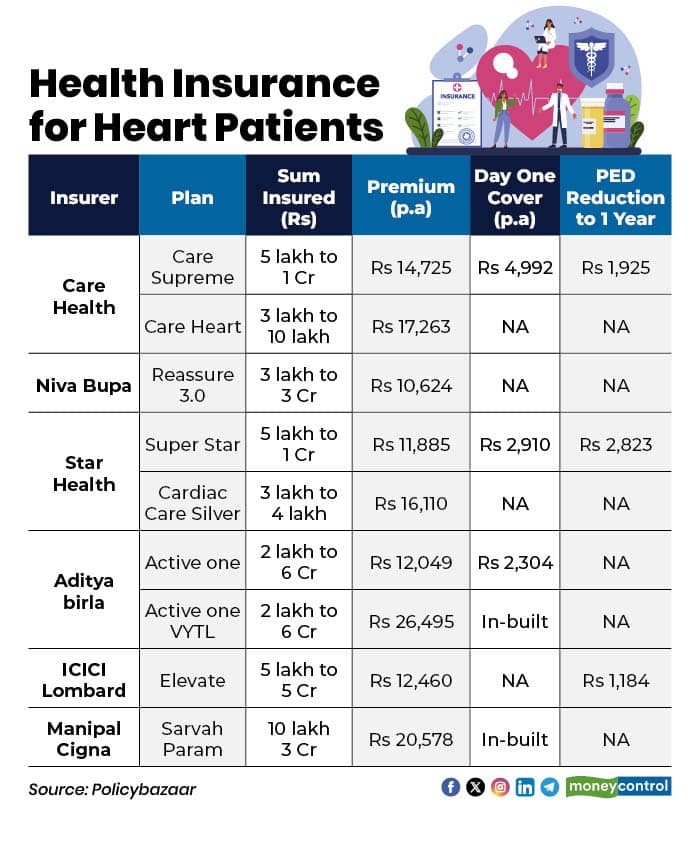
Health insurance for heart patients
While comprehensive health plans include heart disease under critical illness cover, insurers also provide specialised plans tailored specifically for cardiac patients of all ages.
For heart patients, health insurance plans in India typically cover a wide range of cardiac illnesses and related conditions, subject to policy terms, waiting periods, and exclusions. Most policies include treatment for coronary and vascular conditions, rhythm and electrical disorders, structural and functional disorders, inflammatory and other cardiac conditions, and related procedures.
While pre-existing cardiac conditions typically attract waiting periods or higher premiums, policyholders can opt to pay an additional amount for a ‘Day-1 Cover’ add-on, which allows coverage to begin after the 31-day free-look period. In addition, many insurers offer the option to reduce the pre-existing disease (PED) waiting period to just one year.
We analysed the features of six individual insurance policies that either include cardiac treatment under critical illness coverage or provide dedicated heart-specific protection.
Cardiac claims emerge earlier
Furthermore, Plum’s biomarker report noted that insurers have traditionally relied on age‑based risk pooling, assuming that younger members would cross‑subsidise older, higher‑risk cohorts. Plum’s data suggests that this buffer is eroding.
Citing key implications from the study, the report stated:
“Insurers are increasingly seeing members in their early 30s presenting with conditions that previously appeared in the late 40s or 50s,” said the report.
Disclaimer: The views and investment tips expressed by experts on Moneycontrol.com are their own and not those of the website or its management. Moneycontrol.com advises users to consult certified experts before making any investment decisions.
Discover the latest Business News, Sensex, and Nifty updates. Obtain Personal Finance insights, tax queries, and expert opinions on Moneycontrol or download the Moneycontrol App to stay updated!
Find the best of Al News in one place, specially curated for you every weekend.
Stay on top of the latest tech trends and biggest startup news.





