






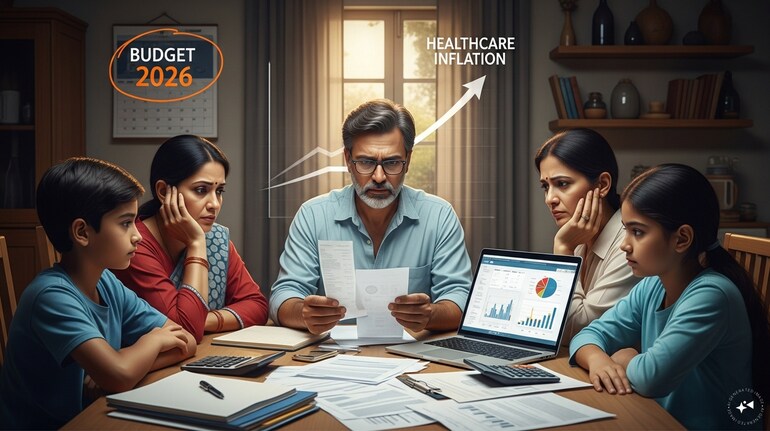

Section 80D of the Income Tax Act has long been the government’s primary tool to encourage health insurance adoption in India. While it has played an important role in nudging families toward insurance, it is increasingly evident that the provision has not kept pace with the realities of rising healthcare costs. As India prepares for Budget 2026, the focus must shift from incremental tax relief to a more comprehensive solution — a Healthcare Inflation Buffer that protects the middle class against rapidly escalating medical expenses.
Healthcare Inflation vs CPI: A Structural Mismatch
Healthcare inflation in India is estimated to be 12–14 percent annually, driven by higher hospital tariffs, advanced medical technologies, costly diagnostics, specialised treatments, and increasing prevalence of lifestyle diseases. In contrast, general inflation measured by the Consumer Price Index (CPI) has remained relatively modest, averaging around 1–3 percent in recent months.
This divergence has serious implications. While salaries, savings returns, and tax deductions grow slowly, medical expenses compound sharply. A treatment that costs Rs 5 lakh today may cost double within a few years. As a result, insurance coverage purchased earlier quickly becomes inadequate, and tax benefits like Section 80D lose their real value over time. This gap disproportionately affects the middle class, which neither qualifies for government-funded health schemes nor has sufficient financial buffers to absorb repeated medical shocks.
Why Section 80D Needs a Major Reset
Under the current framework, Section 80D allows a deduction of up to Rs 25,000 for health insurance premiums (Rs 50,000 for senior citizens), along with a small allowance for preventive health checkups. These limits were designed at a time when healthcare costs were significantly lower.
Today, even a basic family floater policy with a realistic sum assured requires substantially higher premiums. As a result, families are often forced to compromise on coverage or bear higher costs without commensurate tax relief. This perpetuates underinsurance — one of the biggest risks faced by Indian households.
Budget 2026 should consider increasing the Section 80D limit to Rs 1–1.25 lakh, particularly for families. Higher limits would allow households to purchase adequate sum assured policies that reflect actual medical costs, rather than token coverage that offers little protection during serious health events.
Introducing a Healthcare Inflation Buffer
Rather than relying solely on fixed deduction limits, India needs a Healthcare Inflation Buffer — a policy mechanism that recognises healthcare as a high-inflation sector.
One effective approach would be to index health-related tax benefits to medical inflation, ensuring that deductions rise automatically over time. This would prevent erosion of benefits, reduce the need for frequent policy revisions, and align tax relief with real-world cost escalation.
Such a buffer would also acknowledge a critical reality: even insured families incur significant out-of-pocket expenses due to sub-limits, non-payable items, diagnostics, consumables, and post-hospitalisation care. A modern tax framework must therefore support not just insurance premiums, but overall healthcare affordability.
Strengthening Preventive Healthcare Through Tax Policy
Preventive healthcare is one of the most underutilised yet cost-effective tools for reducing long-term medical expenses. Early detection of conditions such as diabetes, hypertension, cardiac disease, and certain cancers can significantly reduce treatment complexity and costs. However, preventive care often gets deprioritised due to upfront expenses and limited incentives.
Currently, taxpayers can claim up to Rs 5,000 for preventive health checkups for themselves, their spouse, dependent children, and parents under Section 80D. This limit is inadequate in today’s context, where advanced diagnostics, screenings, and scans form the backbone of early detection.
Budget 2026 should increase this preventive health check-up limit to Rs 20,000, enabling families to incorporate comprehensive screenings and diagnostic scans into routine healthcare planning. Encouraging preventive care through meaningful tax incentives would lead to better health outcomes, reduce late-stage treatment costs, and lower long-term financial strain on both households and the healthcare system.
Why This Matters for India’s Middle Class
India’s middle class sits at a vulnerable intersection. They contribute significantly to tax revenues, rely heavily on private healthcare, and yet remain exposed to catastrophic health expenses. Medical emergencies are among the leading reasons for savings depletion and distress borrowing in this segment.
A Healthcare Inflation Buffer — combining higher Section 80D limits, indexed benefits, and stronger preventive care incentives — would restore balance. It would enable families to plan healthcare expenses proactively rather than reactively, reduce financial anxiety, and prevent health events from derailing long-term financial goals.
Looking Ahead
Healthcare is no longer an episodic expense; it is a lifelong financial commitment. Budget 2026 offers a timely opportunity to modernise health-related tax policy in line with economic realities. Moving beyond Section 80D toward a Healthcare Inflation Buffer would signal a shift from symbolic relief to meaningful protection.
For India’s middle class, this is not merely a tax reform — it is a critical investment in financial resilience, health security, and long-term economic stability.
Discover the latest Business News, Sensex, and Nifty updates. Obtain Personal Finance insights, tax queries, and expert opinions on Moneycontrol or download the Moneycontrol App to stay updated!
Find the best of Al News in one place, specially curated for you every weekend.
Stay on top of the latest tech trends and biggest startup news.





