






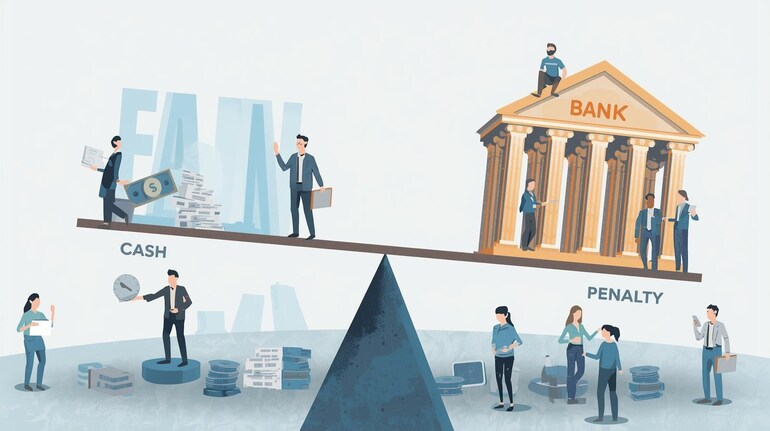

Indian Banks have collectively recovered Rs 19,083 crore in penal charges for non-maintenance of the minimum monthly average balance (MAB) in current and savings accounts, over three financial years up to FY 2024-25.
The Centre maintains that the public sector banks’ collection of Rs 8,092.83 crore from deposit account holders constitutes approximately 0.23 percent of PSBs' total income. In comparison, private-sector banks collected Rs 10,990.91 crore during the same period.
“During FY 2022–23 to FY 2024–25, PSBs have collected Rs 8,092.83 crore from deposit account holders, comprising current account and savings account holders,” the Finance Ministry told Lok Sabha in a written reply on March 9, 2026.
The Ministry further stated that PSBs review their service charges for non-maintenance of the minimum monthly average balance (MAB) in accordance with board-approved policies and commercial considerations.
Banks offer various types of accounts, including a current account for businesses and a savings account, which is usually opened by a salaried employee or general citizens. SBI waived non-maintenance MAB charges on savings accounts in March 2020. Nine more PSBs removed such charges in 2025, while the remaining two have also rationalised penalties.
Here are the bank-wise details of charges collected for non-maintenance of the minimum balance by Public and Private Sector Banks.
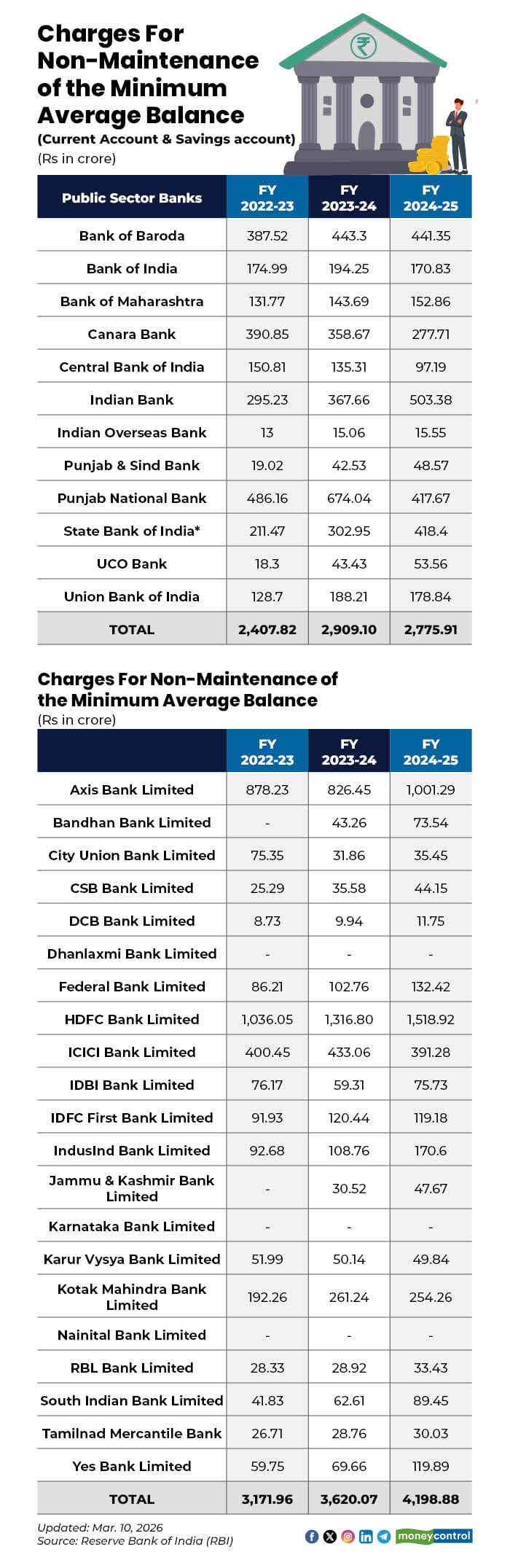
The PSBs' collection for non-maintenance of MAB penal charges in FY 2024-25 dropped 4.58 percent from FY2023-24, though it’s 13.26 percent up from FY 2022-23.
In contrast, private banks collected nearly twice as much in MAB service charges as public sector banks. For FY2024-25, their collection surged 15.99 percent from 2023-24 and 32.37 percent from FY 2022-23.
Citing RBI, the Finance Ministry stated that in cases of non-maintenance of the agreed minimum balance in bank accounts, banks have been advised to notify customers through SMS, email, letter or other appropriate means.
Customers are generally provided time to restore the required minimum balance before penalty charges are applied as per extant regulatory guidelines. Fees generally range from Rs 25 to Rs 500 or more per month, depending on the bank, account type, and location, with an additional 18 percent GST applicable.
“No general direction has been issued by the Hon’ble Supreme Court or any High Court mandating waiver or refund of such penal charges across banks,” the Ministry stated.
According to analysts, the RBI should take a policy view on the relevance of such charges, as they hurt those who have inadvertently left accounts without a minimum balance.
“If these charges are being levied to compensate for the administrative costs of maintenance of these accounts, the banks might as well close the accounts, and any balance can be remitted to the account holders in other bank accounts, UPI or kept in an escrow for seven years, like unpaid dividends of companies,” said Akshat Pande, Managing Partner at Alpha Partners.
Which types of accounts are exempted?
According to the Finance Ministry, banks may levy charges for non-maintenance of the minimum MAB in accordance with their board-approved policies and the extant RBI instructions.
Banks do not charge a non-maintenance fee for accounts under Basic Savings Bank Deposit Accounts (BSBDAs), including accounts opened under the Pradhan Mantri Jan Dhan Yojana (PMJDY).
“These accounts do not require a minimum balance and provide basic banking services such as deposits, withdrawals, and ATM access, free of charge, without the levy of any penal charges,” the Ministry said.
Disclaimer: The views and investment tips expressed by experts on Moneycontrol.com are their own and not those of the website or its management. Moneycontrol.com advises users to check with certified experts before taking any investment decisions.
Discover the latest Business News, Sensex, and Nifty updates. Obtain Personal Finance insights, tax queries, and expert opinions on Moneycontrol or download the Moneycontrol App to stay updated!
Find the best of Al News in one place, specially curated for you every weekend.
Stay on top of the latest tech trends and biggest startup news.





