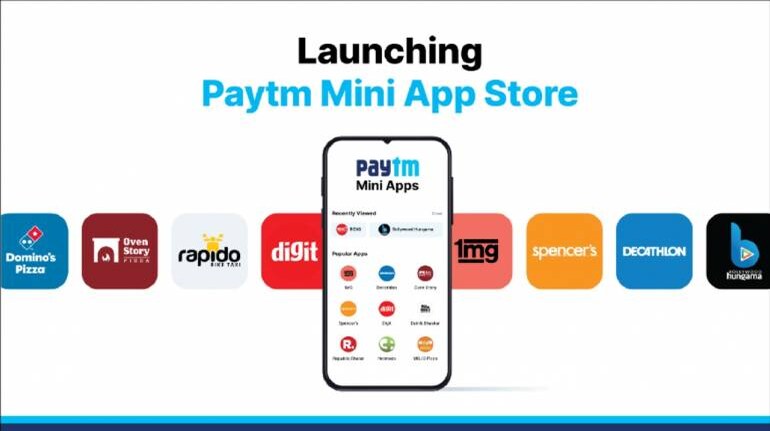
Financial services major Paytm will offer a Rs 10-crore developer fund as equity investments in startups looking to publish their applications on the Paytm Mini App store and looking to scale up their business, the company said during a developer conference on Thursday.
Vijay Shekhar Sharma, founder of Paytm, said that this is part of the Noida-headquartered payment major’s commitment to the Indian app ecosystem and assistance to players in this space to ensure that they can grow without relying only on Google Play Store.
Sharma further offered favourble terms and conditions for this investment.
The developer conference was organised to showcase the recently launched Mini Apps programme of Paytm.
Paytm’s attempt to build its own app store comes as a response to Google’s pricing and restrictive business policies for developers looking to publish apps and sell digital services on Google Play Store.
The big problem
“We cannot have one gatekeeper to our app ecosystem, and, more importantly, the gatekeeper is not even Indian,” said Rajesh Sahwney, founder of GSF Accelerator.
Sawhney was speaking at a post-event roundtable hosted by Sharma and attended by Goqii founder Vishal Gondia, and Anand Lunia, General Partner at venture capital firm India Quotient.
Murugavel Janakiraman, chief executive officer, BharatMatrimony.com,
was also present.
The group of investors and entrepreneurs came together to promote the ‘atmanirbhar’ scheme, and to challenge the hegemony of Google in the country.
Given India has a more than 95 percent share of Android phones, Google Play Store has almost become the default platform for app downloads and updates. While this was always known, matters came to the fore when Google added sectors like education, fitness, dating, music, video and others to its mandatory Google Billing policies.
The policy says that all payments made for apps downloaded through Play Store will have to flow through Google Billing only. Further, for every transaction, 30 percent will be taken by Google and 70 percent will go to the developer.
This is a major problem for internet businesses, which, in a market like India, typically, operates on very thin margins.
Effectively, any app, which is selling services digitally, will have to pay 30 percent at the time of download and for every future in-app payments, which has set alarm bells ringing across the startup ecosystem. All physical sales have been kept outside the purview of the charge.
“The 30 percent charge is atrocious and we need to free the Indian internet ecosystem from the clutches of Google,” said Janakiraman.
Regulatory intervention
Lunia of India Quotient compared Google’s charges to an electricity supplier which will charge 30 percent of the revenue of any business which is using its services.
“There is a need for an alternative. We cannot be fully dependent on the Play Store for our app ecosystem,” he said.
Highlighting the issue recently faced by Paytm, Gondia of Goqii said that despite being an RBI-regulated entity, Paytm had its application removed from Play Store because of some compliance issues with the platform.
“For Indian regulators, it is a wake-up call. Google, in this case, seems to be superseding regulators as well,” he said.
Challenge to Google
The panel unequivocally asked for alternate platforms for app distribution and immediate removal of the 30 percent imposed by Google as distribution charge.
Further, it also asked for clarification on how the entire Google Billing structure would be separated from Google Pay, their digital payment offering in India.
Highlighting the fact that it is a global movement against monopolistic behaviour of these large corporates, Gondia took the example of Epic Games taking both Google and Apple to court in the United States.
“The need of the hour is for our regulators to either get acquainted with these technology businesses or hire lateral talent who can do this,” he said.
Data is the new oil
The way India suffered because of its dependence on import of oil, if the internet ecosystem gets overrun by global companies, the country will continue to pay a hefty digital bill too, said the panelists.
Lunia pointed out that it is only time when the digital import bill of the country will become even bigger than the oil import bill.
Murugavel dismissed the claim that only 3 percent of the existing apps will get affected by the move. He explained that eventually it will affect every app on Play Store since the charges are also being brought to in-app payments, the monetisation route for most of these startups.
“If Google was helping in marketing, I could have understood the charge. It is only for providing a platform, such a charge is being imposed. That is the problem,” added Lunia.
Sharma, who played a critical role in bringing these entrepreneurs and investors together, said that, going forward, there is a clear need to control global companies’ access to Indian data and Indian companies should control the destiny of digital India.
The power should not be with an American or Chinese or Australian company, which do not abide by the law of the land, he said.