






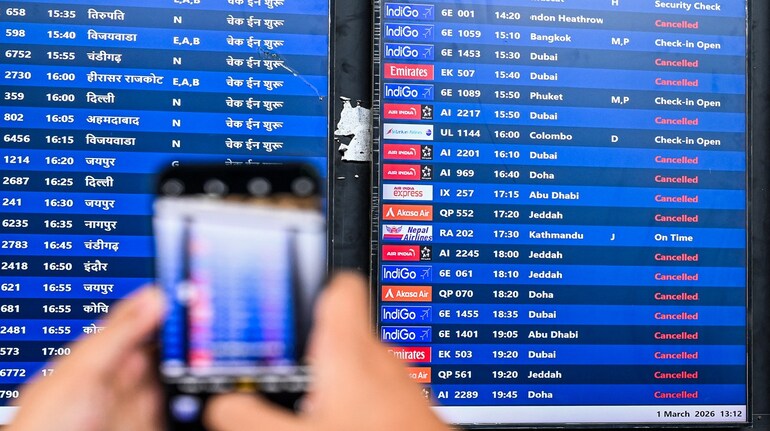

Global aviation is staring at its sharpest disruption since the Covid-19 pandemic, as the conflict involving Iran, the US, and Israel shuts key Gulf airspace, crippling some of the world’s busiest transit hubs. What began as a regional military escalation is rapidly spiralling into a global travel crisis, stranding passengers, driving up fuel costs, disrupting cargo flows, and raising questions about the durability of the Gulf-centric aviation model.
Airlines cancelled and diverted hundreds of flights for a third straight day on Monday as widening closures across West Asia forced carriers to suspend services through critical corridors. Major hubs in Dubai, Doha, and Abu Dhabi were shut for extended periods or operated under heavy restrictions, leaving tens of thousands stranded and aircraft out of position.
The immediate shock
The shock has exposed the structural vulnerability of the Gulf hub model.
Dubai International, the world’s busiest airport for international passengers in 2024, alongside Doha and Abu Dhabi, forms the backbone of east-west connectivity. When these hubs slow or close, the ripple effects cascade across continents, fracturing tightly calibrated aircraft and crew schedules.
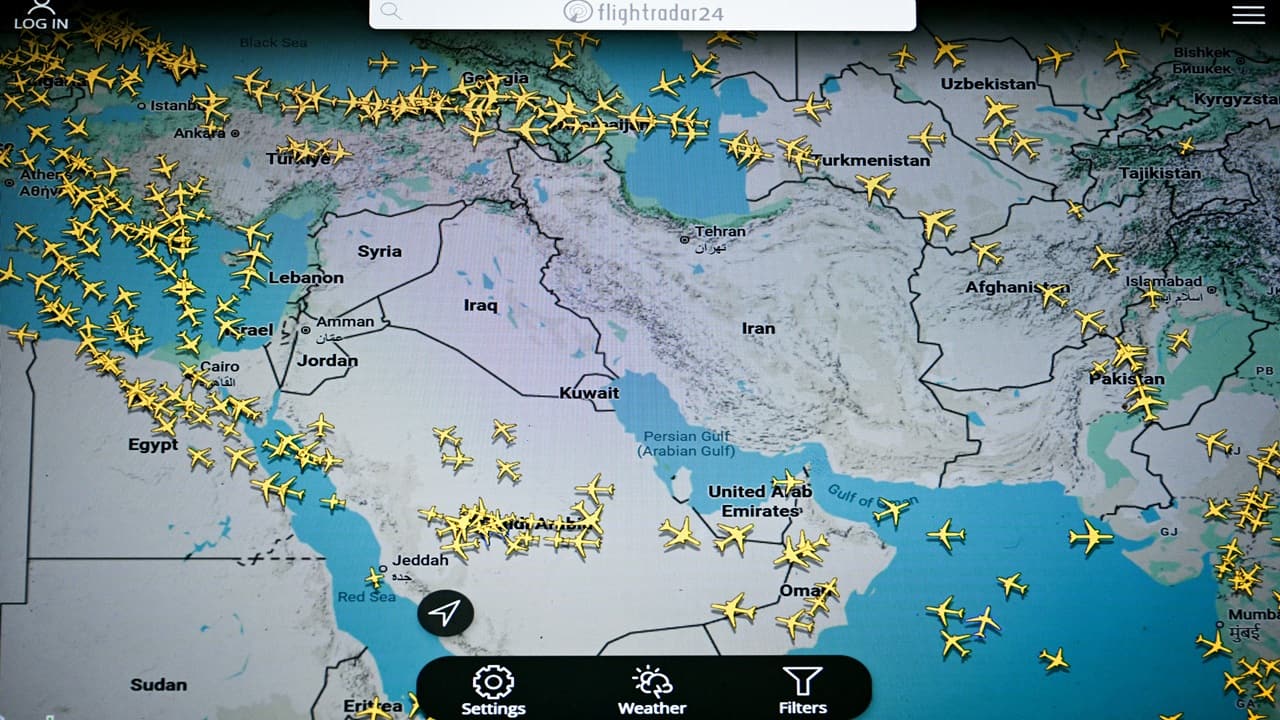 This photograph displays a page on the Flightradar 24 website that shows civilian flights avoiding Iranian and Iraqi skies on Mar 1.
Within the first 72 hours of the West Asia escalation, thousands of flights were cancelled globally.
According to aviation data cited across reports, roughly 90,000 passengers per day were stranded across Gulf hubs in the initial phase. Airlines, including Emirates, Etihad, and Qatar Airways, which together built the modern East-West transit system, halted or sharply curtailed operations.
As author and independent analyst Shanaka Anslem Perera put it, "The global aviation model just hit a missile".
THE GLOBAL AVIATION MODEL JUST HIT A MISSILEEmirates suspended operations from Dubai. Etihad grounded flights from Abu Dhabi until at least March 4 according to FlightGlobal. Qatar Airways halted departures from Doha, holding cargo at hubs worldwide. PBS confirmed 2,280 flights… https://t.co/cTanOjX86Spic.twitter.com/lumHn3fj4T — Shanaka Anslem Perera ⚡ (@shanaka86) March 2, 2026
The very phrase captures the structural nature of the shock. This is not simply about delayed departures.
The Gulf carriers are not ordinary regional airlines, they are the connective tissue of 21st-century aviation.
But why does Iran’s geography matter?
Iran, it should be noted, sits at the very cross-section of critical air corridors connecting Europe and Asia. Even before this escalation, overflight routes above Iran and Iraq had grown more important after airlines began avoiding Russian and Ukrainian airspace following the Ukraine war. That shift had concentrated traffic through West Asia.
Now, with Iranian and neighbouring airspace contested or closed, airlines are being squeezed into narrower southern corridors, rerouting over Saudi Arabia, Oman, Egypt, or further south. Each diversion adds one to three hours of flying time on many long-haul routes.
Longer routes mean:
>> Higher fuel burn
>> Increased crew costs
>> Aircraft and crew displacement
>> Reduced aircraft utilisation
>> Knock-on schedule disruptions worldwide
Flights priced for direct overfly are suddenly absorbing thousands of extra gallons of jet fuel per departure. This comes as oil prices surge sharply amid fears of supply disruptions in the Strait of Hormuz, compounding cost pressures, and further adding to the chaos.
The economic chain reaction
The financial strain is intensifying.
Longer routes mean higher fuel burn, increased crew costs and reduced aircraft utilisation at a time when oil prices are climbing amid fears of supply disruption near the Strait of Hormuz. Flights priced for direct overfly are now absorbing thousands of additional gallons of jet fuel per sector, squeezing margins even for airlines not directly operating to the Gulf.
Airline profitability under strain
Fuel accounts for 25-35% of airline operating costs. A sustained rise in crude prices combined with longer routes can quickly erode margins. Even carriers not flying directly to the Gulf feel the pain through higher global fuel benchmarks.
Ticket prices likely to shoot up
Airlines are known to typically pass part of the cost increases onto passengers. If the conflict lasts another four weeks, as US President Donald Trump has suggested in his latest statements on the conflict, fare surges could become widespread, especially on Europe-Asia and transcontinental routes.
Cargo disruption and trade impact
Gulf hubs are major air cargo crossroads. Freight rates are already spiking as shipments are delayed or rerouted via Istanbul, Singapore, or Addis Ababa. Air cargo is critical for pharmaceuticals, electronics, high-value goods, and just-in-time supply chains. Prolonged disruption risks feeding into broader inflationary pressures.
Insurance and war-risk premiums
Underwriters are recalculating war-risk insurance premiums in real time. Higher insurance costs raise operating expenses for airlines and cargo operators flying near conflict zones.
Tourism demand shock
Travel advisories and dramatic headlines suppress demand even in geographically distant destinations. Experience shows travellers often perceive regional risk broadly. If instability persists, inbound tourism to West Asia could collapse, with spillover effects on neighbouring regions.
The four-week scenario: A structural shift?
If approximately 90,000 passengers are affected per day across Gulf hubs, a four-to-five-week disruption is anticipated impact more than 3 million travellers. Each requires rebooking, accommodation, meals, and potential compensation under international passenger rights frameworks. That is a logistical and financial burden running into hundreds of millions of dollars.
But the deeper risk is structural.
For two decades, Emirates, Etihad and Qatar Airways built a hub-and-spoke model based on one assumption -- the Persian Gulf is a permanently stable midpoint between continents. That geographic midpoint, once a competitive advantage, now becomes a liability if airspace remains contested.
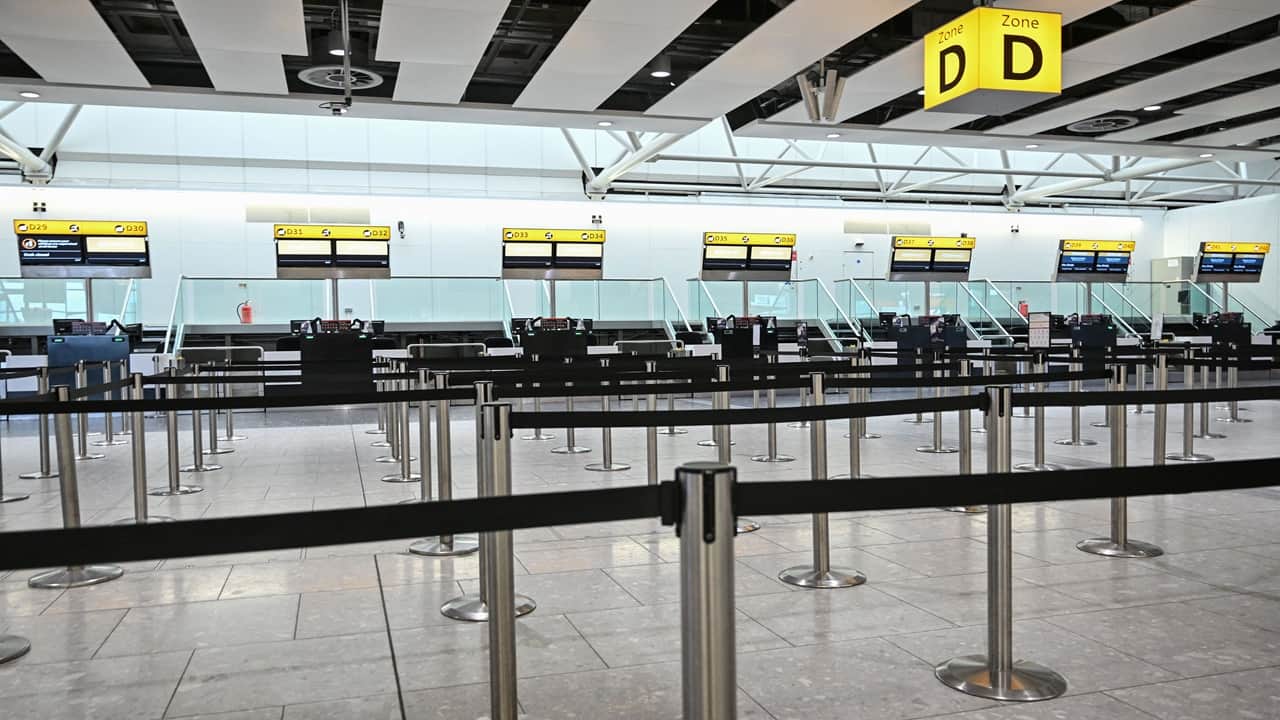 Empty desks at the check-in counter for Gulf carrier Etihad at London Heathrow Airport in west London on March 1.
As Perera warns, “The midpoint between continents is also the midpoint of a war zone.”
If airlines and insurers begin pricing in sustained geopolitical risk, carriers may permanently:
>> Increase direct long-haul services that bypass Gulf hubs
>> Strengthen alternative transit points such as Istanbul or South Asia
>> Reduce capacity growth through the Gulf
>> Reallocate aircraft to less volatile corridors
>> Such adjustments could gradually dilute the dominance of the Gulf model in global aviation.
Tourism economies at risk
West Asia’s aviation success transformed Gulf economies into tourism and logistics powerhouses. Airports like Dubai International and Hamad International are not just transit points; they are economic engines.
Extended airspace instability could:
>> Reduce hotel occupancy
>> Delay tourism investments
>> Slow aviation-led diversification strategies
>> Damage destination branding built on perceptions of safety and neutrality
Beyond the region, tourism-dependent economies in Europe and Asia that rely on Gulf transit flows could see reduced arrivals.
A fragile global system exposed
Modern aviation is deeply interconnected.
Aircraft, crew rotations and maintenance schedules operate in a finely tuned global choreography. When hubs close, crews are stranded out of position, aircraft accumulate in the wrong locations, and recovery takes days, even after airspace reopens.
What makes this crisis distinct is scale. Previous conflicts caused route diversions, but rarely a simultaneous shutdown of multiple major Gulf hubs. Analysts describe the disruption as the most acute since the pandemic halted travel in 2020.
The broader economic picture
Rising oil prices, higher transport costs, disrupted cargo, shaken consumer confidence and volatile equity markets combine into a wider macroeconomic risk. Airlines’ share prices have already plunged across Asia-Pacific as investors factor in prolonged uncertainty.
If hostilities persist for another month, the consequences may extend beyond temporary chaos. The industry could face repricing of long-haul travel economics, permanent route recalibration, shift in global transit hierarchies and higher structural costs embedded into fares.
The West Asia conflict has done more than disrupt flights; it has laid bare how much of global connectivity depends on geopolitical stability in one narrow corridor of airspace.
The world built its modern East-West aviation superhighway through the Gulf. If that corridor remains unstable for weeks, airlines may begin redesigning the map.
As the tweet starkly frames it, "The world built global connectivity through a war zone. The war just arrived".

Discover the latest Business News, Sensex, and Nifty updates. Obtain Personal Finance insights, tax queries, and expert opinions on Moneycontrol or download the Moneycontrol App to stay updated!
Find the best of Al News in one place, specially curated for you every weekend.
Stay on top of the latest tech trends and biggest startup news.





