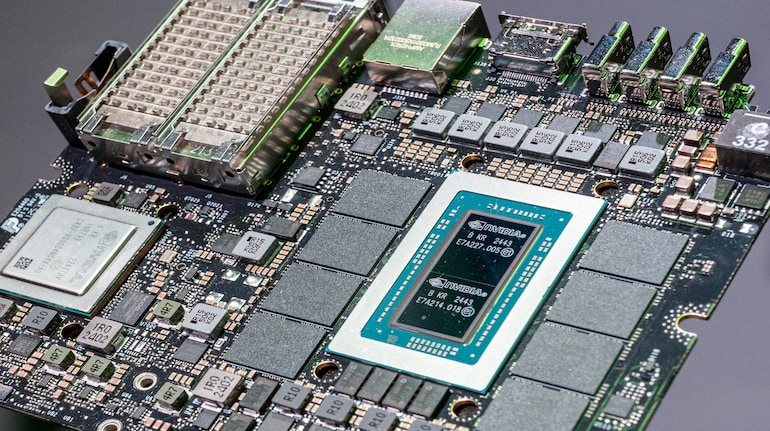
Nvidia Corp. Chief Executive Officer Jensen Huang said his company isn’t in active discussions to sell its Blackwell AI chips to Chinese firms, waving off speculation it’s trying to engineer a return to the world’s largest semiconductor market.
Huang, who arrived in Taiwan Friday ahead of meetings with longtime partner Taiwan Semiconductor Manufacturing Co., took the opportunity also to clarify recent comments about the US-China AI race. The Nvidia honcho caused a stir in an interview this week with the Financial Times, when he was quoted as saying “China will win” that competition. Huang explained he merely intended to point out the Asian country’s prowess in the fledgling technology.
The 62-year-old founder is continuing to tour the world after making stops in Washington and South Korea last week, while striking deals across industries with companies looking to tap Nvidia’s artificial intelligence hardware expertise. Huang has been dogged in particular by persistent speculation that the US would permit sales of Blackwell — Nvidia’s current leading-edge AI chip line — into China.
“There are no active discussions. Currently, we’re not planning to ship anything to China,” Huang said from Tainan, south of Taipei. “It’s up to China when they would like Nvidia products to go back to serve the Chinese market. I look forward to them changing their policy, and hopefully we’ll be able to serve the Chinese market again.”
Nvidia has added $1 trillion to its market value in a matter of months, becoming the first $5 trillion company in history. While the stock has lost steam in recent days, Nvidia remains the most valuable business on the planet, ahead of tech peers Apple Inc. and Microsoft Corp.
Huang is spurring global adoption of AI to expand the use of Nvidia’s technology across regions and industries. The CEO is also trying to alleviate concerns of an AI bubble and prove that trillions of dollars in hardware investments — such as data centers and Nvidia chips — will pay off.
Among Nvidia’s challenges are rival chipmakers Advanced Micro Devices Inc. and Broadcom Inc. that are seeking their own AI payoff.
Nvidia remains barred from selling AI chips that would be big moneymakers in China. A US-China trade accord unveiled last week didn’t include approving sales of Nvidia’s Blackwell chips to Chinese customers, and Trump administration officials have indicated that such a move is off the table for now. If Nvidia were allowed to ship more capable products to the Asian nation, it would be able to take advantage of a $50 billion opportunity there, Huang said during earnings in August. Huge demand for AI systems in China means that market is set to grow at 50% per year, he said.
The China setback has fed into concerns among some Wall Street investors about the sustainability of extraordinary spending on AI. They fear that artificial intelligence risks falling short on its promise of generating new streams of revenue that can justify hundreds of billions of dollars in capital expenditures on data centers and the Nvidia chips that run them.
Discover the latest Business News, Sensex, and Nifty updates. Obtain Personal Finance insights, tax queries, and expert opinions on Moneycontrol or download the Moneycontrol App to stay updated!
Find the best of Al News in one place, specially curated for you every weekend.
Stay on top of the latest tech trends and biggest startup news.