








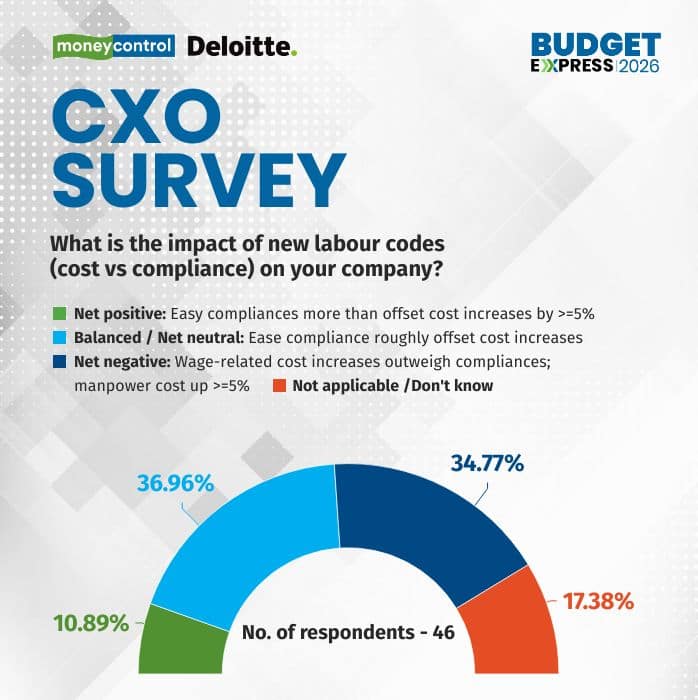
As many as 37 percent of senior company executives feel the new labour codes have not led to any significant gain or loss for the company’s costs, but about 35 percent feel they have been net negative.
These figures have been taken from a Moneycontrol-Deloitte CXO Survey conducted on 46 executives.
As per survey, 17 respondents (37 percent) say that compliance simplification by the four new labour codes roughly offsets costs increases.
16 respondents (34.8 percent) say that wage related cost increases outweigh compliance simplification, thus increasing overall manpower by over 5 percent. 5 respondents, however, say the exact reverse; and 8 are yet to do an assessment.
"Gratuity costs will increase. All other aspects were already in place. No visible reduction in compliance costs, though second degree easing of compliance is highly appreciated," said one executive.
"Simplified compliance frameworks improve operational efficiency, though some cost pressures may emerge during transition," second executive noted.
And another person said that "it’s full of complications and will lead to lots of challenges."
The central government in November notified the four labour codes, which subsumed in it 29 former labour laws. The four codes are: Code of Wages, 2019; The Social Security Code, 2020; The Occupational Safety, Health, and Working Conditions Code, 2020; and The Industrial Relations Code, 2020.
The new codes mandate universal minimum wages, ensures gender equality in pay and hiring, standardises definition of wages, mandates overtime benefits, stipulates social security for gig and platform workers, improves dispute resolution mechanism, decriminalises minor offences, and reduces compliance costs.
Earlier in an interview to Moneycontrol, Labour Secretary Vandana Gurnani had said that in terms of pure costs, there are many provisions in the codes, which will offset the impact on companies.
"There is a huge compliance reduction for companies – which will save them a lot of money," she had said.
"Simpler, transparent, and decriminalised laws led to lesser confusion and litigation. Industry will benefit from this. The registration is single, license is single, return is single. The number of registers that companies need to maintain now have come down from 84 to 8. The compliances approvals will all be digitally now," Gurnani had said.
"Also, there are timelines imposed now. For instance, if a license has to be provided, it has to be done in a specific period, else, it’s deemed approval. 87 criminal offences are reduced to 22, of which 16 are compoundable. Only six are non-compoundable, which are very serious, such as safety violation, or non-adherence to social security rules. Procedural and technical offences have been converted to heavy penalties and fines. Criminal offences have been rationalised," she had said.
All this will benefit the MSMEs the most, because for them meeting compliances is tough, she added.
Earlier this month, India’s major tech companies had reported a hit on profit margins in the December quarter -- on account of additional expenditure incurred on new labour codes.
Moneycontrol reported on January 15 that TCS, Infosys and HCLTech incurred a combined Rs 4,373 crore in exceptional charges (one-off expense) due to the implementation of the labour codes.
Tata Consultancy Services (TCS) reported a Rs 2,128 crore exceptional charge, Infosys Rs 1,289 crore and HCLTech Rs 956 crore.
This was largely because of the changes in definition of “wages”. The Code on Wages mandates that a minimum of 50 percent of an employee’s remuneration include basic pay, dearness allowance and retaining allowance, which are collectively referred to as "wages".
All other allowances such as HRA, conveyance and special allowance, cannot exceed 50 percent of the total remuneration. If allowances account for more than 50 percent of an employee’s remuneration, the excess amount will be automatically added to "wages" for statutory calculations.
It simply means the base for the calculation of the provident fund and gratuity has now increased, and more money will flow to those accounts.
An official from the government, however, said that these are "one-time expenses" due to the transition phase. "The companies going forward will formulate their remuneration package accordingly. We must remember the codes were finalized and implemented after due consultation from all stakeholders, including the industry," the official told Moneycontrol when asked about the higher costs.
Discover the latest Business News, Sensex, and Nifty updates. Obtain Personal Finance insights, tax queries, and expert opinions on Moneycontrol or download the Moneycontrol App to stay updated!
Find the best of Al News in one place, specially curated for you every weekend.
Stay on top of the latest tech trends and biggest startup news.





