







Even as traders debate the intent behind the finance minister’s decision to hike Securities Transaction Tax (STT), the move is projected to generate about Rs 10,000 crore in additional tax revenue, while triggering an estimated Rs 10 lakh crore erosion in market capitalisation — albeit largely on paper — on Budget day.
The sharp hike in STT announced in the Budget has spooked market participants and drawn strong criticism from traders and brokers, who say the measure will significantly raise transaction costs, hurt derivatives activity and weigh on brokerage revenues that are heavily dependent on futures and options volumes.
While a section of the market believes the move is aimed at discouraging excessive retail speculation in derivatives, others argue that the impact will be far more as the additional cost will disrupt high-frequency trading (HFT) models and institutional trading strategies.
Recent regulatory action against global trading firm Jane Street has already highlighted how large quant funds dominate volumes and extract disproportionate gains from derivatives markets, intensifying the debate around more even playing field for market participants.
Diverging Views on Market Impact
Some long-term investors have welcomed the move as a necessary step to rein in speculative excesses by retail traders in the backdrop of the SEBI study showing how more 9 out of 10 individual traders end up losing money in derivatives trading.
“India is not a country where you can realistically ask traders to take an exam and qualify before participating in markets — that would crash volumes by 90 percent and be undesirable,” said S Naren, chief investment officer at ICICI Prudential Mutual Fund.
“In my more than 30 years of experience, I have not come across people who have created long-term wealth by trading in derivatives,” he said, adding that higher taxes could help curb excessive speculation.
Others, however, believe the timing of the move is problematic. They argue that such cost increases are easier for markets to absorb during strong bull phases, but when sentiment is already fragile and indices are showing bearish undertones, higher transaction taxes risk further damaging confidence, participation and liquidity.
Radhika Gupta, Managing Director and Chief Executive Officer of Edelweiss Mutual Fund, cautioned earlier that while curbing speculative excess is a legitimate policy objective, the STT hike could also hurt institutional participation and arbitrage activity, leading to a broader decline in derivatives volumes.
Government Revenue Math
The government had initially set an STT collection target of Rs 78,000 crore for the current financial year, but slowing derivatives activity has forced a downward revision. The revised estimate now stands at Rs 63,670 crore, nearly 18.4 percent lower than the original projection.
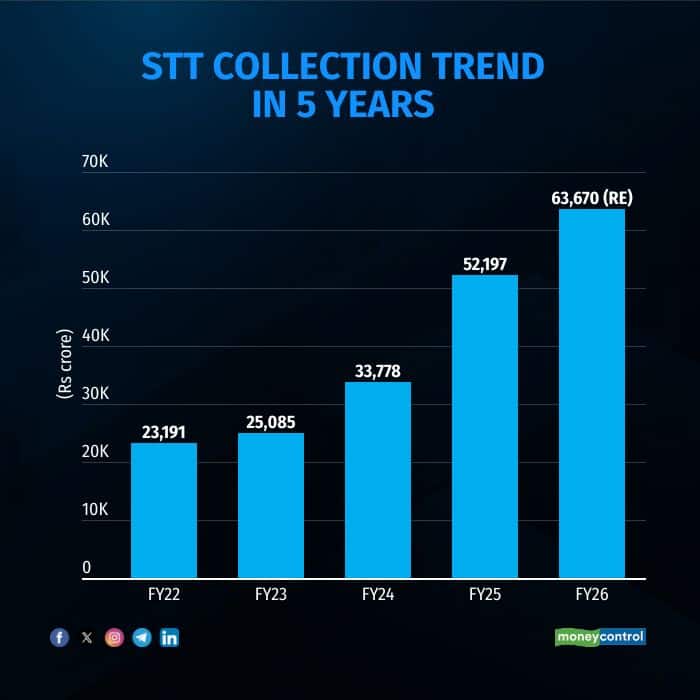
With the latest steep hike, the finance ministry has projected STT collections of Rs 73,700 crore for the next financial year, implying an incremental gain of roughly Rs 10,000 crore over the current year’s expected inflows.
However, market participants caution that the higher tax rates could themselves suppress volumes, making these revenue assumptions difficult to achieve.
Also read: STT hike may hit derivatives volumes up to 30%; market participants flag liquidity concerns
Volumes Already Slowing
Data from Securities and Exchange Board of India shows that derivatives activity has already begun to soften. In December 2025, average daily turnover (ADT) in equity futures declined 11 percent month-on-month, while options premium turnover fell 8 percent across NSE and BSE. On a year-on-year basis, options premium turnover rose 11 percent, but equity futures ADT declined 5 percent, highlighting the uneven nature of market participation.
Market participants say regulatory tightening in the past year, including action against large proprietary trading firms, has already cooled activity, and the latest STT hike is likely to amplify this slowdown.
Why Futures Traders Are Hit Hardest
Traders have also questioned the steep differential in rate hikes across derivatives segments.
From April 1, 2026:
STT on options premium will rise to 0.15 percent from 0.10%
STT on options exercise will increase to 0.15% from 0.125%
STT on futures trading will jump sharply to 0.05% from 0.02%
The futures segment, which has already seen declining volumes —faces the steepest relative increase, intensifying concerns around liquidity and cost viability for systematic strategies.
STT: A Low-Cost Revenue Engine
STT has historically been a stable and efficient revenue stream for the government, given its near-zero collection cost. Exchanges collect the tax and transfer it directly to the exchequer. Collections have surged over the past five years, but last three years have been really good. STT collection was around Rs 23,200 crore in financial year 2021-22, which jumped close to 50 percent in the 2023-24. The numbers further jumped to more than Rs 52,000 crore in 2024-25.
While the government had projected Rs 78,000 crore for the current year, weaker trading activity has forced a recalibration. With market experts now forecasting a 20–30% decline in derivatives volumes, the sustainability of the Rs 73,700-crore STT target for FY27 remains uncertain.
The Bigger Question
For now, the debate remains unresolved: whether the STT hike will successfully curb speculative excess without damaging market depth — or whether the cost of collecting an extra Rs 10,000 crore in tax will be prolonged pressure on liquidity, participation and price discovery.
What is clear is that the derivatives ecosystem—from traders and brokers to institutional desks—is bracing for a structural reset.
Discover the latest Business News, Sensex, and Nifty updates. Obtain Personal Finance insights, tax queries, and expert opinions on Moneycontrol or download the Moneycontrol App to stay updated!
Find the best of Al News in one place, specially curated for you every weekend.
Stay on top of the latest tech trends and biggest startup news.





