






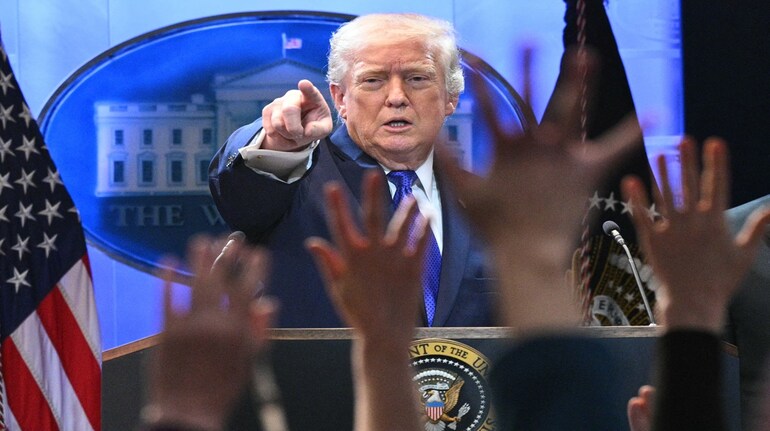

The global tariff story under President Donald Trump has been anything but straightforward. What began as sweeping “reciprocal” duties imposed under emergency powers was upended by a landmark US Supreme Court ruling that struck down the administration’s use of the International Emergency Economic Powers Act (IEEPA) to levy broad tariffs.
For a brief moment, it appeared as though the tariff wall might come down. Instead, within hours, the White House pivoted to another statute — Section 122 of the Trade Act of 1974 — announcing a temporary but sweeping 15% global import surcharge. The result: the tariff regime has been redefined, not removed, and the uncertainty surrounding global trade continues.
For markets, the twists have triggered bouts of trepidation and volatility. For India, the new tariff architecture is positive with the global tariff rate better than the interim US-India trade tariff at 18% announced earlier.
The Financial Times reported that India remains one of the biggest gainers from the new tariff regime, where duties are layered, with most goods facing MFN rates plus the new 15% surcharge, while sector-specific levies under national security provisions remain intact.
As markets, exporters and policymakers assess the new playing field, here is a comprehensive breakdown of the tariff architecture now in force — and what it means for India’s textiles, steel, autos and other export-driven sectors.
Under the second Trump administration, a major trade policy — often called the “Liberation Day” tariff regime — was launched on April 2, 2025. Trump issued an executive order declaring a “national emergency” over the US trade deficit and imposed broad “reciprocal tariffs” on nearly all imports using the International Emergency Economic Powers Act (IEEPA).
This meant:
For India and others, this meant high duties on exports to the US in many categories, including textiles, engineering goods and more — contributing to trade uncertainty and elevated costs.
In a landmark decision on February 20, 2026 in Learning Resources, Inc. v. Trump, the US Supreme Court (6–3) ruled that IEEPA does not authorize the President to impose general tariffs. It held that tariff authority is a legislative power belonging to Congress and cannot be exercised by the president under that statute.
The immediate consequences:
After the Supreme Court strike-down, the Trump administration pivoted to alternate statutory authorities to maintain trade leverage under the law.
1. Global Tariff Under Section 122
Hours after the Supreme Court ruling, Trump signed an order imposing a 10% global tariff under Section 122 and within a day raised it to the statutory maximum of 15%. This is the first time Section 122 has been invoked for a broad “global tariff”. Section 122 of the Trade Act of 1974 allows the US President to impose a temporary import surcharge of up to 15% to address “balance-of-payments deficits”.
It does not require lengthy investigations. But tariffs enacted under it can last up to 150 days unless extended by Congress. Section 122 is now the centerpiece of the new tariff regime. What form and shape this tariff will take after 150 days is the most important monitorable from hereon.
Important nuance: Section 122 does not replace normal US tariff law; it adds an extra layer on top of existing duties. This means that most imports will be subject to:
2. Section 232 – National Security Tariffs (Steel, Autos, etc.)
Section 232 of the Trade Expansion Act of 1962 allows the US to impose tariffs on imports that are deemed to threaten national security, based on findings by the Commerce Department.
This authority has no 15% cap and no built-in expiration. It is sector-specific and typically applies after an investigation.
Steel, aluminum and autos & auto parts are among products historically and currently covered under Section 232. Crucially: Section 232 tariffs remain in force after the Supreme Court’s decision because they are based on a separate statutory authority, not IEEPA.
3. Section 301 – Unfair Trade Practices
Section 301 of the Trade Act of 1974 allows tariffs in response to what the US considers unfair trade practices, like IP theft or discriminatory measures. It has been used most famously in disputes with China. These tariffs also remain in effect; the Supreme Court decision did not affect them. India has never faced Section 301 tariffs and is under threat on this account.
Textiles and Apparel
Under the new regime, most textile imports into the US are subject to their normal Most-Favoured-Nation (MFN) duty rates — the baseline WTO-consistent tariff — and now also face a 15% global surcharge under Section 122.
Because textiles historically have MFN duties in the single- to mid-digit percentages, the 15% surcharge becomes the dominant duty element. But the global tariff as well as the MFN tariffs are uniform across countries, so differentiation in competitiveness because of tariff.
For India, this is a net improvement from the steep IEEPA “reciprocal tariff” rates but it remains a significant extra cost compared with pre-trade-war tariff levels. Compared to the tariff rate of 18% suggested in the interim US-India Trade deal, this is a marginal (3%) gain.
Gems & Jewellery
Under normal US tariff schedules, Cut and polished diamonds typically attract 0% MFN duty. Gold and silver jewellery generally face mid-single-digit MFN rates, depending on product classification.
Under the new regime, however, these products are subject to: MFN tariff + 15% Section 122 surcharge. For diamonds, this means a sharp surge from 0% to 15% effective duty. For gold jewellery, effective rates can rise into the 20%+ range once the surcharge is layered on top of the baseline MFN rate.
Shrimp Exports
Under normal US tariff schedules, MFN tariff on frozen warmwater shrimp is generally 0%. However, Indian exporters are subject to anti-dumping duties (ADD). Current ADD margins (based on the latest administrative review) range roughly between ~2.7% and ~5.1%, depending on the exporter. In addition, some exporters are subject to countervailing duties (CVD) in the mid-single-digit range. So Indian shrimp exports were operating under a combined effective burden in the high single digits in many cases.
Now, with the imposition of the 15% global surcharge under Section 122, shrimp now faces: MFN (0%) + ADD + CVD + 15% Section 122 surcharge
Steel and Aluminium
These products are largely covered under Section 232. Section 232 tariffs remain intact after the Supreme Court decision. Whether the 15% Section 122 surcharge also applies on top of Section 232 duties is not clear and will depend on the specific exemptions finally in the final President’s proclamation. In US tariff policy, broad temporary surcharges often exclude goods already covered under national security tariffs to avoid compounding duties. Country-specific treatment could also vary.
For India: Steel exports to the US have long faced higher duties under Section 232. Duty on most steel exports currently stands at 25%. This does not change. Need to watch if Section 122 will now apply, in which case the totally tariff will rise by another 15%. Most likely, not.
Autos & Auto Ancillaries
These often fall under Section 232 investigations as well. The US considers some automotive imports susceptible to “national security” concerns — especially critical or high-tech parts.
As with steel, Section 232 tariffs are independent of Section 122 unless the 122 proclamation subtly exempts or includes them.
Indian stocks, selectively, climbed after the Supreme Court decision, and the 15% global tariff announcement, reflecting optimism on export relief. However, uncertainty persists because Section 122 tariffs are temporary (150 days) and require Congress for extension or replacement.
Disclaimer: The views and investment tips expressed by investment experts on Moneycontrol.com are their own and not those of the website or its management. Moneycontrol.com advises users to check with certified experts before taking any investment decisions.
Discover the latest Business News, Sensex, and Nifty updates. Obtain Personal Finance insights, tax queries, and expert opinions on Moneycontrol or download the Moneycontrol App to stay updated!
Find the best of Al News in one place, specially curated for you every weekend.
Stay on top of the latest tech trends and biggest startup news.





