








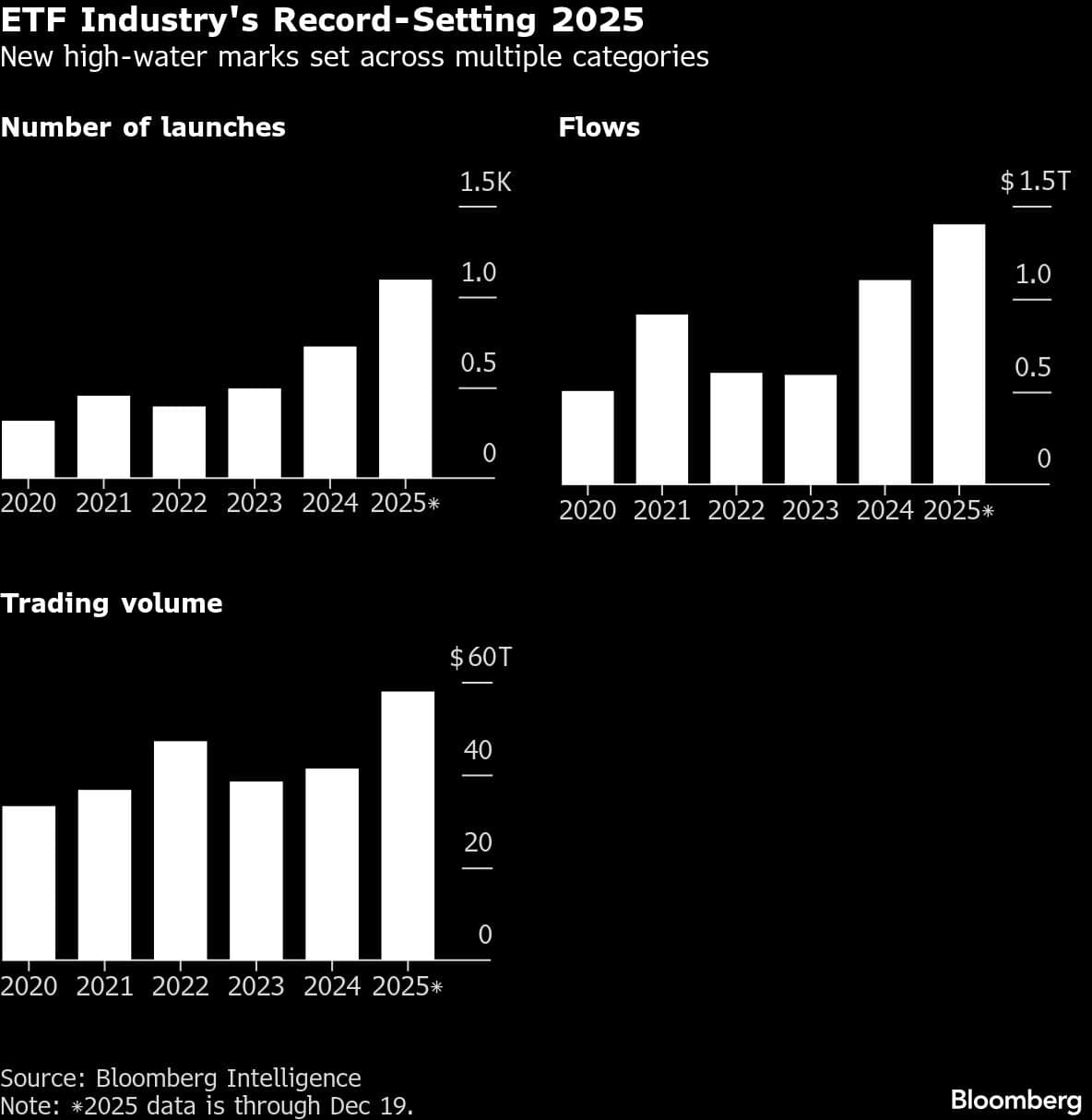
With less than two weeks to go, 2025 is set to be a record-breaking year for the $13 trillion US exchange-traded fund industry: new high-water marks in flows, launches and trading volume. It’s up for debate whether the next few years will be as kind.
US-listed ETFs have attracted a staggering $1.4 trillion so far in 2025, shattering the annual flow record set just last year. At the same time, more than 1,000 new products have entered the market — another unprecedented sum. Trading volume in the ETF market also hit a new yearly high. The last time all three measures hit a record in a single year was in 2021, according to Bloomberg Intelligence data.
The perfect score has some wondering how much longer the music will play. Following 2021’s banner performance, risk assets shuddered the following year — the S&P 500 plunged 19% after soaring to technology-fueled heights the previous year, with safe-haven government debt failing to hedge the plunge as bond yields soared and the Federal Reserve aggressively raised interest rates. While trading volume soared amid the turbulence, ETF inflows and the pace of launches both slowed in 2022 as investors and issuers grappled with the volatility.
“We think there’s going to be some reality check next year, whether in the form of a rougher market, leveraged single-stock ETFs imploding — maybe there’s some tax contagion from mutual funds,” said Bloomberg Intelligence senior ETF analyst Eric Balchunas. “Because of how perfect the year seemed to be for ETFs, you kind of want to brace for it.”
Behind the ETF Boom
US-listed ETFs have attracted new cash at a clip of roughly $5 billion per day this year, with low-cost, index-tracking funds absorbing the lion’s share, according to Bloomberg Intelligence. However, actively managed products — a category which includes derivatives-based and high-octane leveraged single-stock ETFs — have continued to expand their share, accounting for more than 30% of overall industry inflows and roughly 84% of new launches.
 A third straight year of double-digit gains on the S&P 500 helped to power the growth. That’s despite the benchmark trading roughly in a range since October, rattled by Wall Street’s growing skepticism on massive capex spending on artificial intelligence by tech giants and questions about the future of the Fed’s plans to cut interest rates. Should that hot-and-cold environment persist in 2026, it could crimp the pace of product development, according to Todd Sohn of Strategas.
“Maybe we don’t hit the ‘Triple Crown’ again for a few years, but I would be shocked if flows don’t continue to break records, and even volume, especially as ETF adoption really hits its stride,” said Sohn, a senior ETF strategist with Strategas. “Launches are the tricky part, and perhaps more cycle dependent. A tougher equity environment likely means less product activity, especially on the levered side.”
Leveraged single-stock ETFs have exploded in popularity over the past couple years, with options-based funds making up 40% of launches this year, Bloomberg Intelligence data showed. Retail investors have flocked en masse to the high-octane products, despite the fact that the funds’ embedded volatility drag tends to corrode long-term performance.
However, some cracks emerged in the single-stock complex in 2025. A sharp rally in shares of Advanced Micro Devices in October forced the demise of the European-listed GraniteShares 3x Short AMD exchange-traded product, which aimed to offer three times the inverse performance of the stock. While the US currently only permits two times leverage on single-name funds, a particularly turbulent market could test those products as well, Bloomberg Intelligence’s Balchunas said.
Still, any hiccups won’t halt the overall trend, just slow it, according to TMX VettaFi’s Roxanna Islam.
“At some point over the next couple of years, the industry may mature enough for the growth rate to slow down and plateau,” said Islam, head of sector and industry research at the ETF shop. “But I think innovation will continue regardless of net inflows.”
Wild Card Round
A potential wild card for the ETF industry next year is the introduction of dual-share classes. The SEC gave the green light to dozens of asset managers, including the likes of Dimensional Fund Advisors, BlackRock and Fidelity, the ability to have ETFs as a share class of their existing mutual funds — a fund blueprint that would theoretically map the tax advantages of ETFs onto trillions of dollars worth of mutual-fund assets.
While that could lead to a wave of new listings and inflows, concerns abound regarding the roll-out of multi-share classes. A May report from JPMorgan Chase & Co. argued that launching a successful ETF strategy “is not just as simple as adding a share class to an existing mutual fund and expecting it to gain assets.” RBC Capital Markets warned that a deluge of new funds could strain market-makers with “finite” resources.
Meanwhile, investors in the ETF share class could feel the pinch from “tax contagion” from the mutual fund, according to Balchunas. Under normal circumstances, a mutual fund manager has to sell off some securities to meet a redemption request. In the event of a massive outflow, the manager would likely have to offload its holdings that day in order to raise cash. In that scenario, all share classes of the fund would get hit with capital gains distributions, he said.
“The metaphor I would use is, it’s a tent where people are pushing against all sides,” Balchunas said of the ETF industry. “The more the edges of the tent are pushed, the more odds you have of something ripping.”
Discover the latest Business News, Sensex, and Nifty updates. Obtain Personal Finance insights, tax queries, and expert opinions on Moneycontrol or download the Moneycontrol App to stay updated!
Find the best of Al News in one place, specially curated for you every weekend.
Stay on top of the latest tech trends and biggest startup news.





