








More than one-third of the stocks listed on the National Stock Exchange have slipped to their 52-week lows following the sharp market correction that began at the start of 2026.
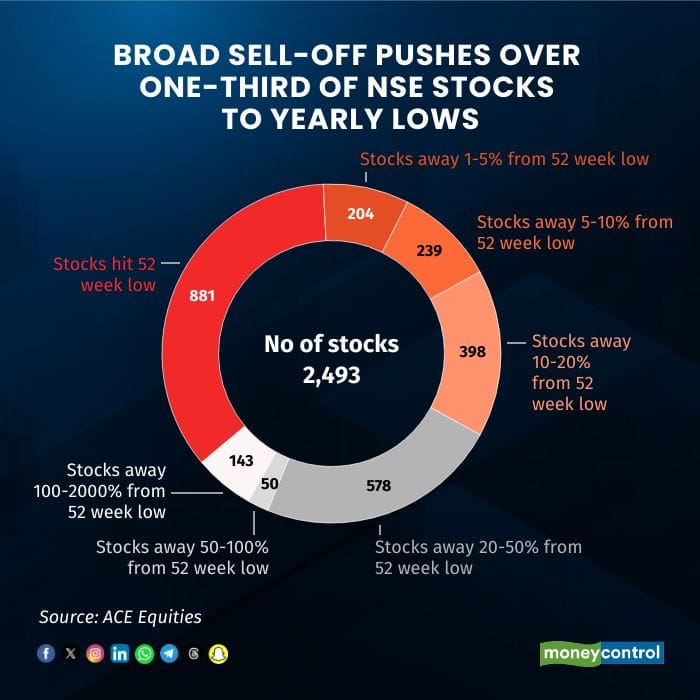
At present, 2,493 stocks are listed on the NSE. Of these, 881 stocks — or about 35.3 percent of the total — have touched their 52-week low levels. Nearly 204 stocks are trading just 1-5 percent away from their yearly lows, while around 239 stocks are positioned 5-10 percent above their 52-week low levels.
Kranthi Bathini, Director of Equity Strategy at WealthMills Securities, said the recent decline has been driven largely by profit booking in mid-cap, small-cap and micro-cap stocks, which led many of these counters to slip to their 52-week low levels. He added that while large-cap stocks have also seen some pressure, the majority of stocks hitting yearly lows belong to the broader market segments rather than frontline indices.
Despite the broader weakness, around 1,612 stocks are still trading in positive territory. Of these, nearly 398 stocks are trading 10-20 percent above their 52-week lows, while 578 stocks are positioned 20-50 percent higher than their yearly low levels. Meanwhile, about 50 stocks are trading between 50-100 percent above their 52-week lows, while 143 stocks are trading between 100-2,000 percent above their respective 52-week low levels.
Ajay Bagga, independent analyst, said that while headline indices suggest weakness, market breadth data indicates pockets of resilience, with a meaningful number of stocks still trading well above their yearly troughs. According to him, the current phase appears to reflect a correction driven by profit-taking rather than a complete breakdown in market structure.
Bagga added that when this data is overlaid with portfolio management service and mutual fund performance, relatively few fund managers have been able to consistently identify outperforming stocks. As a result, fund performance has largely mirrored index returns, leading to limited alpha generation in an environment marked by weak market direction.
On valuations, analysts said the current scenario remains largely stock-specific rather than index-driven. They noted that instead of assessing valuations at an index level, investors need to evaluate individual companies based on fundamentals. Key factors to examine include the company’s current valuation, future growth outlook, order book strength, execution capability and earnings visibility. Investment decisions, they said, should be made only after assessing these company-specific parameters.
Discover the latest Business News, Sensex, and Nifty updates. Obtain Personal Finance insights, tax queries, and expert opinions on Moneycontrol or download the Moneycontrol App to stay updated!
Find the best of Al News in one place, specially curated for you every weekend.
Stay on top of the latest tech trends and biggest startup news.





