








The Nifty 50 index may see 10 percent correction, with valuations tumbling to 18x, according to domestic brokerage ICICI Securities. As crude oil prices surge above the $115/bbl mark amid concerns of supply disruption, it would give the markets an indication that the disruption is likely to continue.
"In such an environment, Nifty 50 could potentially drop by ~10% from the pre-conflict-day level of 25,178; and the Nifty 50’s P/E ratio could drop to ~18x, which is closer to the lowest levels in the post-Covid era," noted the brokerage.
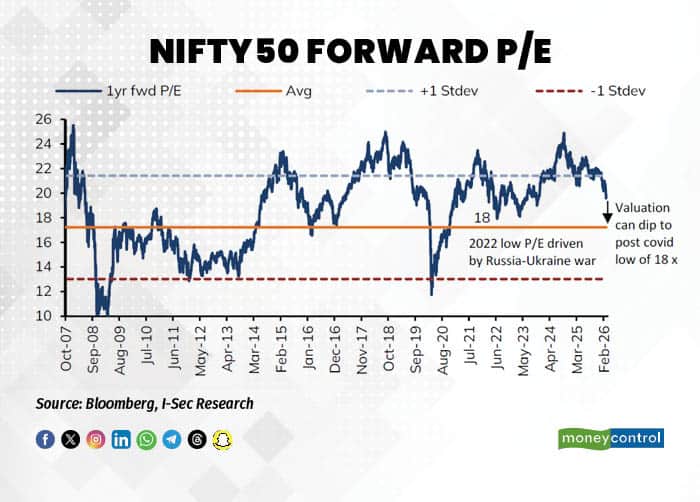
Consequently, said ICICI Securities, the earnings yield could rise to ~5.6% (highest in the post covid
era), while the relative spread of bond yield over earnings yield could dip to ~100bps; thereby, increasing the relative attractiveness of equities over bonds.
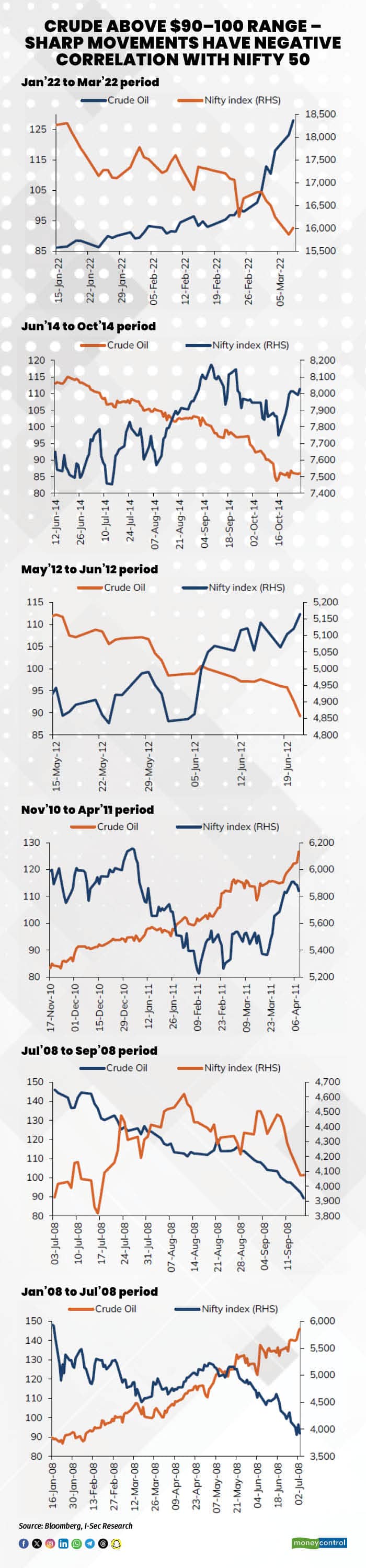
The brokerage noted that the last instance of the negative correlation of crude prices and Nifty 50 was witnessed in 2022, when oil prices spiked beyond $100/bbl for 3-4 months, which was driven by Russia’s invasion of Ukraine. The benchmark index fell 10% in the resulting volatility, which then created the foundation for the big equity rally seen over CY23.
When crude oil is under $100/bbl, it has a largely positive correlation with the Nifty 50, rising crude oil prices result in positive Nifty 50 returns and vice versa. The fundamental rationale is most likely that within a normal supply-side environment, rising/falling crude oil prices reflect a rising/falling aggregate demand environment, which provide bullish/bearish signals for equities. However, above $100/bbl, the positive correlation inverts.
However, the brokerage cautioned that crude oil price is just one of the many fundamental factors – such as corporate earnings, demand environment, policy announcements, global liquidity and interest rates.
"Hence, moderate movements in crude oil may not provide the aforementioned expected outcomes for the Nifty 50 index; especially, if other fundamental factors are at play," added the report.
Brent crude, the global oil benchmark, surged to to around $119/bbl, the highest level since July 2022. Iraq and Kuwait have begun cutting oil output, adding to earlier liquefied natural gas reductions from Qatar as ongoing tensions in the Middle East have disrupted shipments.
The Strait of Hormuz remains one of the most critical chokepoints in the global energy trade, handling nearly 20 million barrels per day (mb/d), which is nearly roughly one-fifth of global oil production. This comes even as Iran accounts for only 3% of the global oil production.
In 2025, exports moving through the strait averaged 13.4 mb/d of crude oil, along with 0.2 mb/d of condensates, 3.5 mb/d of refined products, and 1.4 mb/d of natural gas liquids (NGLs) and other liquids. The bulk of these shipments came from Saudi Arabia, Iraq and the UAE, which together exported about 13.1 mb/d of oil through the strait, with China emerging as the largest destination.
Although estimates differ across agencies, the International Energy Agency (IEA) has suggested that only about 4.2 mb/d of these flows could be rerouted through existing spare pipeline capacity if the strait were disrupted. This means that as much as 16 mb/d of oil could be at risk in the event of a complete closure of the Strait of Hormuz.
Also Read | Oil price shock rattles OMC stocks; profit outlook weakens if pump prices stay frozen
Disclaimer: The views and investment tips expressed by investment experts on Moneycontrol.com are their own and not those of the website or its management. Moneycontrol.com advises users to check with certified experts before taking any investment decisions.

Discover the latest Business News, Sensex, and Nifty updates. Obtain Personal Finance insights, tax queries, and expert opinions on Moneycontrol or download the Moneycontrol App to stay updated!
Find the best of Al News in one place, specially curated for you every weekend.
Stay on top of the latest tech trends and biggest startup news.





