






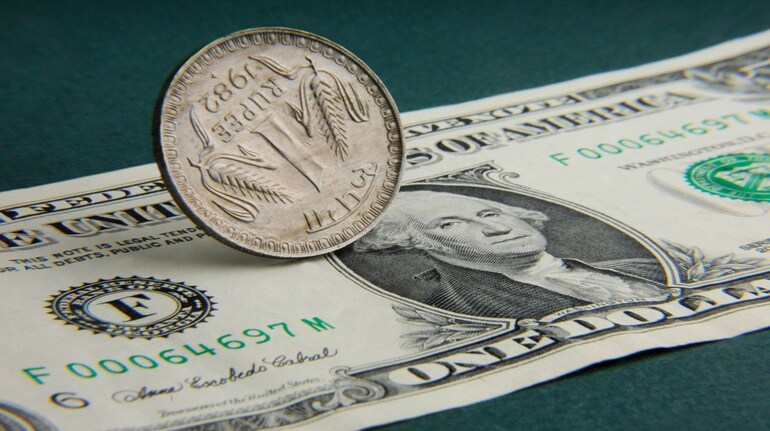
The rupee is unlikely to see an appreciation to Rs 85-86 anytime in the near future, despite India's landmark trade deal with the United States, according to experts. They attribute it to a combination of factors, such as uncertain geopolitical factors, lack of foreign inflows into the markets, and broader negative macro factors.
India and the US reached an interim trade deal earlier this month, which saw tariffs reduced to 18 percent from 50 percent, while the country also made its share of concessions, such as stopping the purchase of Russian oil and eliminating tariffs on industrial and agricultural goods.
However, ambiguities still remain as the fine print of the trade deal is yet to be out, and this is making market participants jittery. Moody’s, a credit rating agency, said in a report that there are still unknown factors, especially regarding the purchase of Russian oil.
“The US deal appears to plaster over their recent breakdown in relations, but the lack of details means that the U.S.-India relationship is far from repaired,” Moody’s said in its report.
Until clarity emerges, it is difficult to translate into tangible inflows, which will, in turn, weigh in on the rupee.
“I don't see Rs 85 anytime now. Now, traders are stuck at the near normal level of Rs 88 plus only. The entire market is negatively biased. If the trade deal comes through and the fine prints are out, and if it is very much favourable for India and enables governance for those investors to invest in the country,there is a chance that the rupee might appreciate further,” according to a forex dealer at a state-owned bank.
What is happening with the rupee?
The rupee slipped to the Rs 90-per-dollar mark for the first time on December 3, 2025, and has consistently stayed below the psychological level for nearly three months now. It fell shy of the Rs 92 mark on January 29, hitting a record low, and has since pulled back. The rupee lost more than 5 percent in 2025, making it one of the worst-performing emerging Asian currencies.
So far, the Indian rupee has depreciated nearly 1 percent against the dollar this year, as compared to its other emerging Asian peers, such as the South Korean won, Taiwanese dollar, and the Chinese yuan, which have, in fact, gained between 0.2 percent and 1.3 percent.
Coincidentally, they are also economies that have invested in artificial intelligence (AI) and have taken a lead in the AI wave globally. In this way, capital flows have been diverted away from India. When US tech outperforms, investors will look to exit from emerging market assets and pour funds into safer havens.
Surprisingly though, the dollar index has fallen about 1 percent so far this year. On the other hand, the benchmark 10-year US Treasury yield has fallen 11 basis points (bps) to 4.06 percent since the start of the year.
“The amount of capital that flew to emerging markets was smaller, and, within that, people had options versus India because India did not have much of an investable theme when it came to AI,” Dhiraj Nim, a forex strategist with ANZ said.
The Indian currency is presently flitting between the 90.50-90.70 levels, trading in a narrow range, and this is unlikely to change anytime soon, traders and market participants say. On Tuesday, the rupee ended at Rs 90.68 to the dollar.
Local importers have signalled that the current levels are attractive enough to hedge their positions, while the Reserve Bank of India (RBI) has also been likely active in the market, selling dollars both in the spot and offshore non-deliverable forwards (NDF) markets, traders say.
The central bank has forex reserves worth about $717 billion, as of February 17, as compared to $723 billion, as at end of January. It is a speculative indication that RBI has been intervening in the market. Moreover, the net short dollar positions of the RBI stood at $66 billion, as at the end of November, as compared to $63 billion in October. Simply put, it will look to sell the forwards contracts of the US dollar.
“It is very difficult for a trader to make calls these days. And then, the arbitrage between the onshore and offshore markets is also close. Over the night, they start intervening in the NDF market and then in the morning the next day, it is altogether a different picture,” the forex dealer quoted above said.
Having a robust economic growth of 8.2 percent in the second quarter of the fiscal year and a benign inflation print within the RBI’s mandate has not helped the rupee’s case either.
“USD/INR had established a base in the 90.00–90.20 zone. That base has now shifted higher toward 90.40. A decisive break above 90.80 could trigger an immediate 40-paisa extension, opening room for a move towards the 91.00–91.20 levels in the near term,” Amit Pabari, Managing Director at CR Forex Advisors, said.
And then, the lack of foreign inflows has also exacerbated the weakness in the rupee. Earnings stress from corporations have also contributed to overvaluation concerns in the market. While foreign portfolio investor (FPI) inflows rebounded in February to Rs 19,675 crore, this was preceded by three months of outflows from the market over concerns about tariffs and overvalued equities.
“Over the past year, we have largely seen selling pressure without a meaningful counterbalance from fresh FPI buying, which has materially weighed on the rupee,” Sachin Sawrikar, Managing Partner at Artha Bharat Investment Managers IFSC, LLP, said. For context, foreign investors pulled out more than Rs 1.6 lakh crore from Indian equities in 2025, which was among the worst years for th markets.
What is required for the rupee to gain its mojo?
For the rupee to go back to the 85 levels, last seen in June 2025, a structural and fundamental shift in investor sentiment, sustained foreign inflows into the market, and more durability in the US-India trade deal is needed. Easing geopolitical concerns, and broader macro-economic stability is required, say experts.
“A significant dial-down in global geopolitical risk premium, certainty in US policies, both economic and institutional, and an even global growth profile are required, but that will likely remain elusive for a while,” Nim said.
Until then, the rupee will likely trade in a range-bound manner. Whether it may go above the Rs 90 mark in the near term, only time will tell.
Discover the latest Business News, Sensex, and Nifty updates. Obtain Personal Finance insights, tax queries, and expert opinions on Moneycontrol or download the Moneycontrol App to stay updated!
Find the best of Al News in one place, specially curated for you every weekend.
Stay on top of the latest tech trends and biggest startup news.




