






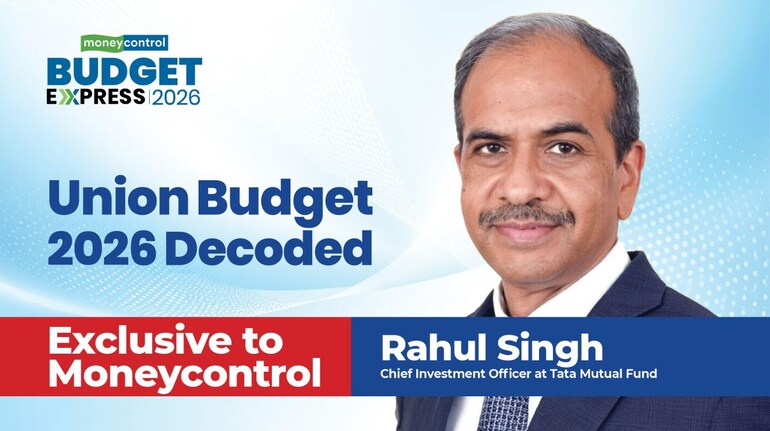

According to Rahul Singh, CIO–Equities at Tata Asset Management, the most reassuring aspect of the Union Budget 2026 is the credibility of its fiscal math and its strong focus on manufacturing.
In an interview with Moneycontrol, Singh said the Budget clearly reinforces confidence in India’s long-term structural growth story. However, he noted that over the next 12–18 months, corporate earnings growth will be the decisive factor for equity markets.
He also believes that defence remains a structural long-term opportunity. The continued emphasis on indigenisation, higher capital outlay, and domestic manufacturing enhances visibility for the sector.
Is the Budget a game changer? How would you rate it on a scale of 1–10, and why?
The Union Budget seeks to simultaneously address medium- and long-term challenges and opportunities arising from an evolving global geopolitical and economic landscape. While it may not be a dramatic, headline-driven “big bang” Budget, it lays out a steady, pragmatic roadmap focused on resilience, competitiveness and structural growth.
After analyzing the Budget, do you think the focus is on simplification, ease of compliance, and policy predictability?
Yes, the intent is clearly visible. The Budget continues the government’s emphasis on policy stability and predictability rather than frequent structural overhauls. Incremental measures aimed at reducing friction, improving compliance efficiency and providing long-term visibility—especially in taxation and capex planning—support a more stable operating environment for businesses and investors.
What is the most comforting aspect of the Budget? Is it the maintenance of fiscal discipline while increasing capex, or something more?
The most reassuring element is the credibility of the fiscal math and focus on manufacturing. The fiscal outlook is based on realistic GDP and revenue growth assumptions, even though the fiscal deficit and gross borrowing are marginally higher than consensus expectations. Budget has also clearly focused on driving manufacturing in exiting as well as new sectors.
Can the Budget provide enough confidence for foreign investors to return to Indian equities?
The Budget clearly reinforces confidence in India’s long-term structural growth story. However, for equity markets over the next 12–18 months, corporate earnings growth will be the decisive factor.
In this context, the ongoing results season has offered some comfort on earnings stability, with the potential for recovery in FY27. Valuations are supportive, both absolute and relative to other EMs, but earnings delivery will drive flows.
Do you think the government can achieve the divestment target, which has been increased to Rs 80,000 crore?
Achieving the divestment target will be challenging but not unachievable. Execution, market conditions and strategic stake sales will be critical. A calibrated approach—focusing on value maximisation rather than aggressive timelines—will determine success, especially in volatile market conditions.
Are you betting on the defence sector, given that the government has been gradually increasing spending in this area?
Yes, defence remains a structural long-term opportunity. The continued emphasis on indigenisation, capital outlay and domestic manufacturing strengthens visibility for the sector. While near-term valuations are full and may fluctuate, the long-term growth trajectory remains intact. It is also however, becoming more stock-specific market within Defence and other themes.
Do you think the Budget has given a major push to accelerate India’s AI journey and strengthen the country’s data centre infrastructure?
The services side of the economy has seen a notable push, particularly in healthcare, medical tourism, domestic tourism hubs and data centre infrastructure. Tax incentives for data centres could help India capture a share of the global AI-led capex cycle, opening up meaningful opportunities over the coming years.
Is the increase in STT a major setback for the growing capital markets, or could it encourage a gradual shift toward the cash market and long-term investing?
Higher Securities Transaction Tax (STT) on Futures & Options, along with the absence of any relief on Capital Gains tax, is a short-term negative for market sentiment. However, over time, it could encourage a gradual shift away from excessive speculative activity toward the cash market and longer-term investing.
Do you anticipate further expansion of available REIT and InvIT instruments for investors as the government pursues its objective of monetising real estate assets?
Yes, further expansion of REITs and InvITs is likely. As asset monetisation remains a key policy objective, these instruments will continue to play an important role in attracting long-term capital and improving balance sheet efficiency.
What do you expect from the proposed high-level banking committee that is expected to be formed to support the next phase of growth?
The committee is expected to focus on strengthening credit transmission, improving governance standards and preparing the banking system for the next investment cycle. If executed well, its recommendations could help deepen financial intermediation and support sustained economic growth.
Disclaimer: The views and investment tips expressed by experts on Moneycontrol are their own and not those of the website or its management. Moneycontrol advises users to check with certified experts before taking any investment decisions.Discover the latest Business News, Sensex, and Nifty updates. Obtain Personal Finance insights, tax queries, and expert opinions on Moneycontrol or download the Moneycontrol App to stay updated!
Find the best of Al News in one place, specially curated for you every weekend.
Stay on top of the latest tech trends and biggest startup news.





